
Enjoy the benefits of a premium membership!
Upgrade Account
-
TalkBass has been independent since 1998. Add your voice.
Create a free account to reply to discussions, view embedded media, and browse with fewer display ads.
Join free Log in
Want zero display ads or expanded classifieds tools? Compare plans.
You are using an out of date browser. It may not display this or other websites correctly.
You should upgrade or use an alternative browser.
You should upgrade or use an alternative browser.
Curious what you all think (pickguard color poll)
- Thread starter Guiseppe
- Start date
More options
Who Replied?

That white pearl looks more like "champagne" color and is very attractive.
Black... IMO not as good as the champagne pearl. The body is too warm for black. And tort doesn't work with this body (nor most except for the right tort with the right sunburst).Black!
White pearl of those choices.


A few posters may disagree, but I like that Tort on your bass, doesnt need to be darker/vintage at all, but that Perloid works so well with that beauty of a bass! Great color finish. I think clear would almost cheapen the bass somehow, no offense to anyone who has or likes clear.
Wonder if anodized gold would work, but Im not a Perloid guy but that one really seems to go 1:1.
Wonder if anodized gold would work, but Im not a Perloid guy but that one really seems to go 1:1.

I like them all, though I agree the tort would look even better if it had more brown than red.
Of those, I prefer the White Pearl. I would have thought Aged White Pearl would be fantastic based on the color of the finish, but the finish makes it look like aged white, or even a champagne-like color, so I'd just go with that.
Of those, I prefer the White Pearl. I would have thought Aged White Pearl would be fantastic based on the color of the finish, but the finish makes it look like aged white, or even a champagne-like color, so I'd just go with that.



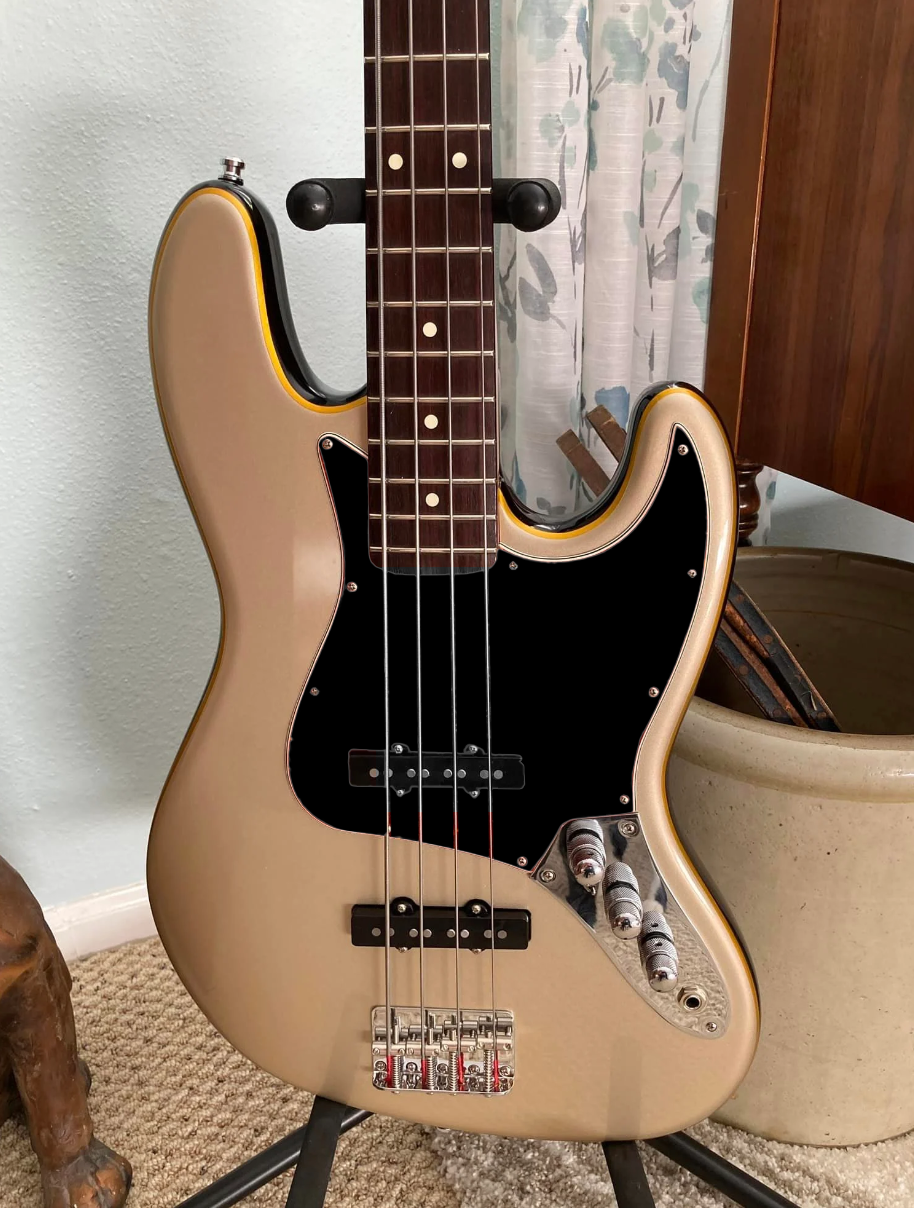
So what's the story on the set of 3 stack knobs on what looks like a Jazz bass?Ok, what color would you all choose? I'm curious about other's taste.View attachment 5318708View attachment 5318707View attachment 5318706

It's 1961 Chevy Fawn Beige.Never tort crew checking in.
Whatever version of white pearloid that is, I think it looks fabulous on that bass.
And congratulations for finding a bass color that I don't think my favorite (mint) would work on.
It's an Audere 4-band preamp. Volume/Blend, Hi/Low mids, Bass/Treble. I did think on the 1960 Jazz Bass that came with stacked knobs. I haven't added them yet but have chrome pickup/bridge covers that I'll add when I have my setup just right.So what's the story on the set of 3 stack knobs on what looks like a Jazz bass?
Custom paint on an alder jazz body. The top is 1961 Chevrolet Fawn Beige, the back burst is a transparent brown, and the gold faux binding is just a bit of bling to dress it up. Just a normal alder body, though!That aged cream pearl is perfect!! Don't change a thing.
What is going on with the body ??? Is it 3 ply of 3 different woods?




- Apr 18, 2008
- 16,026
- 1
- 31,761
- Disclosures
- I'm highly opinionated and extremely self-assured
Curious about what I think?
I think all pickguards are tacky, and the instrument is better without them.
I think all pickguards are tacky, and the instrument is better without them.
The first Jazz bass in late 1960 (I believe) and the '61 and some of the '62 Jazz Basses had two sets of stacked knobs. The first one was volume and tone for the neck pickup and the second one was volume and tone for the bridge pickup. They changed that pretty quickly in 1962 to volume/volume/tone configuration that is still used today although some of the '62 have the stacked knobs. Fender was famous for using all the stock they had before they changed to a newer version.It's an Audere 4-band preamp. Volume/Blend, Hi/Low mids, Bass/Treble. I did think on the 1960 Jazz Bass that came with stacked knobs. I haven't added them yet but have chrome pickup/bridge covers that I'll add when I have my setup just right.
I think having the low and high mids right there on your bass is pretty cool. I presume that is an active bass whereas those 3-knob Jazz Basses were all passive. The active Jazz Basses have 4 knobs. control knobs 1 & 2, the volume and the blend are single knobs. The third and 4th knobs are stacked knobs with bass and treble being on the third knob and mid-range and passive tone on the stacked fourth knob.

