
- Dec 20, 2004
- 4,267
- 2,481
- Disclosures
- Player-Builder-Founder: Honey Badger Pickups & Regenerate Guitar Works

TalkBass has been independent since 1998. Add your voice.
Create a free account to reply to discussions, view embedded media, and browse with fewer display ads.
Join free Log in
Want zero display ads or expanded classifieds tools? Compare plans.

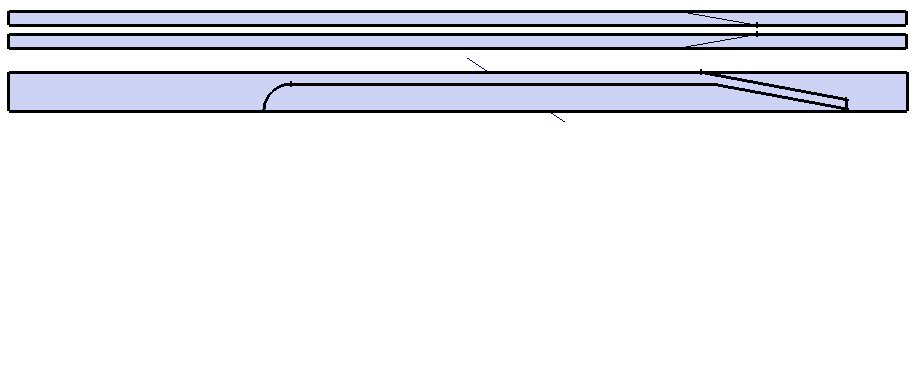
If I used scarf joints on my instruments I could get two necks out of each blank instead of just one. They most certainly save wood Vs. the one-piece (laminated) necks I like to build, thus many makers and manufacturers use this method.
Here, I made a quick drawing, neck blank using scarf joints on top, one piece on the bottom.
1st. Show what my opinion is uninformed.
2nd. I don't view most everything here as ugly, cheap. In fact, 99.99% of what i see here is very nice.
The bass itself is very sexy and beautiful, but that scarf joint..well i said my opinion about that.
And wilser, i remmember when u posted a pic of u doing this kind of scar jointing, and u said something about saving wood. I will search and find the post.
EDIT: Ok Found:
...
=/
I actually said that this specific scarf jointing looks cheap, and i saw on many cheap instruments. I never said its an inferior method of building. Im 100% sure that neck can survive any type of string tensions.
seems like you misinterpreted what I said. What I meant is that you don't save anymore wood in either of the scarf joint methods, not comparing it with a 1 piece angle cut.
why is the scarf joint such a big issue with all you guys? it's easy! But bummer I've scarfed all the necks on this batch so I don't know if I'm even gonna remember to record the process 6 months from now when I start the next batch.
I guess it seems like a touchy subject for you but I have a question about scarf joints. I understand how to do a scarf joint and have done a few of them successfully. The problem is that my joint is always visible about a quarter of the way up the headstock. What do you do different that sets it back under the fretboard?
MNBassist, the difference is where you do the scarf. If you align it such that the scarfed piece of wood is at the end of the cut rather than underneath the neck wood proper, you will end up with part of the fretboard resting on that cut piece of wood. How far down into the neck it goes depends on how thick your scarfed piece of wood is to begin with. Whereas, with the method you are using, you place the cut piece of wood underneath the main hunk of neck wood and the joint ends up in the headstock.
I realize it's confusing to read, but it makes sense if you draw it out. I'm sure there is a good picture illustrating the difference in these two methods floating around somewhere.
So if I use thicker stock, and move the cut down a little bit away from the headstock the joint will lie under the FB?
 half ellipse. The position of the ellipse shape is what is determined by the initial thickness of the headstock blank before thicknessing it down to final shape. If you glue it UNDER the fingerboard instead of getting an ellipse on the neck you will get a line on the headstock.
So if I use thicker stock, and move the cut down a little bit away from the headstock the joint will lie under the FB?

P.S Rudy, you're bass is looking pretty great!

...the world of bass playing will be made safe again when everyone gets a Ramirez...-Rudyboy98


OK, I whipped up a couple of images so that you can see the difference in the two types of scarf joints. In the second style I showed where the original piece of wood was that has now been cut away, that shows you how you get it further down the neck. It's just a matter of understanding the joint and planning for where your nut will be placed on the blank.
You can see what I mean now about placing the scarf under the neck versus placing it at the end.
thank you so much. I didnt realize it was as simple as that. I (like you said) was gluing the scarfed piece under the neck...not over. makes perfect sense now. It'll take some extra measuring i think but it'll be worth it. once again thank you very much.
It's always easier to get your head around it when you can see a picture. 
SX, Ibanez, Fender, Gibson, Warwick, Lakland, and other many many companies that make musical instruments. Imagine how much wood they use. Now imagine how much wood u are not "wasting".
U use fuel everyday, u are wasting it. It will never come back. Wood grows. What's the problem using wood? Companies that are in the wood business are not cutting the trees without control. If they would not put more trees to grow, they would go out of business, and they don't want that..
Please delete this post and take this non-related discussion OUTSIDE my build thread.
Thank you, very much.


