We'll see if he earns his stripes... time (and post quality and quantity) will tell.. ;-)New Ivan isn't active enough to overtake old Ivan.

Enjoy the benefits of a premium membership!
Upgrade Account
-
TalkBass has been independent since 1998. Add your voice.
Create a free account to reply to discussions, view embedded media, and browse with fewer display ads.
Join free Log in
Want zero display ads or expanded classifieds tools? Compare plans.
You are using an out of date browser. It may not display this or other websites correctly.
You should upgrade or use an alternative browser.
You should upgrade or use an alternative browser.
Darkglass Anagram Multi FX Announced
- Thread starter Elmstreet
- Start date
More options
Who Replied?

Any links to your work on the topic(s)? May make for a good comparison.We'll see if he earns his stripes... time (and post quality and quantity) will tell.. ;-)


Hey friends, can you help me with the configuration of how I would use this unit to power the anagram? I know there's a way to do it without pairing it with the Cioks Crux. I'm saving that 24V through for something else.
https://www.sweetwater.com/store/detail/CanvasPHPP--walrus-audio-canvas-power-hp-plus-power-supply
https://www.sweetwater.com/store/detail/CanvasPHPP--walrus-audio-canvas-power-hp-plus-power-supply

IvanBassist
Commercial User
- Jun 8, 2008
- 3,744
- 11,122
- Disclosures
- Content Manager at Darkglass Electronics, Dingwall Guitars Artist
You can connect it to the 9v 3A outputHey friends, can you help me with the configuration of how I would use this unit to power the anagram? I know there's a way to do it without pairing it with the Cioks Crux. I'm saving that 24V through for something else.
https://www.sweetwater.com/store/detail/CanvasPHPP--walrus-audio-canvas-power-hp-plus-power-supply
My man. Thank you, boss.You can connect it to the 9v 3A output
This is totally unfair to the Darkglass Anagram team, but I'm feeling slightly guilty for starting to feel antsy anticipating the next update. Y'all have been spoiling me as of late.
Therefore, just ignore me and take all the time needed(gimme gimme).
Therefore, just ignore me and take all the time needed(gimme gimme).
IvanBassist
Commercial User
- Jun 8, 2008
- 3,744
- 11,122
- Disclosures
- Content Manager at Darkglass Electronics, Dingwall Guitars Artist
Me looking at all the test versions I've gone through the last couple of days *cough cough*This is totally unfair to the Darkglass Anagram team, but I'm feeling slightly guilty for starting to feel antsy anticipating the next update. Y'all have been spoiling me as of late.
Therefore, just ignore me and take all the time needed(gimme gimme).
That's the only hint that I need hahaMe looking at all the test versions I've gone through the last couple of days *cough cough*

I know there is no possible to change the led colours of the switches (as far as I know) but, is there a way to have the led off while the effect is not in use in Stomp mode?
IvanBassist
Commercial User
- Jun 8, 2008
- 3,744
- 11,122
- Disclosures
- Content Manager at Darkglass Electronics, Dingwall Guitars Artist
Completely off? No. It only gets dimmedI know there is no possible to change the led colours of the switches (as far as I know) but, is there a way to have the led off while the effect is not in use in Stomp mode?

What’s the best way to use two guitars and/or basses?
We can plug a second instrument into the Return. I tried it, and it works well with Split/Return/Merge blocks.
And it looks like I can use the Insert instead of the Return with a Y-cable if I want to use an expression pedal.
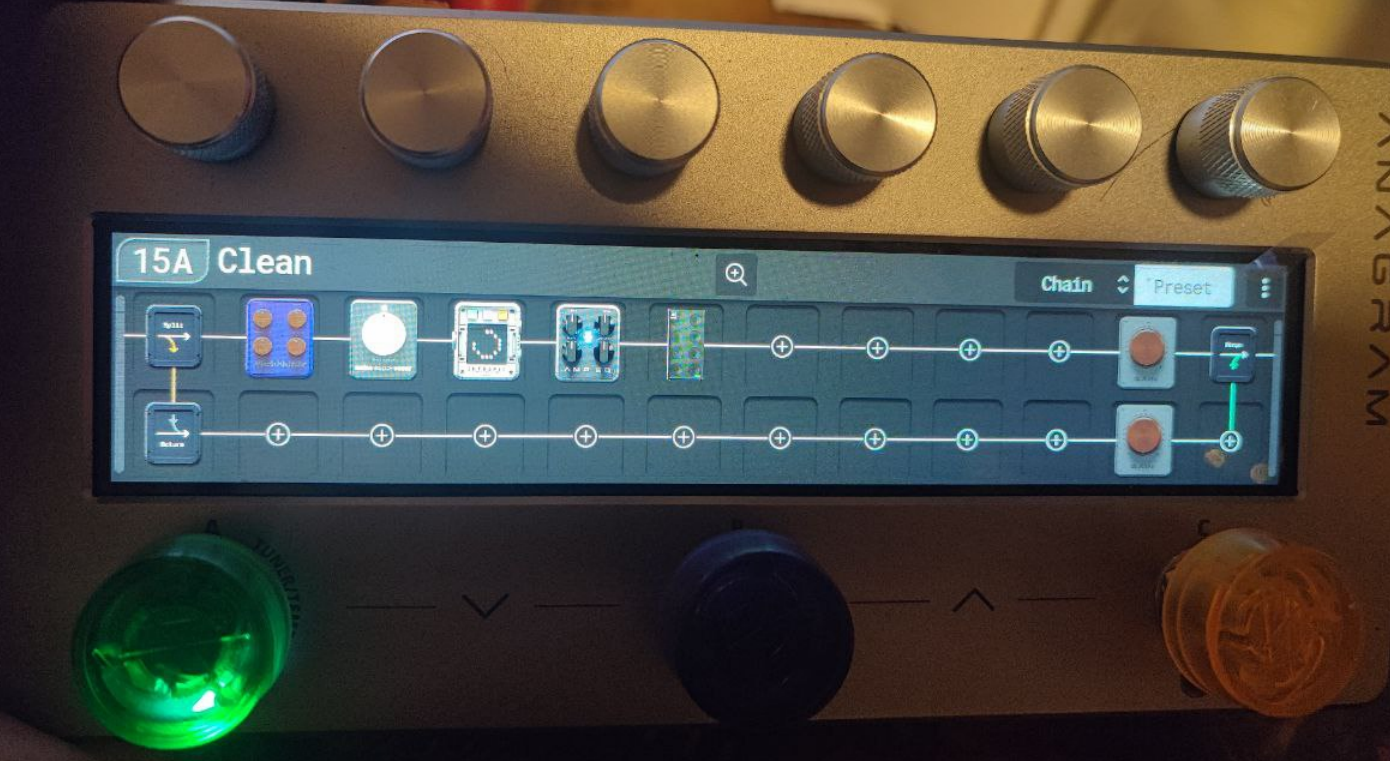
We can plug a second instrument into the Return. I tried it, and it works well with Split/Return/Merge blocks.
And it looks like I can use the Insert instead of the Return with a Y-cable if I want to use an expression pedal.
Last edited:
Looks like they really tried to stop people from using two instruments with this: you can't put a return block on the second path without a split block on the first path. But you can just turn the "Level Row 2" in the split block to -inf so the second row is only getting input from the return.What’s the best way to use two guitars and/or basses?
We can plug a second instrument into the Return. I tried it, and it works well with Split/Return/Merge blocks.
And it looks like I can use the Insert instead of the Return with a Y-cable if I want to use an expression pedal.View attachment 7429736
Depending on how you're monitoring this, you might want to also put an output block on the end of each row to set them to different outputs.

my ongoing Anagram journey.
So after 5 weeks of working with the Anagram to set it up for my specific live music situation, I feel like I have come to a reasonably comfortable understanding of the box and what it can basically do. I've rehearsed and gigged with it several times with positive results.
Following advice I got here, I worked with the factory resources and a couple of NAM downloads and got the Anagram to sound pretty much like my original live work gear: Cali76 => VT => Noble DI with a few FX (OC5, MXR Bass Envelope, PhatPhuk B) in between as needed. This gives me a Fender-ish option, an Ampeg-ish option, both mostly clean, and some FX when needed/desired for any given gig.
I'd have to say that the Anagram signal chains really do NOT sound any BETTER than my Cali76 => VT => Noble pedalboard, but it sounds good and is comparable (although really not quite as good to my ears). I specifically had difficulty getting the light dirt/OD from the largely DG based resources.
I have only built Presets and Stomp signal chains. These work fine for me.
I have not dived into MIDI (I have an MVave Chocolate midi footswitch) because it seems pretty complicated and I'm not sure what I would get from adding it.
All of this has certainly been an interesting and eye opening intro to multiFX.
So, now I'm wondering; if I have just more-or-less recreated my original small pedalboard (Metro 20), what do I need with the Anagram ? The form factor/weight difference between by pedalboard and the Anagram is minimal really, both are pretty small. I have plenty of live gigs, but I don't do many fly dates and have not toured for several years (which is ok by me), so the moderately smaller/lighter carry for the Anagram vs the Metro 20 board is not a huge plus for me.
My live work is all over the map as far as FOH and IEM's. Lots of small venues where my amp/cab carry the bass. I do have festival gigs with solid FOH and good techs, and sometimes I get to use IEM's (I certainly wish it was more often). But it's very mixed. I can see where some folks who tour, travel or do lots of fly dates and work on large stages with FOH, and use IEM's regularly would really appreciate the smaller Anagram footprint.
I'm able to power my original board with just the Noble power. If I use the Anagram with the Cali76 and Noble, I need another power solution (for more $$). Now, my used Anagram, very helpfully came with a 10k mAh USB-PD power bank, so that's been handy, but it's also an add to my original board too. I can and have used the Anagram stand alone, powered by the power bank, so that's an easy solution.
Long and short of all this is, I'm definitely not going to retire my pedalboard and will keep the Anagram in the mix for the time being, if nothing else, as a learning tool (I would like to figure out the MIDI thing) and to see how DG will develop/evolve the system (I'd really like to see a Synth block). But I don't really see why it's better for my live work situation as it stands today.
So after 5 weeks of working with the Anagram to set it up for my specific live music situation, I feel like I have come to a reasonably comfortable understanding of the box and what it can basically do. I've rehearsed and gigged with it several times with positive results.
Following advice I got here, I worked with the factory resources and a couple of NAM downloads and got the Anagram to sound pretty much like my original live work gear: Cali76 => VT => Noble DI with a few FX (OC5, MXR Bass Envelope, PhatPhuk B) in between as needed. This gives me a Fender-ish option, an Ampeg-ish option, both mostly clean, and some FX when needed/desired for any given gig.
I'd have to say that the Anagram signal chains really do NOT sound any BETTER than my Cali76 => VT => Noble pedalboard, but it sounds good and is comparable (although really not quite as good to my ears). I specifically had difficulty getting the light dirt/OD from the largely DG based resources.
I have only built Presets and Stomp signal chains. These work fine for me.
I have not dived into MIDI (I have an MVave Chocolate midi footswitch) because it seems pretty complicated and I'm not sure what I would get from adding it.
All of this has certainly been an interesting and eye opening intro to multiFX.
So, now I'm wondering; if I have just more-or-less recreated my original small pedalboard (Metro 20), what do I need with the Anagram ? The form factor/weight difference between by pedalboard and the Anagram is minimal really, both are pretty small. I have plenty of live gigs, but I don't do many fly dates and have not toured for several years (which is ok by me), so the moderately smaller/lighter carry for the Anagram vs the Metro 20 board is not a huge plus for me.
My live work is all over the map as far as FOH and IEM's. Lots of small venues where my amp/cab carry the bass. I do have festival gigs with solid FOH and good techs, and sometimes I get to use IEM's (I certainly wish it was more often). But it's very mixed. I can see where some folks who tour, travel or do lots of fly dates and work on large stages with FOH, and use IEM's regularly would really appreciate the smaller Anagram footprint.
I'm able to power my original board with just the Noble power. If I use the Anagram with the Cali76 and Noble, I need another power solution (for more $$). Now, my used Anagram, very helpfully came with a 10k mAh USB-PD power bank, so that's been handy, but it's also an add to my original board too. I can and have used the Anagram stand alone, powered by the power bank, so that's an easy solution.
Long and short of all this is, I'm definitely not going to retire my pedalboard and will keep the Anagram in the mix for the time being, if nothing else, as a learning tool (I would like to figure out the MIDI thing) and to see how DG will develop/evolve the system (I'd really like to see a Synth block). But I don't really see why it's better for my live work situation as it stands today.
IvanBassist
Commercial User
- Jun 8, 2008
- 3,744
- 11,122
- Disclosures
- Content Manager at Darkglass Electronics, Dingwall Guitars Artist
As you might know, i also used a similar setup as the one you have before switching to multi-fx units.my ongoing Anagram journey.
So after 5 weeks of working with the Anagram to set it up for my specific live music situation, I feel like I have come to a reasonably comfortable understanding of the box and what it can basically do. I've rehearsed and gigged with it several times with positive results.
Following advice I got here, I worked with the factory resources and a couple of NAM downloads and got the Anagram to sound pretty much like my original live work gear: Cali76 => VT => Noble DI with a few FX (OC5, MXR Bass Envelope, PhatPhuk B) in between as needed. This gives me a Fender-ish option, an Ampeg-ish option, both mostly clean, and some FX when needed/desired for any given gig.
I'd have to say that the Anagram signal chains really do NOT sound any BETTER than my Cali76 => VT => Noble pedalboard, but it sounds good and is comparable (although really not quite as good to my ears). I specifically had difficulty getting the light dirt/OD from the largely DG based resources.
I have only built Presets and Stomp signal chains. These work fine for me.
I have not dived into MIDI (I have an MVave Chocolate midi footswitch) because it seems pretty complicated and I'm not sure what I would get from adding it.
All of this has certainly been an interesting and eye opening intro to multiFX.
So, now I'm wondering; if I have just more-or-less recreated my original small pedalboard (Metro 20), what do I need with the Anagram ? The form factor/weight difference between by pedalboard and the Anagram is minimal really, both are pretty small. I have plenty of live gigs, but I don't do many fly dates and have not toured for several years (which is ok by me), so the moderately smaller/lighter carry for the Anagram vs the Metro 20 board is not a huge plus for me.
My live work is all over the map as far as FOH and IEM's. Lots of small venues where my amp/cab carry the bass. I do have festival gigs with solid FOH and good techs, and sometimes I get to use IEM's (I certainly wish it was more often). But it's very mixed. I can see where some folks who tour, travel or do lots of fly dates and work on large stages with FOH, and use IEM's regularly would really appreciate the smaller Anagram footprint.
I'm able to power my original board with just the Noble power. If I use the Anagram with the Cali76 and Noble, I need another power solution (for more $$). Now, my used Anagram, very helpfully came with a 10k mAh USB-PD power bank, so that's been handy, but it's also an add to my original board too. I can and have used the Anagram stand alone, powered by the power bank, so that's an easy solution.
Long and short of all this is, I'm definitely not going to retire my pedalboard and will keep the Anagram in the mix for the time being, if nothing else, as a learning tool (I would like to figure out the MIDI thing) and to see how DG will develop/evolve the system (I'd really like to see a Synth block). But I don't really see why it's better for my live work situation as it stands today.
For me personally, the biggest advantage of using a solid multi-fx unit is the consistency and ease of use when I need to adapt to a situation.
If you make your presets right, then your tone will be the same night after night and you won’t have to deal with adjusting knobs during soundcheck or worry about broken tubes during transit

Also, the flexibility of being able to pull some effects on the spot if needed, without owning the physical pedal or having to rewire your entire board if needed.
IvanBassist
Commercial User
- Jun 8, 2008
- 3,744
- 11,122
- Disclosures
- Content Manager at Darkglass Electronics, Dingwall Guitars Artist
We didn’t try to stop anythingLooks like they really tried to stop people from using two instruments with this: you can't put a return block on the second path without a split block on the first path. But you can just turn the "Level Row 2" in the split block to -inf so the second row is only getting input from the return.
Depending on how you're monitoring this, you might want to also put an output block on the end of each row to set them to different outputs.

Currently you can’t add any to the 2nd row without a Split block first
Hey Ivan, yes, I know you used a similar setup, we had some communication about the Cali76 and the Noble around the same time.As you might know, i also used a similar setup as the one you have before switching to multi-fx units.
For me personally, the biggest advantage of using a solid multi-fx unit is the consistency and ease of use when I need to adapt to a situation.
If you make your presets right, then your tone will be the same night after night and you won’t have to deal with adjusting knobs during soundcheck or worry about broken tubes during transit
Also, the flexibility of being able to pull some effects on the spot if needed, without owning the physical pedal or having to rewire your entire board if needed.
For my situation, I find the original pedalboard to be very easy to use and I rarely need to adjust much, if anything, on it. When I use them, the added FX, particularly the OC5, are the only things I really ever need to mess with, and even that is easy. So, really, my tone remains very consistent with the Cali76 => VT => Noble setup.
Did you break a tube in your Noble ??? They are built like tanks, and I've never had a tube issue on a gig. I did have to replace the original NOS 12AU7 when it got microphonic, but that was not on a gig and the stock JJ I replaced it with has been solid for years now. Of course, I am not touring like you, so my gear does not take any kind of travel beating.
This is no shot at the Anagram. I'm keeping it, but I'm not going to get rid of my original pedalboard either. They will just have to exist side by side for the time being.
IvanBassist
Commercial User
- Jun 8, 2008
- 3,744
- 11,122
- Disclosures
- Content Manager at Darkglass Electronics, Dingwall Guitars Artist
I know you’re not taking a shot at the AnagramHey Ivan, yes, I know you used a similar setup, we had some communication about the Cali76 and the Noble around the same time.
For my situation, I find the original pedalboard to be very easy to use and I rarely need to adjust much, if anything, on it. When I use them, the added FX, particularly the OC5, are the only things I really ever need to mess with, and even that is easy. So, really, my tone remains very consistent with the Cali76 => VT => Noble setup.
Did you break a tube in your Noble ??? They are built like tanks, and I've never had a tube issue on a gig. I did have to replace the original NOS 12AU7 when it got microphonic, but that was not on a gig and the stock JJ I replaced it with has been solid for years now. Of course, I am not touring like you, so my gear does not take any kind of travel beating.
This is no shot at the Anagram. I'm keeping it, but I'm not going to get rid of my original pedalboard either. They will just have to exist side by side for the time being.
I just wanted to share my personal preference to using multi-fx, specially when touring. I haven’t broken a tube in my Noble, but with the current price and waiting times i really don’t want to risk it getting damaged since I use it all the time to record.
i’ve seen my fair share of broken tubes in guitar amps, though.
New Ivan is just for when Old Ivan is in the gym.New Ivan isn't active enough to overtake old Ivan.
So we only get him for ten minutes on leg days

IvanBassist
Commercial User
- Jun 8, 2008
- 3,744
- 11,122
- Disclosures
- Content Manager at Darkglass Electronics, Dingwall Guitars Artist
I just ran 5k. Does that also count as leg day?New Ivan is just for when Old Ivan is in the gym.
So we only get him for ten minutes on leg days

Ok, this is a quick reply while Ivan is in the gym!! Im just stalking here for ideas ja comments about stuff. I can answer to some technical stuff maybe about the models.


