• TalkBass has been independent since 1998. Add your voice.
    Create a free account to reply to discussions, view embedded media, and browse with fewer display ads.
    Join freeLog in
    Want zero display ads or expanded classifieds tools? Compare plans.

Dead spots on G string - Why??

If I am going to own a bass it needs to be a work of perfection in all respects - with no compromises. That includes no deadspots. Perfection is an inspiration onto itself.

Some manage to see a lot of beauty and possibly inspiration in imperfection - and things like road worn mojo. Not for me.

I like 'em clean and perfect.

Rant over.

BassHappy
www.innertainment.net
 
For me "perfection" excludes 32" scale basses. I like 34" and 35" and I'll take a couple of dead spots here and there if it means keeping the scale length.

Absolutely understood - basses are just like shirts, they come in S-M-L-XL and XXL. You should play what feels comfortable and what fits you perfectly.

The perfection of a medium scale bass is certainly not for everybody.

:D

Best,

BassHappy
www.innertainment.net
 
After "only" 17 years of playing bass I have noticed:

-Every bass (save one) I have ever tried has had some sort of dead spots.
-Cheap Fender style basses have often been some of the worst ones.
-My Gretsch G5123B is 32" but has many and bad dead spots.
-String tension and internal neck tension (as in trussrod) makes a difference - a dead spot can get worse after adjustment.
-The only "perfect" (or at least d*mn close to) bass I have played is a vintage, headless, bodyless Riverhead paddle. I spent minutes in amazement going through every position. It is not a bass for me, but wow...
 
The dead spot was discovered on the original P Bass with the old Telecaster type headstock. One account I read said that Leo hired a consultant to cure the problem. The result was the bigger headstock still in use today.

The dead spot is really noticable if your EQ has a big notch around 800Hz. I wonder if the EQ change in the 5F6 to 5F6A Bassman had anything to do with the dead spot. The Vox AC100 with the bass pot at max is particularly bad. The last little bit of bass boost really drops out the mid range.

I have a Kawai neck-thru bass that you can make the dead spot come and go with a slight truss rod adjustment. All my 34" solid body Fender type basses have the dead spot. I have one Ric bass with two truss rods, it has two dead spots. The normal one and on the D string between frets 10 and 12. I have no 32" basses and none of my 30" basses have the dead spot to the degree that a P Bass has.
 
BassHappy, is that a Gretsch G5123B in your collection of "perfect" medium scale basses? I have owned two of that model and they could be used to demonstrate dead spots - both of them are really bad in that respect. They still shine in other areas, though.
 
BassHappy, is that a Gretsch G5123B in your collection of "perfect" medium scale basses? I have owned two of that model and they could be used to demonstrate dead spots - both of them are really bad in that respect. They still shine in other areas, though.

Wow, so sorry to hear.

Mine is fine, no dead spots at all - perhaps I just got lucky?

Could you please tell us which specific notes have dead spots? This is really interesting to me, as I have never EVER experienced a dead spot on any of my 32" scale babies.

Where are you located? Is there a chance I could visit and check this bass out in person and see for myself about this rare phenomena?

I am really curious?

Oh, that's right, don't happen to still have them?

Best,

BassHappy
www.innertainment.net
 
I find it somewhat hard to believe, but sure... Mine has various level of dead spots at open E, F (rest of the E string is ok), fret 5 + 12-14 on the A string, around 10-12 on the D string, slightly on fret 7 on the G string + quite bad on 14-16 on G string.
The one I had before was pretty much the same, but worse om the open E.

A while ago I tried the 34" model (5440?) and that was worse with more pronounced issues also high up on the E string etc.
 
Some time ago I read a fix for the fairly common dead spot on the G string. It said to remove a tuner, drill a hole under it (on the back), fill it with lead like you use to make fishing weights, reinstall the tuner over the hole, and that's it. You have to have the normal fender style tuners rather than mini ones. The idea is to add mass to the headstock where it can't be seen.
 
I find it somewhat hard to believe, but sure... Mine has various level of dead spots at open E, F (rest of the E string is ok), fret 5 + 12-14 on the A string, around 10-12 on the D string, slightly on fret 7 on the G string + quite bad on 14-16 on G string.
The one I had before was pretty much the same, but worse om the open E.

A while ago I tried the 34" model (5440?) and that was worse with more pronounced issues also high up on the E string etc.

Howdy

I see the old thread about your 5123B and in fact, I responded to it at the time. It's here:

http://www.talkbass.com/forum/f8/gretsch-5123-weak-e-string-no-solution-sight-1025604/

Might I suggest that an open string issue would not be considered a dead spot in the neck, as you are not fretting a note. So when you pluck the F on the E string, even when it is not plugged into an amp - the fundamental on the F dies out right away? Like less than a four count?

I find it really baffling, as mine easily passes the 4 count test, but if true, I take back what I said. I guess there are dead spots on medium scale basses, I must have an angel on my shoulder as all of mine are perfect.

In all my years this is the first one I have heard of, but if it exists, it exists.

BassHappy
www.innertainment.net
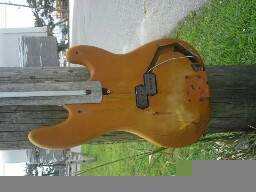
 
I own two 32" scale basses, but I am not sure either can be a yard stcick for measuring dead spots on a 32" scale. I have to discount my Gretsch 5123 because dead spots could be due to the damping nature of the bridge. The lack of dead spots on my Kubicki could be due to the multi-laminate neck rather than the scale length.

I don't remember my former Urge I having dead spots. I do remember it being an incredible instrument. To be honest, though, I just played it and it sounded good; I didn't sweat the details.

I seem to remember over on the Dingwall thread, somebody mentioned a dead spot on a Super bass. If it was on the G string, I believe that would be a 32" dead spot.