• TalkBass has been independent since 1998. Add your voice.
    Create a free account to reply to discussions, view embedded media, and browse with fewer display ads.
    Join freeLog in
    Want zero display ads or expanded classifieds tools? Compare plans.

Dead spots.. Where are they typically, what does it sound like?

Do all basses have them ?
Or most?
I've heard all fenders have 'em
I suspect that's a myth..
I played every note along my Roscoe's fretboard
to the top fret, I found nothing that seemed like a faulty or bum note anywhere.
I tried it on my peavey zodiac and found a fret
buzz here and there
but nothing I'd describe as a problem or dead sounding anything, anywhere...

where are they?
Describe the symptom, a "dead", lack of sustain?.. Like old, dead strings?

what frets/ strings do they typically appear?

And how much of it is myth?
I can't find 'em.
 
My P-bass had one on the G-string at the 6th fret. It sounds like a dampened string. Not just no sustain, it just sounds dead.

All of my other basses are neck through, and they don't have the dead spot. I don't know if that's a neck through vs bolt on neck thing or not.
 
The fenders-get-dead-spots concept is all about that, right?
bolt-on vs. neck-through?

Stanley & Jerry Garcia are the only players I dig who play neck through, they both like hi-fi, brighter tones, so it works for them.
bolted necks seem warmer, more vintage sounding to me

It seems the dead spots are fairly rare, or not
common enough to discourage me from playing bolt-ons.
 
Virtually every bass has one (except the graphite neck models, and supposedly they have them also... just so subtle that you can't hear them).

A dead spot is almost impossible to 'fix', and typically occurs on the G string between the 4th and 7th fret. Laminated necks, long scale, short scale, graphite bars, etc., etc. might help 'on average', but won't eliminate them in every case for each and every instrument. I've heard significant dead spots on virtually every brand and bass design, other than the graphite stuff.

The way to check a neck for a deadspot is to plug in the bass, and then play long, ringing whole notes up the G string. A minor dead spot will result in the fundamental of the note decaying a bit quicker than the other notes, leaving just the high overtones of the note. This is no problem, and is just something bassists have to deal with. A MAJOR dead spot will result in the fundamental of the note not sounding at all, and is just a miserable thing. The note will sound like you are playing a 'harmonic', and will have no attack. This is luckily rare.

Only you can determine how problematic a deadspot is. For me, as long as I have a full, even, strong fundamental attack when plucking the note, I'm fine. If it decays a touch faster than the rest of the strings, that is a minor deal, and you can play around it in the rare case that you need a ringing, long whole not.
 
Great reply, thanks for that kj~

I avoid high g stuff
ALL the notes on the g sound like that to me,thin..

I try to use the fatter strings for long, sustaining notes anyway..
Unless I'm going for a thinner sound,( like at the top of a verse,etc)
can't avoid it, I stay off the g for the most part.
 
I was actually going to post this thread soon, so thanks for posting it and saving me the work!

Either on the A or D string of my first bass (P knockoff) at the 12th fret when I plucked it the note would ring then die quickly, but then return to almost the same volume as before. What was that?
 
For basses with Fender Jazz-style necks, I find that the D# or C on the G string fades into harmonics faster than other note in almost every bass of this type that I play. However, I rarely sustain on that note long enough to notice when playing the kind of music that I play.
 
My Fender P has a dead spot on 'C' on the G-string and my Tobias Killer B's dead spot is at the 'C#'.

My experience has been that the dead spots on these basses aren't that noticeable when I play at home by myself because the overtones are still very present. I don't necessarily notice any volume drop or difference in tone unless I'm listening closely for the fundamental pitch.

However, on a gig with a full band mix, I find the dead spots much more noticeable so I usually avoid those notes if I can. In the mix, many of the overtones get buried anyway, so the weaker fundamental of the dead note really jumps out.
 
A dead spot is almost impossible to 'fix', and typically occurs on the G string between the 4th and 7th fret.
Yep.
The ONLY time they are not as noticed, IMO, is when a brand new set of Rotosounds have just been installed. A few gigs later, they're back and in the area mentioned above.
These appear on all of my bolt-necks, neck-thru not as bad at all, and synthetic Steinbergers(1980's~early 1990's) NONE.
If they drive you insane, get a REAL Steinberger and learn to love the shape/sound.

They sound like dead or dying strings with a noticed lack of sustain, rapid decay of the note and you can FEEL the neck absorbing the energy of the string.
 
Amazing that so many Fenders have that same dead zone - mine on all of my Fenders or Squiers are on the G string at the C# position - give or take a fret.
Squier P - Roto 77s DEAD
Squier J - Fender 7250 NPS - DEAD
Fender Deluxe J - Elixir Nanos - DEAD.​
If I hit the C# on the D sting at the 11th fret (that's in the same octave) - it's not dead like that one string/one position.

So - it's not the frequency that is being attenuated if I can duplicate the same note on the same octave and it's just fine and rich at that position.

This makes the argument for woods/necks NOT having any tonal or frequency effect on the sounds I think.

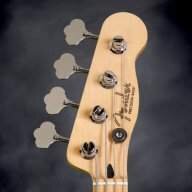
I tried adding a weight to the head with c-clamps and then holding the head against a hollow door and even holding the head against my OWN head and ---> *NADA! * NICHTS! * ZILCH! *

If wood type/wood quality made a difference, then this dead zone would be all over the board - on different days of the week or moon phase or on different strings and different positions with different wood densities, grain, oil/wax percentages and even the color - if wood on an electric bass makes a big difference at all.

'Way too many variables here for the wood to be anywhere in the equation.

It ain't strings either - they are all different brands and designs.
 
My G&L L2000 has a dead spot on G string as well (5th fret), not a major one, but it's there.
However, since I changed strings (from TI jazz flats to D'Addario Chromes) the said dead spot is much, much less noticeable. I suppose that string tension may also something to do with it.