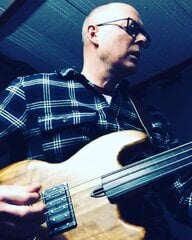
I'd go with none of the above. Here's a bass - not a PJ (I'm not a fan of the spacing of PJ's, among other things):
It has two pickups. It has 2 modes - selected by a switch. One mode is "P mode" - it's just the neck pickup, and it has its own tone control. A different value tone capacitor, a loading cap, and a couple other tweaks, but it's relatively straightforward.
The second mode involves both pickups - we'll call that the "J mode", but it's not just both pickups wired in parallel. There is a crossover between the pickups. At low frequencies, just the neck pickup is active. At mid frequencies, the neck is still more in tee mix than the bridge, there is some "scoop", but not as much as on a regular J with both pickups dimed. At high frequencies, both pickups are active - it's got a good amount of clink and clank - actually more than a standard J as there are only 2 pots in the circuit at a given time. There is a tone circuit for this mode - different values for all the parts than for the other mode.
It's all hum cancelling, it has 2 good sounds that can each be tweaked independently, and you can go from one to the other literally at the flick of a switch. Both modes have the same amount of solid low end - FOH won't complain that the bottom dropped out when you changed your sound. It doesn't allow for you to solo the bridge pickup - I never do that, as I like bass in the output of my bass. And the volume control is wired regular - not backwards like on a VVT setup. As such, it works like a volume control - the tone stays pretty constant as you turn the volume down (which definitely doesn't happen on a standard vvt circuit).
The mental "box" that people work in when deciding how to wire basses and guitars is needlessly strict - there are a lot of things that you can do that are just outside what most folks consider, but that make cool, new sounds that don't exist inside the box.