• TalkBass has been independent since 1998. Add your voice.
    Create a free account to reply to discussions, view embedded media, and browse with fewer display ads.
    Join freeLog in
    Want zero display ads or expanded classifieds tools? Compare plans.

Dingwall Owners Club

It's done!!! Love the sound of Bridge+Neck and Neck alone sounds good too.
Had to drill the hole 0,5mm bigger (it's 9,5mm now) to fit in the new rotary switch.

Thanks again to @packrat !
IMG_20191020_162633.jpg IMG_20191020_162639.jpg IMG_20191020_164611.jpg
 
Y
Ah ok, mine (A/E) are also 4/5mm high.
Well I don't know, the block it screws into is 10mm high, so half the maximum possible threading height is outside.
Is that really sound mechanically ?

They are that high because of the tapered strings, you would need to drop them 2mm or so if you put non tapered strings on.
Yes it's mechanically sound, there is very little shear force on the screws as the pressure is mostly downwards. Nothing Dingwall make is under engineered ;)
 
  • Like
Reactions: AB Nate
I've actually found the harder the bridge is forced downward to the bass, the better it sounds.

I think that's part of the secret of basses like warwicks and the tune-o-matics on guitars.

My Rockbass had mud for pickups, but sustain and punch for days.
 
When I said absolutely no buzz above the 12th fret, that was shorthand for absolutely no buzz if you are not playing too hard. :-). Sounds like you have it right.

At this point, the most likely causes are either that the nut slot is too deep, or that the string is floating a little bit in the nut because there is not enough break angle to pull it down tightly. That one is easy to diagnose. Take your left index finger and press down on the strings right next to the nut between the nut and tuners in order to force the string to be fully seated in the nut. Then play the string and see if the buzz goes away.

If it does stop, you have a break angle issue. Next time, leave 4.5" to 4.75" of string past the tuner when you cut the string. Bend the last 3/4" with needle-nose pliers before cutting.

If it does not stop, then it seems like the nut slots may be a little too deep. A very carefully placed drop of super glue mixed with baking soda in there could be used to build it back up. You can Google that technique.
 
Ok so I put the bass flat on my lap and tried 2 things :
- pull just a bit towards me (or push away from me) the string (between tuner and nut), being careful to not increase the break angle at the same time, in order to simulate a narrower nut. Buzz gone.
- push downwards a bit on the string to simulate a higher break angle. Buzz gone. In this scenario however I can't guarantee I'm not also stabilizing the string side-to-side at the same time, so I'm not 100% sure that this is the problem.

I will try to shim the strings anyway to see what that gives.

But yeah, maybe I put the strings wrong.
The open A and E did not buzz before the setup though, but maybe something was hiding it somehow.

I normally put the ball into the bridge, then the string through the tuner and twist from there.
This time however I put the end of it into the tuner after having bent and cut it, since the bass came this way and in the DW videos they are also put this way, but this is new to me (it also seems to me that the chance of twisting a string is higher this way ?).
Also the bass came with around a single wrapping of string around each tuner, which is the fewest I had ever seen.
I just looked and now each string goes 2.5 times around the tuner, and the break angle is definitely higher now than it was before (and before had no buzz so I assumed it was good like this).
 
  • Like
Reactions: singlemalt
I run my necks pretty darn close to flat, but I have a light touch. The action is very low, and I run very light strings. .030’s boomers on the Super P and .040 Pure Blues on the AB-1.

I’ve never had a Dingwall that needed a shim. I have had to get shorter saddle screws to get the action down to where I wanted it. Usually, this was because I had non tapered strings at the ball ends. TI jazz flats come to mind.

These screws are easy to find at a well stocked hardware.

Yes. Mine are all nearly flat or flat. That with the stock setup a the bridge yields an action that's at the higher end of 'low'. I've dropped my saddles a turn or so, so I'm at the medium to low side of 'low action'. Not to the point of choking or compressing notes though.

My Fretless did have a shim for a while until I sent it to Mo for work. But then, that's not unusual for a conversion.
 
I'm trying out the new NordyMute for Dingwalls.
I’ve been making foam mutes like that for myself for years (minus the wood) and literally two days ago I wondered why I hadn’t seen anyone making/marketing them.
So this was a very interesting post to me.
 

Attachments

  • 5BC4DC45-5376-4969-A45A-D2077BE4530E.jpeg
    5BC4DC45-5376-4969-A45A-D2077BE4530E.jpeg
    780.7 KB · Views: 30
  • Like
Reactions: graphics1988
I’ve been making foam mutes like that for myself for years (minus the wood) and literally two days ago I wondered why I hadn’t seen anyone making/marketing them.
So this was a very interesting post to me.

they work quite nicely, with minimal adjustment from out of the box.
Probably the 2nd best mute I’ve tried. Unfortunately no matter how much a beg and plead the other mute maker won’t make a version of theirs suitable for multiscale instruments.
 
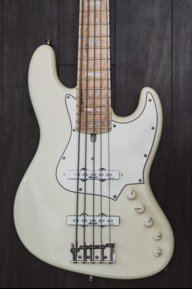
Peter, I need that trans white SJ5! Great collection man! If you need to be all natural, I have a SJ5 natural w/ blocks to trade in.

what is your fingerboard made of? The trans white one is my second favorite of my basses. She is very light for a 5er and speaks with great authority.
I also had Luminlay markers installed on her ;)
 

Latest posts