

Enjoy the benefits of a premium membership!
Upgrade Account
-
TalkBass has been independent since 1998. Add your voice.
Create a free account to reply to discussions, view embedded media, and browse with fewer display ads.
Join free Log in
Want zero display ads or expanded classifieds tools? Compare plans.
You are using an out of date browser. It may not display this or other websites correctly.
You should upgrade or use an alternative browser.
You should upgrade or use an alternative browser.
Dingwall Owners Club
- Thread starter FroggyOne2
- Start date
More options
Who Replied?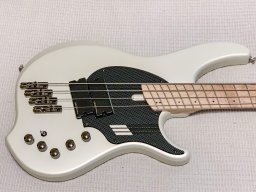
Sound is very similar. Paysons are perhaps a little smoother both sounding and playing. I don't have a direct comparison because Paysons are on a fretted AB2, TIs on the fretless which has a slightly different tone (different pre-amp, etc. as well). Paysons are definitely lighter than the TIs (The TIs have a .136 for the B). From a preference standpoint, I'm leaning towards the Paysons. I put the Paysons on and it was like:
.
Thanks, I think I'll try them.

I don’t believe it’s possible with the routing.So... Will Dingwall build a Super P w/o the pickguard?
No back plate

So... Will Dingwall build a Super P w/o the pickguard?
I believe that's gonna be a hard no. With the way the SP's are routed, don't think that's possible.
Sorry, my man.
Although, if you throw enough cash at Sheldon...


My apologies but it’s been put on hold already.Could I grab the name please. I might need to do something about it.
Maybe...

My apologies but it’s been put on hold already.
Well, balls.
Not that I want another bass just now but I really like that colour scheme on a Super P.
Well, balls.
Not that I want another bass just now but I really like that colour scheme on a Super P.
I hear ya. I almost brought it home..... same as the DG edition NG3 and definitely contemplated the Droc but it’s just not the bass I’ll pick up as a go to so there isn’t a lot of sense.

So... Will Dingwall build a Super P w/o the pickguard?
I have seen at least one 4-string a long while back with a fancy top that had no pickguard, so it is possible.
johnsonabq
Watch out where the huskies go...
It's just that I so much prefer the P style over the J style. IMHOI have seen at least one 4-string a long while back with a fancy top that had no pickguard, so it is possible.
I have seen at least one 4-string a long while back with a fancy top that had no pickguard, so it is possible.
That would be a rare bird, indeed. I can’t find any Super P’s w/o a pickguard. There's that fretless one with a fancy top, but it still has the guard. It's pretty sweet though.
@johnsonabq -Have you reached out to anyone at Dingwall to inquire?
johnsonabq
Watch out where the huskies go...
I have not. It's something I'm interested in but not financially ready for at this time. Just thought I'd throw that out. I just paid off an Afterburner 1 that I should receive in the next couple of weeks. I'm sure I'll be caught up in that for a while to come.@johnsonabq -Have you reached out to anyone at Dingwall to inquire?
Ok here's my issue, I have Combustion 5 with three pickups. One day I was playing thru my X Ultra and noticed some volume and low end loss(almost like out of phase style effect), its kinda hard to notice by ear but when I recorded the signal and compared the sound graphs, there definately was some loss. First I thought its the pedal but after tracking down the issue, with power supply and cable changes etc, I noticed that if I plug the jack off and put it back it fixes it temporarily...althought it comes back at some point. I also hear some buzzing when I change to bridge, middle or 3 pickups, but oddly enough there is none when the 2 pickups are on. Its more noticeable on active mode, but its still there on passive too.
So could it be some wiring issue, or faulty/dirty jack? Anything else?
So could it be some wiring issue, or faulty/dirty jack? Anything else?
Battery?........Ok here's my issue, I have Combustion 5 with three pickups. One day I was playing thru my X Ultra and noticed some volume and low end loss(almost like out of phase style effect), its kinda hard to notice by ear but when I recorded the signal and compared the sound graphs, there definately was some loss. First I thought its the pedal but after tracking down the issue, with power supply and cable changes etc, I noticed that if I plug the jack off and put it back it fixes it temporarily...althought it comes back at some point. I also hear some buzzing when I change to bridge, middle or 3 pickups, but oddly enough there is none when the 2 pickups are on. Its more noticeable on active mode, but its still there on passive too.
So could it be some wiring issue, or faulty/dirty jack? Anything else?
shouldn't be if it’s happening in passive but ??? A simple thing to check
Is it a factory 3x or an upgraded 2x?
Battery?........
shouldn't be if it’s happening in passive but ??? A simple thing to check
Is it a factory 3x or an upgraded 2x?
Yea its still possible, even though the batteries are not that old...I will try if changing them helps. Its a factory 3x
I have not. It's something I'm interested in but not financially ready for at this time. Just thought I'd throw that out. I just paid off an Afterburner 1 that I should receive in the next couple of weeks. I'm sure I'll be caught up in that for a while to come.
Oh, I'm with you, my man! I'd REALLY like to know what the finish on Jacob Umansky's Z3/6 runs, but I need to stop. You and I are in the same queue, since our builds are in the same batch, so I have no reason to even be THINKING about a new bass...but I am. LOL! I feel more alive when I'm making seriously questionable decisions.


Ok, I've been waiting for these...
[Invalid or Expired Link Removed]
I just ordered a set from Jason to try out, even though that's what I was using, and loved, before I made it back to Dingwall. I'm actually super excited about this development!

[Invalid or Expired Link Removed]
I just ordered a set from Jason to try out, even though that's what I was using, and loved, before I made it back to Dingwall. I'm actually super excited about this development!

Not sure anyone else will be interested in this, but I did the math so I figured I might as well post it here.
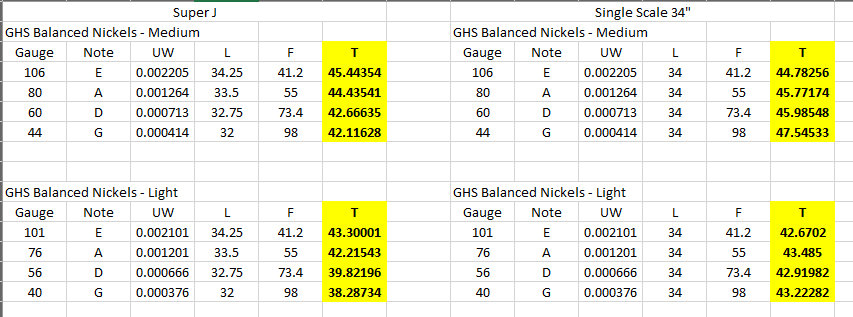
My go-to strings for roundwound applications are GHS Balanced Nickels, typically in the medium gauge set (106-44). I was curious as to the tension result from using them on my upcoming Super J (i.e. 34.25" to 32" versus a single 34" scale), so I jumped over to GHS's tension chart and used their formula to calculate the resultant tensions of these particular strings on Dingwall's medium scale basses. I compared the medium and light gauge sets. The results (below) are very encouraging. A complaint I have on most basses is that the G string, for me, tends to be a little overly present compared to the other strings. I realize the D string is the commonly "over-tensioned" string on a single 34" scale bass, but the G always pops out a little too much to my ears. Looking at the chart below, especially for the medium gauge set, I'm very excited about the increased tension balance from string-to-string that I'm seeing for my bass. I was worried that I'd have to stop using these wonderful strings when my Dingwall arrives, but it looks like they'll work extremely well.
T = (UW x (2 x L x F)^2) / 386.4
My go-to strings for roundwound applications are GHS Balanced Nickels, typically in the medium gauge set (106-44). I was curious as to the tension result from using them on my upcoming Super J (i.e. 34.25" to 32" versus a single 34" scale), so I jumped over to GHS's tension chart and used their formula to calculate the resultant tensions of these particular strings on Dingwall's medium scale basses. I compared the medium and light gauge sets. The results (below) are very encouraging. A complaint I have on most basses is that the G string, for me, tends to be a little overly present compared to the other strings. I realize the D string is the commonly "over-tensioned" string on a single 34" scale bass, but the G always pops out a little too much to my ears. Looking at the chart below, especially for the medium gauge set, I'm very excited about the increased tension balance from string-to-string that I'm seeing for my bass. I was worried that I'd have to stop using these wonderful strings when my Dingwall arrives, but it looks like they'll work extremely well.
T = (UW x (2 x L x F)^2) / 386.4
I'd probably roll with the lights if it were meNot sure anyone else will be interested in this, but I did the math so I figured I might as well post it here.
My go-to strings for roundwound applications are GHS Balanced Nickels, typically in the medium gauge set (106-44). I was curious as to the tension result from using them on my upcoming Super J (i.e. 34.25" to 32" versus a single 34" scale), so I jumped over to GHS's tension chart and used their formula to calculate the resultant tensions of these particular strings on Dingwall's medium scale basses. I compared the medium and light gauge sets. The results (below) are very encouraging. A complaint I have on most basses is that the G string, for me, tends to be a little overly present compared to the other strings. I realize the D string is the commonly "over-tensioned" string on a single 34" scale bass, but the G always pops out a little too much to my ears. Looking at the chart below, especially for the medium gauge set, I'm very excited about the increased tension balance from string-to-string that I'm seeing for my bass. I was worried that I'd have to stop using these wonderful strings when my Dingwall arrives, but it looks like they'll work extremely well.
T = (UW x (2 x L x F)^2) / 386.4
View attachment 3596390

I’ve got a rack drawer in my studio filled with both medium and light sets at all times, so I’m sure both will get tried.I'd probably roll with the lights if it were me

IvanBassist
Commercial User
- Jun 8, 2008
- 3,744
- 11,128
- Disclosures
- Content Manager at Darkglass Electronics, Dingwall Guitars Artist
When are you getting the SJ? I'd like to know your thoughts once it arrivesNot sure anyone else will be interested in this, but I did the math so I figured I might as well post it here.
My go-to strings for roundwound applications are GHS Balanced Nickels, typically in the medium gauge set (106-44). I was curious as to the tension result from using them on my upcoming Super J (i.e. 34.25" to 32" versus a single 34" scale), so I jumped over to GHS's tension chart and used their formula to calculate the resultant tensions of these particular strings on Dingwall's medium scale basses. I compared the medium and light gauge sets. The results (below) are very encouraging. A complaint I have on most basses is that the G string, for me, tends to be a little overly present compared to the other strings. I realize the D string is the commonly "over-tensioned" string on a single 34" scale bass, but the G always pops out a little too much to my ears. Looking at the chart below, especially for the medium gauge set, I'm very excited about the increased tension balance from string-to-string that I'm seeing for my bass. I was worried that I'd have to stop using these wonderful strings when my Dingwall arrives, but it looks like they'll work extremely well.
T = (UW x (2 x L x F)^2) / 386.4
View attachment 3596390


