• TalkBass has been independent since 1998. Add your voice.
    Create a free account to reply to discussions, view embedded media, and browse with fewer display ads.
    Join freeLog in
    Want zero display ads or expanded classifieds tools? Compare plans.

Dingwall Owners Club

Yeah, sigh...

I've got a build happening at 'the shop' right now (my Super-P) but down the line maybe a couple years, I have a feeling that I'd like to have Mo do another fretless for me. Think I could talk him into a graphite neck multi-scale fretless 5? He did so much work on my Combustion and he's done so much with other Dingwalls I kind of feel like if you're going 'off the map' for features that Dingwall won't do, he might be the guy. I just can't see Sheldon ever doing a graphite or carbon fiber neck.

And while I'm at it, since it's sitting in my lap now (and most days)...

View attachment 3903478


Yeah, sigh...... why am I even looking at other instruments when I have more then I need or definitely can handle. It’s just that neck and fretboard!!!! I had a fretless Zon in my possession for a while that was graphite with a dymondwood fretboard it was killer.

also, the epoxy coated boards have a certain characteristic that is sweet! I love the raw ebony I have and never would have thought a variety of fretless basses was on my radar but......

“No, it’s not” “yes it is” “no it’s not”
 
  • Like
Reactions: BurningSkies
I have found that some of the organic aspect of the tone is simply not there with a full composite makeup unless you make up for it somehow, like a chambered body or something.
For the money, this Kiesel is really tough to beat! The neck has proven to be perfectly level and stable, and the board has a beautiful glass-like cyanoacrylate finish. it does have a pair of carbon fiber reinforcing rods in it, which probably contribute to the stability but without sucking away a noticeable amount of the natural tone.. I would love to have a Dingwall that sounds like this!
The sweepable midrange really lets you work a lot of magic with the tone:

Those are round wounds on there, correct?
 
  • Like
Reactions: Andyman001
Sounds great...and nice groove and smooth playing!

Yeah, I could buy that, and chambered body wouldn't ever be a problem. The one nut that seems hard to crack is to get the acoustic/vibrational tone to translate amplified. I did my best by moving my pickups into the Z2 position and having a piezo bridge, but while better isn't really what I'm hearing when I play unamplified. The best at getting this kind of tone to really translate seems to be hollow or semi.

Have you looked at Fishman Fluence pickups? One of the three voices is super transparent-sounding.
 
Have you looked at Fishman Fluence pickups? One of the three voices is super transparent-sounding.

I haven't though they look cool. The problem is less the pickups and more that there's no a great way to capture the resonant tone of the neck and body. I would assume that something like a Rick Turner or a Rob Allen Mouse fixes that by having a SUPER resonant hollow body and with a really well integrated piezo setup. Not that the Graphtech Ghost system I have is bad, it's just well isolated from the body in the ABS pickup 'sled' so that's the tone you get.
 
  • Like
Reactions: IronSpatula
Those are round wounds on there, correct?
Yes, they sure are. On fretless, I'm mostly a roundwounds kinda guy. Except for sometimes when I'm not. In those times, I love LaBella nylon tapewounds. Hmm, wouldn't that be interesting, a walnut hollow-body AB II with nylon tapewounds. Or Sadowsky Blue Label Flatwounds. Hmm, now the daydreaming starts...
 
Can I get a number ? Just took delivery of this...
D87BEEEC-3F9F-4FFC-92B6-61888B9A7CC0.jpeg
 
Anyone else noticed the 5 string D-roc standard being discretely shown off on Instagram/Facebook?


Good question they're asking by the way : "Is anybody using a humidifier to store their bass?" :)
I usually see people having problems with too much humidity for instruments (or gear in general), but not enough .. ?
Will the wood develop problem if the atmosphere is too dry ? And if yes what is too dry, then ?
 
I am so excited,
Dingwall #4 will arrive tomorrow.
A Yellow NG2 - the colour which I always wanted.

But my black NG3 has to go. Now the hard part...
Keep the Yellow one a NG2 or switch the Neck Pickup... if yes - DBird switch or 3x Switch.
I have both at home :D
I'm curious to hear opinions on the 3X vrs the Dbird switch also. I have the 3X pup kit to convert my NG2 and it came with the 3X switch, but there is no all 3 pups on setting with the 3X ! As I am 95% pick player, I'm curious to hear other pick player's opinions on the difference between the two switches, and their tonal settings !
 
Nice! You're in. ;)

We stopped issuing numbers long long ago. If you wish to pick a number you like, rational or otherwise, feel free.
I’m good being numberless. This is my first Dingwall. I emailed Dingwall my serial number and this is a 2009 with a Glockenklang preamp. They had no information regarding the pickups. Any information on what they used on Super J’s around the time was built would be greatly appreciated. Also wondering if having this routed for FD style pickups would be much of an improvement.
 
  • Like
Reactions: singlemalt
I’m good being numberless. This is my first Dingwall. I emailed Dingwall my serial number and this is a 2009 with a Glockenklang preamp. They had no information regarding the pickups. Any information on what they used on Super J’s around the time was built would be greatly appreciated. Also wondering if having this routed for FD style pickups would be much of an improvement.

I'm sure someone else will know right off, but these look like the original Super-Fatty pickups. I bet they're marked on the bottom. I think that FD-3's would be a lateral move at best, and I don't know that the pickup width would make that a possible thing.
 
I’m good being numberless. This is my first Dingwall. I emailed Dingwall my serial number and this is a 2009 with a Glockenklang preamp. They had no information regarding the pickups. Any information on what they used on Super J’s around the time was built would be greatly appreciated. Also wondering if having this routed for FD style pickups would be much of an improvement.

Those are Super Fatty.
I've had a SJ4 with them and liked them. They're darker and more compressed than FD3 (which I recently took out of my fretless SJ5 and still have in an ABI)
 
  • Like
Reactions: Cantstandsya
Good question they're asking by the way : "Is anybody using a humidifier to store their bass?" :)
I usually see people having problems with too much humidity for instruments (or gear in general), but not enough .. ?
Will the wood develop problem if the atmosphere is too dry ? And if yes what is too dry, then ?

Generally, you want to try and keep your instruments between 40-60% humidity with no big swings in either direction, but it's really a much bigger deal for acoustic instruments than our solid body basses. Mostly we just see neck movement and fret sprout on our basses. With acoustics, super low humidity can cause the wood to dry out and body to crack. I suspect all those amazing and expensive veneer tops Dingwall have stored in that room are susceptible to the same issues i.e. if they dry out they will crack and become unusable.
In the winter it wouldn't be unusual to have around 15-20% inside in Saskatoon which is pretty low, welcome to Canadian weather ;)
 
I’m good being numberless. This is my first Dingwall. I emailed Dingwall my serial number and this is a 2009 with a Glockenklang preamp. They had no information regarding the pickups. Any information on what they used on Super J’s around the time was built would be greatly appreciated. Also wondering if having this routed for FD style pickups would be much of an improvement.


I would also suspect they would be super fatties.

I wouldn’t think taking the effort to install FD3s would be an “improvement” but more so an alteration.
You would get a much more Modern sounding bass by installing the FD3s IMO.
That’s nice but what you have is pretty much a vintage instrument now and from my experience those pick ups really hold their own on the Js.

one mod you could possibly do with very little imposition on the existing instrument would be to increase the 2 band glockenklang, presuming that’s what it is, to 18v. This will increase your headroom.
Your out put will be the same if not greater then an FD3 loaded modern J.

that is theoretical of course but it is what I’ve first hand experienced on a bass I sold. It’s current owner had this done by someone qualified and it was quite impressive in all honesty.
You should confirm what preamp it is and if it’s the glock confirm with @Helge_Glock that it can be done.

congrats man
 
I would also suspect they would be super fatties.

I wouldn’t think taking the effort to install FD3s would be an “improvement” but more so an alteration.
You would get a much more Modern sounding bass by installing the FD3s IMO.
That’s nice but what you have is pretty much a vintage instrument now and from my experience those pick ups really hold their own on the Js.

one mod you could possibly do with very little imposition on the existing instrument would be to increase the 2 band glockenklang, presuming that’s what it is, to 18v. This will increase your headroom.
Your out put will be the same if not greater then an FD3 loaded modern J.

that is theoretical of course but it is what I’ve first hand experienced on a bass I sold. It’s current owner had this done by someone qualified and it was quite impressive in all honesty.
You should confirm what preamp it is and if it’s the glock confirm with @Helge_Glock that it can be done.

congrats man
The current preamp is 18V. It surprised me that the passive sound is slightly louder than active. First thing I did was check the batteries and install new ones. It’s not necessarily a bad thing to not have the huge spike in volume that I’m used to when going from passive to active. The pickups are much lower output when compared to my other passive basses. Again, not a bad thing. Just a slight volume bump on my amp takes care of it.
 
Good question they're asking by the way : "Is anybody using a humidifier to store their bass?" :)
I usually see people having problems with too much humidity for instruments (or gear in general), but not enough .. ?
Will the wood develop problem if the atmosphere is too dry ? And if yes what is too dry, then ?
Wet wood expands. That's why necks start buzzing in summer, when the fretboard expands faster than the neck and causes the neck to flatten out. If it expands evenly (like on a well made instrument), you will only need to adjust the truss rod to compensate. If it expands a LOT, cracks can open up.
Dry wood contracts (shrinks). That's why a neck develops high action in winter, requiring you to tighten the truss rod to compensate. If it contracts a lot, frets can start popping out. Also, glue joints can loosen up or even fail.
How dry is too dry? Partly depends on the particular wood species, and what degree of extreme dryness it has already experienced in its aging process on the builder's shelf. There is almost certainly not a single magic number you can use. Some basses will probably be fine at 30% or 25%. Some may start coming apart at 25%. Someone in Arizona can probably tell us what happens (or doesn't happen) at crazy low humidities. I'm curious about that myself. I do instinctively think that a lot of what an instrument can tolerate is determined by not just the species of wood and the build quality, but also by the degree of extremes that the wood has already experienced and survived. And it's an organic material, so one piece is not the same as the next.

I am using a humidifier here (in the winter), in addition to the dehumidifier (in the summer).
We have gas-fired forced hot air heat. Without the equipment, the humidity would be 15% to 20% in the winter and 80% to 85% in the summer. Both of those extremes would probably spell disaster for the instruments.
When I first moved here, I had a small department store grade dehumidifier. It ran continuously, but wasn't enough for the square footage. The belly bowed on an acoustic guitar so much that the bridge started lifting around the edges. I replaced that unit with a Fral FDK70 dehumidifier, and summers are great now - it never goes above 50%. And for the winter, I installed this wall-mounted humidifier which I found at NAMM last year, made by TAC Water & Misting Systems.
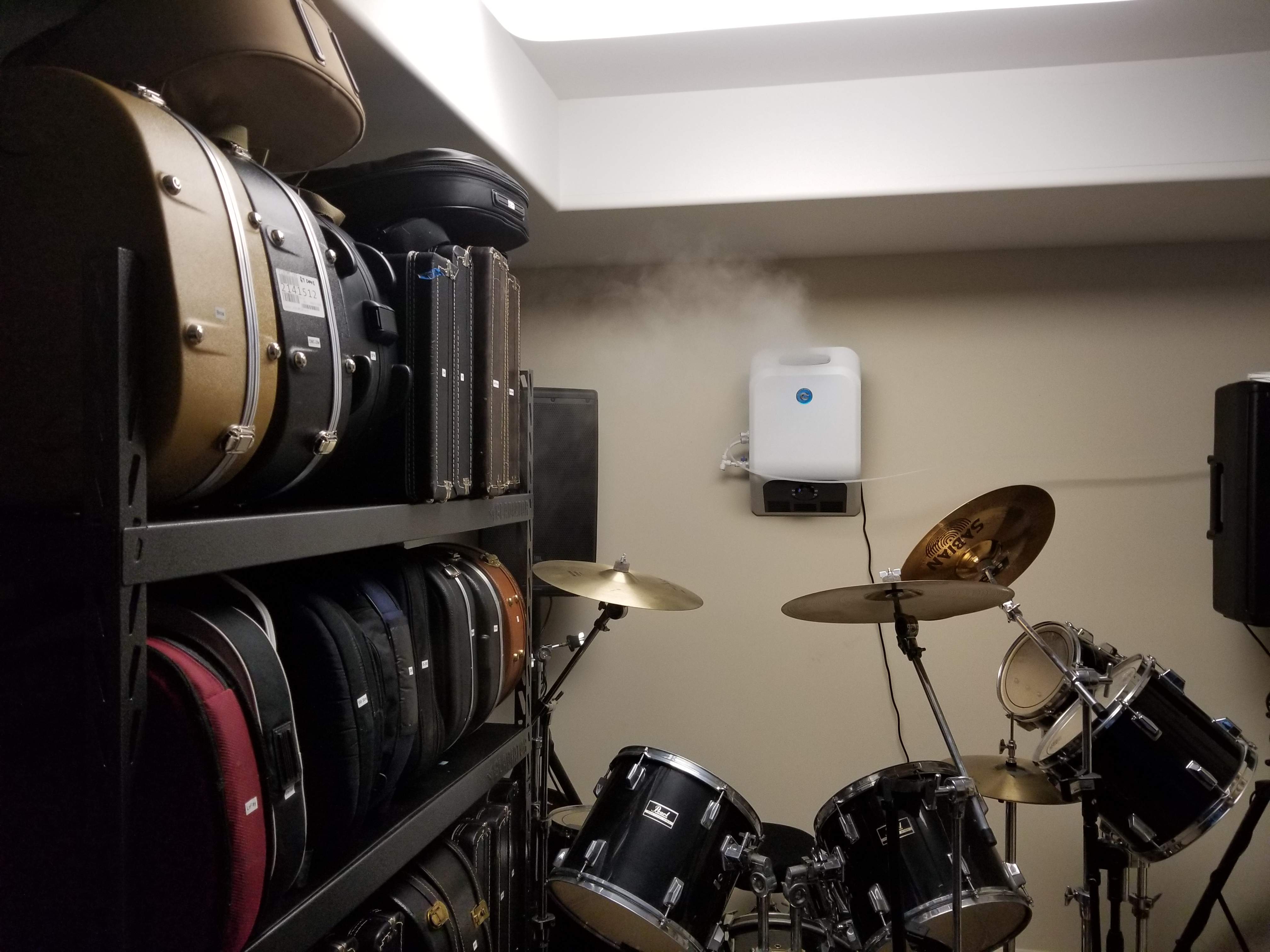
20191203_150520.jpg

Tom, the owner ("TAC" are his initials) also convinced me to feed it with Reverse Osmosis water instead of plain tap water, to guarantee that there would be zero dust, and zero mineral buildup in the machine. We have a well, and all our other humidifiers require frequent descaling, which is a huge hassle. I am very glad that I took his advice and got a Reverse Osmosis filter from him as well. The whole setup works fantastic, and I can keep the place at 50% humidity year round, which keeps all the instruments very happy. Never have to touch a truss rod. Hardly ever even have to touch a tuner in fact. And both the humidifier and dehumidier are completely self-sufficient, maintenance free - set-it-and-forget-it. (Like comedian Steven Wright said - sometimes I like to turn them both on at the same time and watch them duke it out.) LOL

I know it's summer (at least in the Northern hemisphere), so talking about humidifiers is kind of like talking about down jackets and snow blowers. But it doesn't hurt to plan ahead. For all the living space in our house, we have Aprilaire humidifiers on the ductwork on our furnace, and in each bedroom we use a Venta Airwasher. The Venta units are fantastic because they use virtually no power, and use natural evaporation so they cannot overhumidify and they don't cause dust to build up all over everything. HOWEVER, you have to manually refill them every day. And if you don't use distilled water or Reverse Osmosis water, then you have to frequently clean the mineral buildup from the machine using vinegar or equivalent. It was a real pain until we got the Reverse Osmosis unit and started using that water to fill a pitcher and carry the water upstairs to fill up the Venta units.

True story: I once played two and a half songs while standing outdoors (to get some fresh air because the cigarette smoke was literally killing me) at a bar in Talkeetna, Alaska when it was 24 degrees below zero Fahrenheit. I had to come back inside when my fingers just wouldn't move any more. I could hear the drummer fine from outside, but couldn't really hear myself at all. The band said that I went WAY out of tune while I was outside, but when I came back inside, I came back to proper pitch pretty quickly. I'm guessing the humidity was below 10%. That was one well built Ibanez, it didn't even get any finish checking.
 
Last edited:
I’m good being numberless. This is my first Dingwall. I emailed Dingwall my serial number and this is a 2009 with a Glockenklang preamp. They had no information regarding the pickups. Any information on what they used on Super J’s around the time was built would be greatly appreciated. Also wondering if having this routed for FD style pickups would be much of an improvement.
Super Fattys...you could also consider changing the neck PU to a P. The bass should already be routed for that. Easy to get the P from Dingwall and install. You'll see lots of examples in here. Adds some dynamics and gives a nice P-tone.
 
The current preamp is 18V. It surprised me that the passive sound is slightly louder than active. First thing I did was check the batteries and install new ones. It’s not necessarily a bad thing to not have the huge spike in volume that I’m used to when going from passive to active. The pickups are much lower output when compared to my other passive basses. Again, not a bad thing. Just a slight volume bump on my amp takes care of it.

The glockenklang pre isn’t really a booster, unless of course you boost everything but flat it is very neutral and transparent.

have you confirmed the pick ups are at an appropriate height?

oh, and passive on these things really is amazing. If you get the chance, try it with a Mesa WD800. Wow
 
  • Like
Reactions: Lowendtech
The glockenklang pre isn’t really a booster, unless of course you boost everything but flat it is very neutral and transparent.

have you confirmed the pick ups are at an appropriate height?

oh, and passive on these things really is amazing. If you get the chance, try it with a Mesa WD800. Wow
Yeah, the passive sound is great. Especially series. I haven’t got a chance to play it out of my big setup yet. Just a Rumble combo with GED YYZ pedal, but it definitely has some character to it.
 
  • Like
Reactions: AB Nate