• TalkBass has been independent since 1998. Add your voice.
    Create a free account to reply to discussions, view embedded media, and browse with fewer display ads.
    Join freeLog in
    Want zero display ads or expanded classifieds tools? Compare plans.

Dingwall Owners Club

Hang in there Ivan. Being laid up is tough, just take one day at a time and eventually things heal.

I'm enjoying your Youtube channel. Can you do a vlog to let us know how things are going?

Best of luck!
Probably will do an update vid as soon as I have a fixed surgery date and know more or less how the rehab process is gonna go.

I’ll try to ask a friend to help me with an unboxing video once the bass arrives, as well :D
 
They don’t. But they did a few I think back in the day before the business plan unfolded.

Not too terribly long ago... 2010. Sheldon came out with a handful of guitar models, but at the time it was probably more than the shop needed to be dealing with (similar to the Dingwall skateboards)... Though Dingwall also made guitars back in the 90s too.

Press release:
Dingwall Custom I Guitar

Dingwall Guitars best known for their critically acclaimed high-end bass guitars are going back to their roots with the Custom I guitar. The first guitar in this series combines the look of a classic rock/blues guitar with the fit, finish, performance and tone equaling the very best of the boutique guitar world. It made its debut at the Montreal Guitar show and received rave reviews.

Guitar designer Sheldon Dingwall concentrated on several key areas such as tone, resonance, lightweight, balance, ergonomics, tuning stability, seasonal stability, feel and appearance.

Resonance, tone and lightweight all can be greatly affected by wood choice and tone chambers. Years of testing have lead Dingwall to a tone that’s warm and full without the typical nasal quality that some tone chamber designs produce. Traditional woods like alder and swamp ash are used for the body because they provide a great platform to enhance through design. Using ultra lightweight Sperzel tuners and leaving select areas of the body solid to create a ballast effect achieve exceptional balance.

The body’s contours have been designed with several playing positions in mind from standing with the guitar strapped high, slung low, seated in a traditional position or hunched over as you would late at night when playing quietly. The scooped out horn and tapered heel allow unhindered access to the very last frets.

Tuning stability is addressed by combining an ultra low headstock angle in conjunction with a custom formula Graph Tech nut, locking Sperzel tuners a Graph Tech bridge and a customized Bigsby tremolo. Sheldon says “It’s hard to tell the difference between the best sounding guitar and the worst sounding if they’re both out of tune. They both just sound bad.” For this reason Sheldon Dingwall takes the “use any means possible” approach to making sure the guitar plays and stays as in tune as possible.

Seasonal stability is not something that’s discussed or advertised much. Due to the extreme mid-west climate a large percentage of guitar repairs that came into Sheldon Dingwall’s repair shop were humidity related. Glenn McDougall of Fury Guitar (Canada’s first electric guitar manufacturer) taught Sheldon many secrets to a stable neck/truss-rod assembly. By carefully matching neck and fingerboard woods, installing a truss-rod designed to minimize thermal changes Dingwall has created a neck that is extremely stable through temperature and humidity changes. The standard neck is a 3 piece maple laminate with walnut as an option for even more resonance and lighter weight.

The Custom I neck carve is influenced by 60’s C-shaped necks. The fretboard edges are rolled in for a played in feel. The fingerboard features a compound radius starting at a very comfortable 7-1/2” at the nut and flattening out to 16” at the bridge.

A TV Jones Classic Plus is featured in the bridge position with a TV Jones MagnaTron in the neck position. The 3-way blade switch is located out of strumming range to avoid accidental selection changes.

The look of the Dingwall Custom I is pure Rock’n Roll. With the gain dialed up on a good tube amp the bridge pickup nails the crunchy yet warm classic rock tone with a distinct almost cello-like character. Through the clean channel the neck pickup tone ranges from sweet and slightly scooped to warm and jazzy.

dingwall-custom-i-108794.jpg


bae5c096-eb44-4123-a2b0-c124c6bf545e.jpg


ce5ae62ac6a4e8e942ccc9bfc128c230.jpg


Premier Guitar review:
Dingwall Custom I Electric Guitar Review

Older Dingwall guitar pics:

14756435021_69bb8a6d31_b-1.jpg


14759607245_3efe3e3426_o.jpg
 
They did skateboards?!

Yep. Dingwall Carvedart longboards. I actually called and discussed with Sheldon to do one in matching Rastaburst but I don't think it was a priority for either of us in the long run. I'll dig through the archives and see if I can find any pictures. I don't see any hits on google right now.
 
Last edited:
Not too terribly long ago... 2010. Sheldon came out with a handful of guitar models, but at the time it was probably more than the shop needed to be dealing with (similar to the Dingwall skateboards)... Though Dingwall also made guitars back in the 90s too.

Press release:
Dingwall Custom I Guitar

Dingwall Guitars best known for their critically acclaimed high-end bass guitars are going back to their roots with the Custom I guitar. The first guitar in this series combines the look of a classic rock/blues guitar with the fit, finish, performance and tone equaling the very best of the boutique guitar world. It made its debut at the Montreal Guitar show and received rave reviews.

Guitar designer Sheldon Dingwall concentrated on several key areas such as tone, resonance, lightweight, balance, ergonomics, tuning stability, seasonal stability, feel and appearance.

Resonance, tone and lightweight all can be greatly affected by wood choice and tone chambers. Years of testing have lead Dingwall to a tone that’s warm and full without the typical nasal quality that some tone chamber designs produce. Traditional woods like alder and swamp ash are used for the body because they provide a great platform to enhance through design. Using ultra lightweight Sperzel tuners and leaving select areas of the body solid to create a ballast effect achieve exceptional balance.

The body’s contours have been designed with several playing positions in mind from standing with the guitar strapped high, slung low, seated in a traditional position or hunched over as you would late at night when playing quietly. The scooped out horn and tapered heel allow unhindered access to the very last frets.

Tuning stability is addressed by combining an ultra low headstock angle in conjunction with a custom formula Graph Tech nut, locking Sperzel tuners a Graph Tech bridge and a customized Bigsby tremolo. Sheldon says “It’s hard to tell the difference between the best sounding guitar and the worst sounding if they’re both out of tune. They both just sound bad.” For this reason Sheldon Dingwall takes the “use any means possible” approach to making sure the guitar plays and stays as in tune as possible.

Seasonal stability is not something that’s discussed or advertised much. Due to the extreme mid-west climate a large percentage of guitar repairs that came into Sheldon Dingwall’s repair shop were humidity related. Glenn McDougall of Fury Guitar (Canada’s first electric guitar manufacturer) taught Sheldon many secrets to a stable neck/truss-rod assembly. By carefully matching neck and fingerboard woods, installing a truss-rod designed to minimize thermal changes Dingwall has created a neck that is extremely stable through temperature and humidity changes. The standard neck is a 3 piece maple laminate with walnut as an option for even more resonance and lighter weight.

The Custom I neck carve is influenced by 60’s C-shaped necks. The fretboard edges are rolled in for a played in feel. The fingerboard features a compound radius starting at a very comfortable 7-1/2” at the nut and flattening out to 16” at the bridge.

A TV Jones Classic Plus is featured in the bridge position with a TV Jones MagnaTron in the neck position. The 3-way blade switch is located out of strumming range to avoid accidental selection changes.

The look of the Dingwall Custom I is pure Rock’n Roll. With the gain dialed up on a good tube amp the bridge pickup nails the crunchy yet warm classic rock tone with a distinct almost cello-like character. Through the clean channel the neck pickup tone ranges from sweet and slightly scooped to warm and jazzy.

View attachment 4081640

View attachment 4081641

View attachment 4081643

Premier Guitar review:
Dingwall Custom I Electric Guitar Review

Older Dingwall guitar pics:

View attachment 4081644

View attachment 4081646

very cool chunk of history right there.
The one I pictured I think is one of the later ones.
A friend of mine locally has a couple of the older ones.
 
  • Like
Reactions: Andyman001
very cool chunk of history right there.
The one I pictured I think is one of the later ones.
A friend of mine locally has a couple of the older ones.

Yeah, not much mention around of the older 1990s ones, I grab whatever pictures I see when I come across them, but they're few and far between.
 
Thanks for doing all that digging @BurningSkies

since the website redo. I’ve lost track of all that history.

Yeah, there were more pieces on the old message board, etc. I also have a few old HDs that have pics but it's not terribly organized so I can never find what I'm looking for. I did come across that old picture of FRB's Dingwall collection, though I know it's well out of date and he has way more now.

27067477_1804107136289461_5988204854907836238_n.jpg
 
Yeah, there were more pieces on the old message board, etc. I also have a few old HDs that have pics but it's not terribly organized so I can never find what I'm looking for. I did come across that old picture of FRB's Dingwall collection, though I know it's well out of date and he has way more now.

View attachment 4081832

excellent. I think that pic exists waaaaay back in this thread somewhere but That could be some extensive digging.

I would love to see better photos of his collection. He posts the odd one on IG sometimes.
I would love to step foot in that room. Lol
 
I don't have a copy of it, but one shocking picture that I recall from the old site was a reject Afterburner body burning merrily on a campfire. :woot:

I probably have the inflamous Dingwall body campfire picture tucked away in the recesses of a hard drive somewhere...
 
I saw that beauty also. Love the grain in the body.

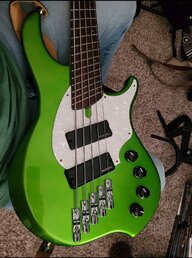
Interesting bass. Kind of threw me for a moment, with the dot markers but newer knobs and the maple body. Backstory is that it was owned buy USAF band. It doesn't have BluEQube. Owner thinks it's late 90's but AFAIK it would have to be super extra last minute 90's. Anyone remember the date on that green Proto that just showed up in the past month or two? I thought that was 2000ish.
 
  • Like
Reactions: spiritbass

Latest posts