• TalkBass has been independent since 1998. Add your voice.
    Create a free account to reply to discussions, view embedded media, and browse with fewer display ads.
    Join freeLog in
    Want zero display ads or expanded classifieds tools? Compare plans.

Dingwall Owners Club

It ended up a little different than what I had originally submitted as a reference with my order and in discussions with the paint shop. I was trying to match the finish of an old Fenderbird I had built. This is quite a bit warmer and lands somewhere between Olympic White and a "true" white but obviously with pearl added in. The finish is almost identical to what you'll see on Lexus cars in pearl white from about 10 years ago. Even though it's not quite what I had in mind when I put the order together I'm quite happy with it. When comparing it to photos of that old Fenderbird, which I no longer own, my wife commented that my Dingwall's finish looks nicer. The pearl adds a nice "depth" to the color where it changes pretty dramatically based on the lighting and angle you're viewing it. Sometimes when it's hanging on a strap and I look down it almost looks gold, but hanging on the wall and looking at it straight on it's much closer to "true" white than Olympic. Very interesting. I'm quite happy with it thus far.

Ah, I know that slightly creamy pearl color. I remember some Fender Lites or whatever that had it. I always have believed that the color of those is more due to yellowing of the clearcoat. I think you do better with the color as it is now.
 
  • Like
Reactions: seedokebass
I have a Lake Placid Blue bass that I built back in 2005 that I keep waiting to yellow and do the typical LPB thing where it turns green over time. Still blue 16 years later!

Really depends on the clear coat used I think as well as the amount of UV exposure. Some may never yellow. I had a blonde (non transparent) 1983 strat that was nearly lemon yellow but pale honey under the pickguard.
 
In case anyone is interested; I just took a measurement of the neck at the nut on my 4-string Super J. Every time I grab this off the rack it feels noticeably skinnier than either my Warmoth Jazz neck from 2019 or my Status Jazz neck from 2005. Both the Warmoth and the Status are 1 9/16" wide at the nut, whereas the Dingwall is right on 1 1/2" measured perpendicular to the neck (i.e. how a parallel fret would align) beginning on the G-string side of the nut. That minor 1/16" difference is very apparent when you grab the bass off the rack, but doesn't really throw me off in either direction when playing it. Since the frets are angled in the lower positions which effectively elongates your fretting hand I think the 1/16" savings makes a lot of sense.

Unrelated to the neck; The Dingwall bridge is quite a creation. Whenever I palm mute similar to how Anthony Wellington does it I find that the bridge is shockingly low profile and "gets out of the way" better than any bridge I've ever used. Really nice design. Hopefully that opinion holds as I use it to make action adjustments when needed.
 
It is a wonderful bit of engineering. If I had a quibble with it, I would want a treaded intonation adjustment. Sliding the saddle block back and forth it a bit of hit or miss.

Occasionally, with fatter, no tapered strings, ( like a .136 TI jazz flat B) the saddle screws will be too long. These are a common stainless steel cap head, available at any well stocked hardware. If the action screws are all the way through the block, it can be hard to slide.

Man, remember when you started the studio project. What an epic journey!
 
Man, remember when you started the studio project. What an epic journey!
Too epic. Now it doubles as my remote work location for my day job.

Thanks for the insights on the bridge. I’m not totally digging the stock Dingwall strings and will be trying some others soon and I’m sure some setup changes will come along with that.
 
  • Like
Reactions: BurningSkies
I’ve been away for a good while. I tried to do everything I could to put my NG-3 out of mind, or waiting on it was going to drive me nuts.

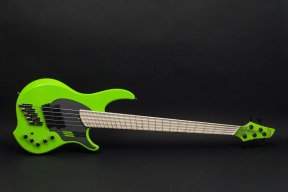
Well, yesterday John Fox emailed me with the FedEx info that it was headed to his shop (where he’ll give it one last check to make sure shipping treated it right, tweak setup, etc) and just now I got an email with these pics of my new bass.

AB430CAA-9CFB-4064-A169-F877291DAE64.jpeg
4B78D6FD-B818-4B13-9C5F-D800E3FCF042.jpeg
2B069168-3700-49F0-AB22-9B7513BB0600.jpeg
A6585881-30BB-4D7E-AC44-0B3DB41F8857.jpeg
 
I’ve been away for a good while. I tried to do everything I could to put my NG-3 out of mind, or waiting on it was going to drive me nuts.

Well, yesterday John Fox emailed me with the FedEx info that it was headed to his shop (where he’ll give it one last check to make sure shipping treated it right, tweak setup, etc) and just now I got an email with these pics of my new bass.

View attachment 4288865 View attachment 4288864 View attachment 4288867 View attachment 4288866
Awesome!!!! I like that green on a sixer!
 
They are both split coil, but there may be other differences, like gauge of the winding wire and how much they're wrapped or what pattern they're wrapped in. My recollection is that the FDV is also less output than the others.

What's the difference between the FD3 and FD3n's from the import models then? I figured the n on the import models meant neodymium magnets, which to me implied that the Canadian FD3's would be alinco.
 
And while I was catching up on the last couple of pages, the invoice came in and I paid, so now I’m super excited. Just one more shipping trip from John Fox to me and I can spend all day playing my new Ferrari Green baby.

And he’s already got FedEx picking it up today. As soon as it came in to his shop, he dropped everything and did what he needed to turn it around. Just world-class customer service.
 
Last edited:
Those are GIK Alpha 4A and Alpha CT panels in my recording studio. They're a great sounding product that suffered from major QA/QC which you can read about here if you'd like: My New Studio Build (perhaps overly detailed). Suffice it to say, I caution people from dealing with GIK, at least as it relates to their Alpha series. Great product that, at the time I purchased them, needed some refinements to the construction process that I also saw echoed over on the Gearspace forums. Hopefully they've resolved the issue.

Gearspace .. man, what has that world come to.
 
  • Like
Reactions: Bob_Ross
My old AB1 has the BluEQube but my new AB1 fretless does not, sadly. I don't remember if Sheldon has ever said why they got rid of it, but it's a unique feature I've not seen on any other passive bass.

My rememberies of the situation was that once the FD3's became FD3-4L and most basses were getting switches for series/parallel it became a bit of a redundancy because you could more or less use the coil and pickup switching to get in the same tonal ballpark as the BluEQube (passive mid cut).
 
What's the difference between the FD3 and FD3n's from the import models then? I figured the n on the import models meant neodymium magnets, which to me implied that the Canadian FD3's would be alinco.

Canadian FD3's are definitely neodymium. Per this email below:

FD3-A were FD3s with alnico II magnets instead of neos.
FDV are FD3 based but with more turns per coil and alnico V magnets.
Mach II were FD3s with two conductor leads where the neck coils were wired in parallel and the bridge coils in series. The Mach II name went away when we introduced 4 conductor leads (FD3-4L).
Super-Fatty II have the highest output and most bottom-end of all our pickups. They come stock on the Sklar II and are optional in place of FDV.

FD3 - Neodymium magnets
FD3A - Alnico II (I think these are not made anymore)
FD3N - Neo, but on production models...sound slightly different than standard FD-3
FDV - Alnico V magnets
 
My old AB1 has the BluEQube but my new AB1 fretless does not, sadly. I don't remember if Sheldon has ever said why they got rid of it, but it's a unique feature I've not seen on any other passive bass.
We found the tone of two FD3's combined in parallel got the tone we were after with the FD1+bluEQube, so we discontinued the bluEQube.
 
Another update on my new Super J; I spent my lunch break working through some material for a string of upcoming gigs over the summer. I've been a Jazz bass player for almost my entire playing career. Every time I deviate from that I find myself back with a Jazz of some sort. With a typical Jazz setup (i.e. two single coils, usually in 60s position) I find that anchoring my thumb at the neck pickup is a little too far forward for me to achieve the tone I prefer and find that it's not comfortable for me to play that way unless seated. Conversely the bridge pickup is a much more comfortable thumb anchoring position and while it gets closer to the tone that I prefer it can sometimes get a little thin. Somewhere in between would be ideal. Enter the Super J 3X. I'm finding that while I still don't really dig the tone when anchoring on the neck pickup, it's far enough back to be more usable than a typical J+J arrangement. For me the money spot is either anchoring on the middle or the bridge pickup. That tiny change is enough to go from "make it fat but still articulate" at the middle to "I want to cut a little harder" at the bridge. While I won't do much playing with my thumb anchored at the neck pickup it definitely has its place on mellower tunes and is far more comfortable than a typical J+J.

Lastly, the pickup switching options are just wonderful. The Glockenklang really does a good job of sounding identical when set flat and then bypassing the EQ. There might be a tiny difference when listening solo, but in a mix it would be indistinguishable. Very handy to have a flat EQ at the pull of a knob and then leave the EQ set as a sort of preset that you can click in as needed. I also love that the passive tone roll-off on the treble knob still functions when in passive mode. It's not like the typical active/passive bypass that's just there to save you in the event a battery is dead or dying and you have to get through a gig. In this case it turns it into a legit passive bass. Very very cool. All that gushing notwithstanding; The real magic, for me, is in the series/parallel switching. Putting the selector to the bridge/neck position, leaving the bridge in parallel and the neck in series sounds just about perfect for the vast majority of what I do on a live date. I'll make more use of the other positions on studio sessions, but for live work that position with the neck in series and bridge in parallel is just crazy useful at being fat in the mix while retaining articulation and avoiding bloat.
 
Chatted with @Selta a bit and placed an order for some Payson Medium Scale Light Gauge strings based on my usual preference for GHS Balanced Nickel Lights on my Jazz basses. I’m hoping these Paysons are a little closer to that vibe than the Dingnwall nickels that came on the bass, which are excellent but perhaps have a little too much zing up top for my taste. Going to leave them on until they mellow and then try the Paysons for the same length of time and then throw the GHS BNs on it last. That should paint a nice picture of what I like on this bass.

Also, after a few hours of woodshedding today the fanned frets are completely inconsequential to fretting. I don’t even think about it anymore. That was fast! :smug:
 
Chatted with @Selta a bit and placed an order for some Payson Medium Scale Light Gauge strings based on my usual preference for GHS Balanced Nickel Lights on my Jazz basses. I’m hoping these Paysons are a little closer to that vibe than the Dingnwall nickels that came on the bass, which are excellent but perhaps have a little too much zing up top for my taste. Going to leave them on until they mellow and then try the Paysons for the same length of time and then throw the GHS BNs on it last. That should paint a nice picture of what I like on this bass.

Also, after a few hours of woodshedding today the fanned frets are completely inconsequential to fretting. I don’t even think about it anymore. That was fast! :smug:
I think you'll enjoy the Payson strings quite a lot. I know I certainly do :)

It's pretty cool how quickly and simply it is to adapt to the fanned frets! I'm glad that it's comfortable already and feeling at home. I'll have to catch you at a gig for sure :)
 
  • Like
Reactions: SemiDriven