• TalkBass has been independent since 1998. Add your voice.
    Create a free account to reply to discussions, view embedded media, and browse with fewer display ads.
    Join freeLog in
    Want zero display ads or expanded classifieds tools? Compare plans.

Dingwall Owners Club

Mine are for sure, hopefully you’re using a capo to hold down the strings and an adequate measuring device?
Youu might be best to take it to a pro for a diagnosis to be Shute. If you bought it new then Dingwall will sort it out if it turns out to be a twist.
I'm using capo and a feeler gauge, from 0.05mm to 1mm in 0.05mm steps, so I can tell quite precisely.
Yes, the bass is new, bought at an authorized Dingwall dealer here in the EU. I already reached out asking Dingwall about this.
That is definitely concerning. Not the most reliable method, but if you look down the length of the neck, is there a visible twist?
Yes, if I look down the neck from the body side, I can see the slight curve I adjusted at the B string, but much less curve at the G string.
 
Last edited:
Yes, if I look down the neck from the body side, I can see the slight curve I adjusted at the B string, but much more less curve at the G string.
Dingwall seems to be one of the best in the industry for neck construction, but it’s hard to say what a dead plant will do over time given the multitude of environmental factors that occur around the large rock we all live on, and especially the nature of nature itself (every piece of wood is unique). It does sound like a twist, anxious to hear what Dingwall concludes.
 
  • Like
Reactions: Afc70
Dingwall seems to be one of the best in the industry for neck construction, but it’s hard to say what a dead plant will do over time given the multitude of environmental factors that occur around the large rock we all live on, and especially the nature of nature itself (every piece of wood is unique). It does sound like a twist, anxious to hear what Dingwall concludes.
The craftsmanship is flawless and I totally agree with you, every piece of wood is unique so no one can predict how the fibers will move over time. There is no one to blame, it is just unlucky for me but I'm sure now we talk about a twist or warped neck here.

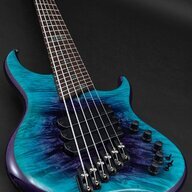
By the way it is a 10th Anniversary Edition in Amethyst Burst color, a really beautiful one.
I'm a bit disappointed at the moment, but I'm sure it will be sorted out.
20210927_160353.jpg
 
I agree. In my opinion you give more clearance to the thicker strings by adjusting the bridge saddles higher. The curve of the neck mostly affects the fret buzz in the lower region, up to the 12th fret.
The thing is, that as I adjust the truss rod I already have enough gap measured at the B string, it plays nice and there is no buzz, but at the G string the gap is very small, I have massive buzz from fret 1-7. This is what concerns me.

How is your G saddle set? In your photo it looks fairly screwed down in comparison to the rest
 
While some will find this to be polar opposite to what they like, I found it extremely interesting. The level of timing required in that is very impressive. The bass sounds perfect, and technique is great.

indeed. Check the album Relentless mutation for one of the most masterfully written albums ever IMO. I don’t think they can top it TBH.

Jared does offer Skype lessons for those interested in tapping techniques and such.
 
How is your G saddle set? In your photo it looks fairly screwed down in comparison to the rest
Yes, it is set as low as possible to have no buzz above the 7th fret. I like the lowest action as possible. The rest set accordingly to follow the radius of the fingerboard, even higher for low E and B because of their higher amplitude, so no buzz when playing normally, little fret grind when I really dig in. My problem is that I have buzz even with a really light touch on the G string from fret 1-7, however there is no buzz at all on the lower strings.
 
Yes, it is set as low as possible to have no buzz above the 7th fret. I like the lowest action as possible. The rest set accordingly to follow the radius of the fingerboard, even higher for low E and B because of their higher amplitude, so no buzz when playing normally, little fret grind when I really dig in. My problem is that I have buzz even with a really light touch on the G string from fret 1-7, however there is no buzz at all on the lower strings.
I wonder if you have a high fret around the 8th?
 
The neck does not have enough curve on the G side, it is almost flat and seems like twisted. At the B side the curve is perfect. When I press down at fret 1 the string buzzes on fret 2, when I press down at fret 2 it buzzes on fret 3, and so on, until fret 7. From there and up there is no buzz.

just suggesting alternative possibilities that can get overlooked.
Good luck :thumbsup:
 
My 4 string ABZ has arrived and I can't put this thing down! It took me literally no adjustment to the fanned frets, it just seems natural. Soundwise very much reminds me of my Roscoe 4 string which is a good thing.

But what sets it apart is the fact that my band tunes everything down 1/2 step, then sometimes we drop D which means the E string goes down to C# and that feels so tight and punchy on this bass. And the upper strings ring out so clear. I do a lot of hammer ons and octaves for 'accent' sounds on the upper strings and man do they pop on this bass!

I have two questions:

This is an ABZ with the high mass bridge and the saddles are two allen screws. To adjust pickup height, do I adjust the silver allen screws that the strings rest on, or the allen screws down inside the block of the saddle? I have a picture in post #44610 if you need to see the bridge.

There is what looks like a string-thru ferrule on the back but it has a screw in it. What is that for?

Thanks! Can't wait for my 2nd Dingwall! :)
 
There is what looks like a string-thru ferrule on the back but it has a screw in it. What is that for?

Congrats! That's got to be the Dunlop strap lock hole? If your strap has strap locks on it, you can stick one end in there instead of onto the end pin. That makes the bass sit a little further right on your body (for right-handed basses), which puts the lower frets a little closer for your left hand to reach.
 
Congrats! That's got to be the Dunlop strap lock hole? If your strap has strap locks on it, you can stick one end in there instead of onto the end pin. That makes the bass sit a little further right on your body (for right-handed basses), which puts the lower frets a little closer for your left hand to reach.

Oh okay! Funny, I told the guy I bought it from that the only thing I may have to adjust to would be the longer reach to the first fret so now I can't wait to get back home to try that :)
 
To adjust pickup height, do I adjust the silver allen screws that the strings rest on, or the allen screws down inside the block of the saddle? :)
Yes - the string "rides" in that V between the two screws; turn the screws counterclockwise to raise the action, clockwise to lower the action.

In general, you want that pair of screw heads to be level - you can set one side slightly higher to help keep the string in the groove if you have an especially aggressive right hand attack, but you can only offset them a little before the string (especially the skinny ones) can slip through the gap.
 
  • Like
Reactions: spiritbass
Yes - the string "rides" in that V between the two screws; turn the screws counterclockwise to raise the action, clockwise to lower the action.

In general, you want that pair of screw heads to be level - you can set one side slightly higher to help keep the string in the groove if you have an especially aggressive right hand attack, but you can only offset them a little before the string (especially the skinny ones) can slip through the gap.

Excellent, thank you!
 
  • Like
Reactions: DeltaPhoenix
My 4 string ABZ has arrived and I can't put this thing down! It took me literally no adjustment to the fanned frets, it just seems natural. Soundwise very much reminds me of my Roscoe 4 string which is a good thing.

But what sets it apart is the fact that my band tunes everything down 1/2 step, then sometimes we drop D which means the E string goes down to C# and that feels so tight and punchy on this bass. And the upper strings ring out so clear. I do a lot of hammer ons and octaves for 'accent' sounds on the upper strings and man do they pop on this bass!

I have two questions:

This is an ABZ with the high mass bridge and the saddles are two allen screws. To adjust pickup height, do I adjust the silver allen screws that the strings rest on, or the allen screws down inside the block of the saddle? I have a picture in post #44610 if you need to see the bridge.

There is what looks like a string-thru ferrule on the back but it has a screw in it. What is that for?

Thanks! Can't wait for my 2nd Dingwall! :)

welcome aboard!
The other Allen screw is the bridge piece lock screw. Loosen this before adjusting intonation. As mentioned the round head screws are for height adjustment and should be closer to level with each other then not.
 
  • Like
Reactions: mmbongo
Been thinking a lot about finishes for my Z. I do really like the Nebula Burst:
A7B2DC7F-50D9-498E-9688-D0EB084416BF.jpeg


But I would kind of like it to be just brighter and more saturated. Very vibrant. I’m also tempted to try a reverse of that (reverse burst bright green on the outside, deep blue in the middle), but I’m iffy, without an example.

Then there’s the really, really strong draw of the purple to turquoise reverse bursts that they’ve got a fair few pictures of:

7C87E39D-141C-45F0-B6FC-16DCF1542A51.jpeg


So hard to choose, I swear.
 
On that G string buzzing, could the nut slot be cut too deep? Does the open string rattle and buzz?

I’ve sometimes noticed a difference in the relief curve from bass to treble side on my basses. If it is different side to side, the treble side is always flatter. Usually, it’s not a problem.

I run super light strings with low tension. Basically, I’ve shifted the strings over one slot, think A-C strings tuned E-G. 030-.032 G strings. Occasionally, I’ll have an open string rattle or too much low fret buzz because the nut was cut for, say, a .045 G string. I’ll take a bit of heat shrink tubing, slide it over the string and settle it in the nut. Sometimes, it might take a bit more than one layer.

I also try to get as much bend over the nut as I can, wrapping the string as low as possible on the tuner post.

I’ve never had to go so far as a new nut, because I’m never sure where I’m going to end up with strings. I’m always trying new sets.

Once I’ve set the neck relief at pitch, I crash the G string saddles down to hitting the frets and start backing it up until it plays clean. Then I work the other strings, with a slight curve to follow the fretboard radius. It’s a bit of back and forth and fiddling to taste, and then intonation last.

Action is super low with minimal relief. Light touch.

What strings are on the bass now?
 
  • Like
Reactions: AB Nate

Latest posts