• TalkBass has been independent since 1998. Add your voice.
    Create a free account to reply to discussions, view embedded media, and browse with fewer display ads.
    Join freeLog in
    Want zero display ads or expanded classifieds tools? Compare plans.

Dingwall Owners Club

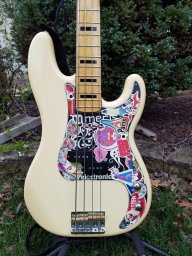
The Dingwall shop has made a custom Super P with a Super J neck. I saw one in the classifieds here a year or two ago. There may be more out there in the wild... Both necks are fantastic. The SP neck is just a bit meatier and rounder than the J. Don't ask me to pick a favorite because I love 'em both. ;)
I have a 4 string super PJ coming in December and they were willing to do the J neck on it.
 
I have insanely small hands, especially for my size, otherwise I would have kept it stock! I actually liked how yours turned out so well I went with the same finish.
Nice! Also with a satin finish?
The SJ neck does feel slimmer compared to the P. It’s definitely a bit easier to shred on that. Hope you like it!
 
Hey,

Quick question for 5 string Combustion owners.
When you adjust the curve of the neck with the truss rod and measure the gap between fret and string at 7th fret while pressing down at the 1st and at the 17th fret (method recommended by Sheldon), is this gap the same at the B and at the G string?

Thanks in advance!

No, B string has higher tension so the gap will be a bit higher than G string.
And the lower strings need more space to vibrate, so no need to worry when you see B string has higher gap then G string.
 
No, B string has higher tension so the gap will be a bit higher than G string.
And the lower strings need more space to vibrate, so no need to worry when you see B string has higher gap then G string.

First part is incorrect, the B string actually has the least amount of tension if you're using a standard .125. The second part is correct however, since the diameter of the string is larger, it will need more clearance to allow it to vibrate freely.
 
No, B string has higher tension so the gap will be a bit higher than G string.
And the lower strings need more space to vibrate, so no need to worry when you see B string has higher gap then G string.

First part is incorrect, the B string actually has the least amount of tension if you're using a standard .125. The second part is correct however, since the diameter of the string is larger, it will need more clearance to allow it to vibrate freely.

Sound like @erdosi3 is talking about relief and where as these posts are talking string height.
My understanding is that relief should be consistent across all the strings other wise the neck is twisted
 
First part is incorrect, the B string actually has the least amount of tension if you're using a standard .125. The second part is correct however, since the diameter of the string is larger, it will need more clearance to allow it to vibrate freely.
But isn’t multi scale bass supposed to have equal tension across the strings? I was sure it’s one of the reasons for using fanned frets?
 
  • Like
Reactions: AB Nate
First part is incorrect, the B string actually has the least amount of tension if you're using a standard .125. The second part is correct however, since the diameter of the string is larger, it will need more clearance to allow it to vibrate freely.
I agree. In my opinion you give more clearance to the thicker strings by adjusting the bridge saddles higher. The curve of the neck mostly affects the fret buzz in the lower region, up to the 12th fret.
The thing is, that as I adjust the truss rod I already have enough gap measured at the B string, it plays nice and there is no buzz, but at the G string the gap is very small, I have massive buzz from fret 1-7. This is what concerns me.
 
This is what I'm afraid of. The gap should be the same whether I measure at the B or G string.

Mine are for sure, hopefully you’re using a capo to hold down the strings and an adequate measuring device?
Youu might be best to take it to a pro for a diagnosis to be Shute. If you bought it new then Dingwall will sort it out if it turns out to be a twist.
 
  • Like
Reactions: Jack Deth
Sound like @erdosi3 is talking about relief and where as these posts are talking string height.
My understanding is that relief should be consistent across all the strings other wise the neck is twisted

You're correct, my apologies. The relief should be the same regardless of string

But isn’t multi scale bass supposed to have equal tension across the strings? I was sure it’s one of the reasons for using fanned frets?

So the tension is certainly "more equal" and in fact, very close but they aren't exactly equal because that would involve a specialized scale length per each string. Sheldon's design has the fan increasing/decreasing .75" per string which creates a nice linear fan across the fretboard. If you really wanted to get the tension equal for a specific set of strings, each string would have a scale length that was independent of the others, where the difference between them isn't necessarily equal. For example, you may end up with scale lengths of 37, 36.3, 35.6, 34.9 and 34 from B-G. You'd end up with a "multiscale" design, but the frets would be a series of straight lines perpendicular to the neck.

I agree. In my opinion you give more clearance to the thicker strings by adjusting the bridge saddles higher. The curve of the neck mostly affects the fret buzz in the lower region, up to the 12th fret.
The thing is, that as I adjust the truss rod I already have enough gap measured at the B string, it plays nice and there is no buzz, but at the G string the gap is very small, I have massive buzz from fret 1-7. This is what concerns me.

That is definitely concerning. Not the most reliable method, but if you look down the length of the neck, is there a visible twist?