• TalkBass has been independent since 1998. Add your voice.
    Create a free account to reply to discussions, view embedded media, and browse with fewer display ads.
    Join freeLog in
    Want zero display ads or expanded classifieds tools? Compare plans.

Dingwall Owners Club

Steel bars, definitely. But I'd be surprised if CF bars weighed a lot more than the equivalent amount of wood.
It's pretty well documented in a number of other building threads that it can be an issue. I suspect when comparing CF to a very dense/heavy wood it would be comparable. For lighter woods it appears to be a weight savings when they're omitted. I'm no expert. I own a Status neck which is a very thin layup and is hollow. Despite being hollow it weights almost the same as a similar Warmoth maple neck that I own. Given that single comparison the wood is considerably lighter by volume than the CF since one is solid, the other is hollow and they both weight the same.
 
It's pretty well documented in a number of other building threads that it can be an issue. I suspect when comparing CF to a very dense/heavy wood ies would be comparable. For lighter woods it appears to be a weight savings when they're omitted. I'm no expert. I own a Status neck which is a very thin layup and is hollow. Despite being hollow it weights almost the same as a similar Warmoth maple neck that I own. Given that single comparison the wood is considerably lighter by volume than the CF since one is solid, the other is hollow and they both weight the same.
Fair enough. I half heartedly tried to google what the density of CF frp would be, but didn't get very far with it and gave up :p.
Carry on. :)
 
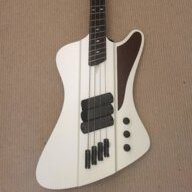
Welp. This fella made it way back to me.

I think I'm going to disassemble it and sand off the clear finish the previous owner did. Possibly refinish it.
IMG_20220131_210104.jpg
 
Last edited:
Interesting video on the topic. I won't say anything else on the matter as I don't want to stir things up.


I am a man of evidence and science… with no real qualifications in this area… and i must say what he showed was quite convincing. It makes me want to swap strings and check pickup to string height on my ng vs ab1 (the ab1 is likely closer due to lower action). But i also would love to see it repeated with lower notes, and looking at elements like sustain. But the result may be the same. In the end it is strings vibrating over magnets.

But all science aside… i will let everyone in on a little dirty secret i have. Please don't tell anyone. All i care about is form, function, and sound.


I like the sound of a bass or i dont. In the end what i prize most is a stable neck, low action if i want it, great balance and great tone. But if it is the worlds greatest bass… yet looks like les claypool’s carl thomspon on an acid trip… or a two by four with the tone of gods… i wont buy… i wont play. Look great… sound bad… pass! Bad quality… pass.

i don't want a wenge neck because of low mids (my multiband eq can do wonders). I want a stable neck that is well made, and that looks cool as hell.

i like rics cause they have a bright aggressive tone that i like… but also cause they just look badass and make me feel good. If they sounded like they do but looked like *insert generic bass here* i would not have four of the same model.

i got a dingwall because i am sold on the benefits of the design for lower notes (which i play). They also had killer tone (bridge and middle in series!!!)… great build quality (that neck!)… and… imho look really sexy. Sure… there are many multiscale bases out there now… but for me they lack the look.

If a bass does not look cool… i wont even pick it up to try it.

for me woods… inlays… paint… is more about a piece of art than tone. It also becomes a bit of self expression.

maybe i put the same strings on my ng2 and ab1 and set pickup height identically. Maybe they sound the same… maybe they dont. For me… it does not matter. Both are very well crafted, well balanced bases with quality parts. Once function and tone are covered… It just comes down to look for me. And i will pay a premium for that.

for my april build i have in no way stressed my wood choices (wenge neck 100%). I want the same/similar electronics as my ng… upgraded hardware will be nice (but i wont hear lighter tuning pegs). If the tone wood is a thing and it sounds a bit different… cool! If it sounds identical… even better cause i love the tone of my ng and ab1.
 
Last edited:
Fodera does that too, same pieces of quartersawn cut in 3, and then the edge are installed in the opposite direction, I think that's a clever method that makes the neck twisted "proof", but Fodera is still not nearly as stable as my Combustion Dingwalls, they often require small adjustments while Dingwall can hold on for months, if not seasons.


I asked them about NGs, but they are combustions as well.
Mainly my question was about an Afterburner order, and since my action is really low, they recommended me graphite reinforcement. But I told them that I prefer without, because it does affect the tone, but also the neck would be much harder to move in case of quick needed adjustments.

graphite reinforcement is an option on afterburners? I may need to add that to my build.
 
  • Like
Reactions: libanass
Aha! Now that answers why I could notice some slight tone shaping due to carbon reinforcement somewhere in there! I was still in doubt even though the email told otherwise (honest mistake)

You did a wonderful job leaving the neck very easy to adjust as well! I've had carbon reinforced necks that were extremely hard to adjust!
It is great that sheldon replied because i could not find my email.
 
Not specific to Dingwall but in other threads I’ve seen comments indicating that CF stiffening bars or rods add weight to the overall structure. If weight savings was your primary concern then leaving out the reinforcement would be preferable. My one and only Dingwall is plenty light and balances just fine, so I’m perfectly happy with whatever Sheldon is doing :smug:
Exactly.

No competent designer is going to build a huge amount of mass into a neck, regardless of whether they're using wood or carbon fibre. We're building a light, resonant music instrument here, not a girder bridge!

My friend Tony builds very fine acoustics. He uses CF reinforcements in baritone guitars, because they sound better with than without. Like Sheldon, he's just trying to stabilize an unusually long neck and control unwanted resonances.

The rectangular bars Tony gets from Luthiers Mercantile aren't very large, maybe 3/8th's by 1/8th inch?

When we put them in the bass I built, I found that they weighed almost exactly the same as a piece of rock maple the same size. Both had a linear grain structure, and sounded like wood when tapped on a hard surface.

Both are very different to a piece of steel of the same dimensions- much lighter, and they don't ring with the unrestrained "ping" you get from steel.

The most discernable differences between maple and CF are that a.) if you flex the CF between your fingers, it feels noticeably stiffer than the maple, and b.) if you tap the carbon, the pitch it gives off is slightly higher.

Tony loves to demonstrate the same thing with Brazilian rosewood and Gaboon ebony bridge blanks. If you drop them on the floor at the same time, Brazilian bounces higher, with a more lively and high-pitched sound. Ebony makes a dull clack. He can't use Brazilian bridges in export instruments any more because of CITES, but they're great in domestic instruments.

However, it's important to understand how different these two applications are:

Compared to an electric bass neck, the top of an acoustic guitar weighs next to nothing. Also, the bridge is at the most critical point in tone production on an acoustic guitar- right where the string vibrations are driving that thin, light spruce or cedar top.

You're also talking about conserving finer, higher-pitched vibrations, of a much smaller amplitude than the ones you get from a bassist whacking on a .130 B string...

The neck of a bass guitar is massive in comparison. The mass of a couple of thin carbon sticks relative to the rest of the neck is inconsequential. Also, the neck is pretty far removed from where the player is striking the strings- it's purpose is more structural, than about tone production.

What matters isn't the mass, so much as that subtle increase in stiffness, along with the slightly higher resonant frequency compared to the wood you removed. The designer isn't attempting to damp out or kill resonance, like wrapping the neck in rubber, or hanging a lead weight off it. You're just smoothing out any unwanted peaks or cancellations.

Once you bond those sticks into the maple neck, you get a single assembly with a broader Q than it had before lamination: peaks in the resonance of the neck at specific frequencies are going to be tamed sightly, resulting in a more even response, and less likelihood of dead spots or wolf tones. It's really no different than laminating contrasting stripes of a stiffer wood into a 5-piece neck.

It's also worth remembering that a Wenge fingerboard is pretty massive compared to two little bars buried in the middle of the neck. Once again, the CF bars are about fine-tuning. We're talking about VERY sublte differences, with or without.
 
Last edited:
I am a man of evidence and science… with no real qualifications in this area… and i must say what he showed was quite convincing. It makes me want to swap strings and check pickup to string height on my ng vs ab1 (the ab1 is likely closer due to lower action). But i also would love to see it repeated with lower notes, and looking at elements like sustain. But the result may be the same. In the end it is strings vibrating over magnets.

But all science aside… i will let everyone in on a little dirty secret i have. Please don't tell anyone. All i care about is form, function, and sound.


I like the sound of a bass or i dont. In the end what i prize most is a stable neck, low action if i want it, great balance and great tone. But if it is the worlds greatest bass… yet looks like les claypool’s carl thomspon on an acid trip… or a two by four with the tone of gods… i wont buy… i wont play. Look great… sound bad… pass! Bad quality… pass.

i don't want a wenge neck because of low mids (my multiband eq can do wonders). I want a stable neck that is well made, and that looks cool as hell.

i like rics cause they have a bright aggressive tone that i like… but also cause they just look badass and make me feel good. If they sounded like they do but looked like *insert generic bass here* i would not have four of the same model.

i got a dingwall because i am sold on the benefits of the design for lower notes (which i play). They also had killer tone (bridge and middle in series!!!)… great build quality (that neck!)… and… imho look really sexy. Sure… there are many multiscale bases out there now… but for me they lack the look.

If a bass does not look cool… i wont even pick it up to try it.

for me woods… inlays… paint… is more about a piece of art than tone. It also becomes a bit of self expression.

maybe i put the same strings on my ng2 and ab1 and set pickup height identically. Maybe they sound the same… maybe they dont. For me… it does not matter. Both are very well crafted, well balanced bases with quality parts. Once function and tone are covered… It just comes down to look for me. And i will pay a premium for that.

for my april build i have in no way stressed my wood choices (wenge neck 100%). I want the same/similar electronics as my ng… upgraded hardware will be nice (but i wont hear lighter tuning pegs). If the tone wood is a thing and it sounds a bit different… cool! If it sounds identical… even better cause i love the tone of my ng and ab1.

I am really enjoying this intellectual masturbation. Lets think in first principles.

i had an early waking thought about this idea of strings, pickups, pickup height is most of what makes a tone.

it goes to what was said earlier… it is about frequencies.

the test is looking at a bridge pickup in a high frequency instrument. I cant recall higher frequencies being much influenced to my ear beyond pickups, their location, and strings. The biggest differences i perceive are in the mids… low mids. Lows i fond hard to differentiate again.

When i play my ab1 i feel it resonate. The bass feels alive… it is literally oscillating. A big b string has a lot of power and energy that it is dissipating into the body. A guitar? Far weaker forces involved. So woods would matter less.

waves can be synched in ways that are constructive (1+1 =2) or destructive (1+1 = 0). My understanding (and i am probably wrong… i am an armchair non-expert) is that the latter is what can result in dead spots on a neck. My mexican j bass (that feels like a solid block of unmovable wood) has one that it notable dead spot. My dingwall ab1 sings everywhere and has far far superior sustain.

so physics dictates that different woods vibrating in different ways due to density, modulus of elasticity, thickness, will all cause the some level of constructive or destructive vibration.

But then again… it is all about what the pickup “sees”.

The physics of this comes down to… how does the oscillation of a bass effect what a pickup “sees”. That will be the answer.

But in the big picture of all things influencing sound… even if tone woods in an electric bass are a thing… it is just one component of many.
 
Last edited: