• TalkBass has been independent since 1998. Add your voice.
    Create a free account to reply to discussions, view embedded media, and browse with fewer display ads.
    Join freeLog in
    Want zero display ads or expanded classifieds tools? Compare plans.

Dingwall Owners Club

Well folks, it comes down to this - I'm going to have to turn in my number. I'm letting go of my Super J. Even though it's a well built, lightweight, beautiful instrument, it just doesn't quite have the tone that I'm going for. Sheldon has been exceedingly cool dealing with me over the last year, and I'm saddened to be leaving this tiny little family of Dingwall owners.

I'm reversing all the mods I made on my instrument, and putting it back to spec (I won't be able to remove the battle scars it has from hundreds of gigs, but oh well - it's on it's way to being a reliced SJ4, and I'm sure somebody will be able to appreciate that.). Once I get it all back together, I'll be popping it up on eBay (unless somebody has a fretless Bongo they'd like to trade... :ninja: ), so hopefully somebody will continute to enjoy this wonderful bass.

Perhaps I'll get another Dingwall in the future - one that's more suited to my particular needs. As it is, I have gained a lot from owning a Dingwall - I'm hooked on the fanned scale concept. So much so, that I now fan out my bridges much as possible on my fretless instruments (33.5"-35" on my Ovation - yow!). Maybe if Sheldon makes a Super P someday...

Post some pics when you get it sorted out, I'd be interestred, I'm in the market for a J-Bass.

 
Post some pics when you get it sorted out, I'd be interestred, I'm in the market for a J-Bass.

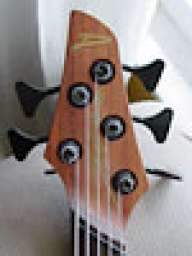
The only thing I really have to sort out is get a new preamp for it. Once that's installed, it's pretty much done. I installed a rolling string tee on the headstock for the D and G strings - this is an older model which had a tendency to allow the G to pop out of the nut pretty often, and didn't have enough downward angle against the nut for the top two strings. I understand that's been fixed on newer instruments. It's also got a Mach II pickup in the bridge position.

Here's what it looks like:

Link Removed

It's got a few scratches, but nothing that will really show up on camera. Make no mistake - this has been gigged, and certainly isn't mint condition. That said, Sheldon was right: his finishes are designed to withstand Canadian winters! It's also got a tiny little bit of fretwear, and a small part of the D on the headstock has flaked off.
 
Hey guys

I got really interested in Dingwalls the last couple of days...I got a question about right hand position:

I get the concept of the fanned frets which gives the same tone and tension to each string. BUT if you anchor your thumb on one of the pickups and play, then you will play the B string further from the bridge then you would play the E string, and you would play the G string pretty close to the bridge. Because right hand position can make so much difference in tone, it got me wondering if this in fact makes the concept moot? The tone would still go from phat low string to twangy high string (I think).

I hope you guys get what I'm trying to ask and I hope it's not too much of a ramble. Thanks
 
Hi Willem

Keeping a "fanned" approach regarding the distance from the bridge comes naturally from the ergonomics of the Dingwall bass (maybe 10min time to adjust???) . I am one of many self taught bass players here and technique-wise I consider myself NOT a Jaco-Wooten-Patitucci guy. Still, after watching videos of gigs and concerts I've done, I realized that I was keeping the relative distance from the bridge "constant" (unless I wanted to change it). My gigs vary from Progressive to Ethnic, from Dub to Heavy, from Pop to Funk and Disco. So it's not an issue of style (from my side) but an issue of ergonomics (Dingwall basses)

My .02
 
I get the concept of the fanned frets which gives the same tone and tension to each string. BUT if you anchor your thumb on one of the pickups and play, then you will play the B string further from the bridge then you would play the E string, and you would play the G string pretty close to the bridge. Because right hand position can make so much difference in tone, it got me wondering if this in fact makes the concept moot?


I had problems with that on my Dingwalls. I ultimately could not overcome this issue :( and sold my last one a short time ago. It was NOT a question of string TONE (with me) but more of note volume..... strike a string nearly on top of the saddle and it won't ring out. I chalk it up to my LACK of ability to change my technique (instrument-to-instrument--- I have a collection :rollno:), not a flaw in the instrument design. If you don't anchor your thumb on the bridge pup (primarily), you probly won't have a problem with this. God, I miss that PERFECT B string!!! :bawl:
 
I use the top neck corner of the bridge pickup as my pivotal point and then I "ark" my touch point. It gives me the 'perfect" distance for that "Jaco" next-to-the-bridge tone with even volume (I highly dislike ( =hate) compressors and all other effects on bass). Oh, I forgot to mention that I have few more basses that I use too YMMV ;)

PS I CANNOT do any Jaco lick or tune. It's just that this approach can be useful when needed
 
I usually anchor my thumb on the neck pickup, so getting a little closer to the bridge on the D and G actually sounds good to me. If I shift my thumb to the bridge pickup to get some Jacoesque honk, then yes I need to bend my wrist so as not to pluck the D and G too close to the bridge.

And yes, when I do that, it does feel unnatural to me. Perhaps if I used that position more frequently, it might, but to me bending my wrist like that not only feels unnatural, but feels like it is straining my wrist more than usual.
 
I play it relatively straight across and haven't noticed any problem. I don't anchor on the pickup though. I use more of a semi-floating thumb technique (just on the B and E string and sometimes the A). In general, if I were to anchor my thumb on a pickup where I normally pluck the strings, it would be around the neck pickup so I don't pluck to close to the bridge on the higher strings.

EDIT: I just played a bit and I do naturally tend to move a little diagonally across the strings. Not as drastic as the bride fan angle, but still some.
 
Dear dingwall owners,
Ive considering to buy a Dingwall.I borrowed myfriend's AB onced,and the low tones are greatand the fanned fets are making my playing better.
But Im curious as to the reliability of he neck over a long period of time,say 10 years.Will the neck take the extra tension from heavy gauge strings,37" long.?
Wont they wrap?Any one had a bad experience?
Or is this a truly reliable design.
Any experience wouldbe truly appreciated.
Thank you very much
Robert
 
As far as pickups, Benjamin's referring to the Super J's only. I know that the pickups in the Afterburner 5 string are the same dimensions as Bartolini's P2 shape and most of the Nordstrand 5 string pickups (obviously none of the MM replacements).

I've got a set of Nordstrand Fat Stacks in my Afterburner 5.

The pickup routes are pretty shallow, though. I going to make mine about 1/4" deeper so I can dial in the pickup height just right. As it is, it's fine on the low strings, but a little too close on the high strings for my taste.

Also, there's quite a few string options. Check the forums at Dingwall's website, plenty of string info there.
 
Suresh the fanning of the frets evens the tension on the neck, so it's actually better than parallel fretted basses.;)

I read of a guy leaving his gig bagged DW at the back of a club in a blizzard. He returned the next day and the neck was perfect.
 
....been meaning to get some pics up........my Afterburner with Nordstrand Fat Stacks. Audere 3ZB preamp.

Knobs are (top to bottom) volume, balance, passive tone, active mid, stacked active bass/treble.

Switches are single coil/humbucker neck, single coil/humbucker bridge, series/parallel, mid frequency select (250/500/860Hz), Z-Mode (low/mid/high).

I put the Audere's status indicator LED on the control cavity cover rather than put another hole on the face on the instrument.

So anyway, here it is..... (flanked by a Modulus Quantum 6 TBX (neck through) fretless and a Modulus Genesis 5).
 

Attachments

  • Dingwall-1.JPG
    Dingwall-1.JPG
    53.5 KB · Views: 112
  • Dingwall-2.JPG
    Dingwall-2.JPG
    51.4 KB · Views: 73
:0 Bruce is that Carey's standard 19mm spacing? If so it appears to line up perfectly w/the DW's 18mm spacing.

Since the Afterburner's bridge spacing is a tad narrower than 19mm, the stock spacing on the Fat Stacks worked out perfectly. Well, I assume these have stock spacing, but they were custom ordered to have the pole "twist" reversed for fanned fret application, so it is possible that the spacing was changed as well. I didn't order them - bought 'em from DavidRavenMoon after a fanned fret project of his got postponed.

The basic difference - Fat Stacks are less sizzly on the high end than the stock FD3's. I like darker sounding pickups because, for whatever reason, my playing technique seems to really bring out the treble response of a bass. Some players just seem to have "bassy" hands, some have "trebly" hands, and I'm definitely in the latter group.

The FD3's are good, but for me, they're just not the ticket. I'd turn down the treble to tame them a bit, but then I'd lose the presence I like. I like my bass to sound like it's right there, I like it to have immediacy, and with the treble backed off on the FD3's it started getting a bit of a "playing through a blanket" feel to the sound, a little distant. Hard to describe. I tried an Aguilar OBP-3 and the Audere with the FD3's -and of course, the stock passive system - before deciding to try some different pickups.

The Fat Stacks, as I said, are more muted on the high end but still have great note definition and character. Clear, clear, clear, all the way up and all the way down to low B. Response seems pretty even, but I can't really judge yet 'cause I need to deepen the routes in the Dingwall a little - the stock routes are rather shallow compared to most basses. An extra 1/4" of depth will give plenty of height adjustment. Right now the pickups are bottomed out and it's fine on the bass side, but the treble side needs to come down a bit (my preference due to my trebly hands).

Loads of flexibility here with the coil switching. Single coil mode gets nice and raw and right up in your face, humbucker mellows things out a bit but remains very present. And things get really interesting when you mix things up - single coil neck with humbucker bridge, series, parallel...... and the Audere pre has a buffered blend, so blending pickups is completely smooth. 70% neck/30% bridge? 40/60? No problem - it's all there.
 
Just thought I'd mention - I considered a lot of other possibilities for a pickup swap. Since the Dingwall's spacing is 18mm, a lot of standard jazz style pickups made for 19mm will work fine once you factor in the "tilt" - I was thinking about getting a set of Sadowsky humcancelling or a set of Seymour Duncan SJ-5-70/74's and having some custom wood covers made so they'd fill out the pickup routes. But then these Fat Stacks came up for sale at a great price..........

Might still do that some day - not right now, though. We're remodelling our house, so $$$ for gear are non-existant.

Basically, it came down to the fact that the Afterburner 5 is a great playing bass, totally comfortable, very lightweight, yet totally solid. A great design. But the sound, for me, wasn't quite as perfect as everything else. So rather than sell it and move on, I decided to try to dial in the sound.