• TalkBass has been independent since 1998. Add your voice.
    Create a free account to reply to discussions, view embedded media, and browse with fewer display ads.
    Join freeLog in
    Want zero display ads or expanded classifieds tools? Compare plans.

Dingwall Owners Club

I still use my Yamaha TRB5 at home. Silent practice is required as my wife is up at 4:30 for work. Set up is through Line6 X3 board, computer plugged into it and headphones on, always ready for me to play. It's only been out of the house once since I bought my Combustion almost 4 years ago.

The Combustion sits ever so patiently in its case by the front door just waiting to go out and play.

I've pretty much decided an ABZ is my next purchase. It will happen as soon as I can get into a money making gigging band and not the jam session ones I playing with now.
 
And this is why I've sold almost everything.

It's pretty bad when I see a really nice bass, then blow it off because it DOESN'T have fanned frets.

Yes, I don't have any interest these days in any parallel fret instruments. But then, its been that way for a few years.

Trust me, you'll play them for a while, and then you'll just realize how much better fanned frets are... Plus the Dingwall craftsmanship, tone, how they're all lightweight...

One of us, one of us!

While the fanned frets get all the glory, the workmanship and design work on Dingwall basses SHOULD be sharing the spotlight, along with those great pickups.

*Also, my AB1 is noticeably LIGHTER than my Voodoo/Zebra. :) No back strain there.

-If people haven't guessed, it looks like my original 2005 Afterburner 1 will be heading to CL400Peavey.
 
What are the differences between the AB 1, 1.5, and 2?

There have been a few iterations of each. The original AB1's had maple bodies and have had a number of different pickups over the years, including FD-1 and FD-3's of a couple varieties. They've also had either 3 or 5pc maple necks. These days they're passive alder bodied, and some have a fancier top woods. Usually the fretboards are wenge, but some have been maple.

The AB1.5 was mainly an exclusive for Jong at JiveSound and is an AB-1 with a preamp.

The AB2's are also a moving target. Once solid bodied Walnut (sometimes mahogany), with Pomelle bubinga tops, active electronics. Later they became semi-hollow bodied mahogany. And may have some additional features like contrasting top layers.
 
So now the big difference is the preamp and the semi hollow? Can you get a AB 2 without semi hollow? I was pretty fixed on a super p/j but I don't know anymore.

You'd have to talk to Sheldon about that. The Preamps have also changed over the years, so something else to discuss. I'd classify the wood a big difference too walnut or mahogany vs. alder or maple. Bubinga (or some of the other exotic tops he's used recently) vs. flame maple top.

Remember also, there are also used AB's both I and II floating around in the world, so if he can't set you up with a solid bodied one, maybe you can find a nice one used.

I think there's a fairly major distinction between the 'long scale' Dingwalls and the 'short scale' Dingwalls, so that should be leading you anyway.
 
Wow, you didn't play it much! Or took really good care of it, it's still almost new condition, almost no signs of having been played. I was thinking there was very little fret wear, even considering the way Dingwall frets look chewed up after moderate playing!

I love it, lightest DW I've had yet! I told my wife it was like putting on a pair of silk panties after wearing my heavier Z2....of course she asked how I knew what those felt like....I said "in theory of course"....:hiding:

yes -a perfect bass
as far as the silk panties go...that's a winner-lmao
 
So now the big difference is the preamp and the semi hollow? Can you get a AB 2 without semi hollow? I was pretty fixed on a super p/j but I don't know anymore.

There's a new model that's a solid body AB-II. Designed to be heavier than other models, but to really make the lows shine. It's called Invalid Link Removed

file.jpg


My AB-II is a fretless hollowbody and the hollow body gives it a really mellow, acoustic sound. It's great. And so, so light.

As for the preamp, Dingwalls mostly use very transparent-sounding preamps. They give you EQ flexibility without coloring the sound in any way. You can barely notice the difference between passive mode and the active EQ with no boosts/cuts. To me and to many others, this kind of preamp is useful but not necessary in any way.

I leave my AB-II in passive very frequently, for no reason other then to marvel at the sound that those pickups have. My Combustion, on the other hand, has a John East EBMM preamp and it most definitely colors the sound. For the better, in my mind, and that's why it's there. This preamp is always on and plays a big part in making it sound the way it does.
 
There's a new model that's a solid body AB-II. Designed to be heavier than other models, but to really make the lows shine. It's called Invalid Link Removed

file.jpg


My AB-II is a fretless hollowbody and the hollow body gives it a really mellow, acoustic sound. It's great. And so, so light.

As for the preamp, Dingwalls mostly use very transparent-sounding preamps. They give you EQ flexibility without coloring the sound in any way. You can barely notice the difference between passive mode and the active EQ with no boosts/cuts. To me and to many others, this kind of preamp is useful but not necessary in any way.

I leave my AB-II in passive very frequently, for no reason other then to marvel at the sound that those pickups have. My Combustion, on the other hand, has a John East EBMM preamp and it most definitely colors the sound. For the better, in my mind, and that's why it's there. This preamp is always on and plays a big part in making it sound the way it does.

Wow that AB 2 looks incredible. 3 pickups?! Considering the tons of variations and the lack a nearby dealer makes it tough. I know the super p is closer in scale length to 34" I'm used to to. I haven't played one of his longer scales though, so I can't fairly say if it's too long for me. So you prefer the ab2 passive but the combustion with a preamp. Why don't you like both ways in both basses, I guess. Why not the East preamp in AB 2?
 
Wow that AB 2 looks incredible. 3 pickups?! Considering the tons of variations and the lack a nearby dealer makes it tough. I know the super p is closer in scale length to 34" I'm used to to. I haven't played one of his longer scales though, so I can't fairly say if it's too long for me.

Very few people have had problems with long scale Dingwall playability. Most of the added scale length is at the bridge so your left hand doesn't even notice it. In fact, a long scale Dingwall is just as long as your average Fender. The way Dingwalls balance and are strapped keeps the nut at the same location where you'd expect it on a 34". Well, with less neck dive. It's so easy to adapt that there's no adapt period to talk about, unless you're chording and tapping way up the neck.

In my experience, you don't even notice the extra scale length on a fretted long scale Dingwall. On a fretless you do, as your fingers need to match the fret spread perfectly; frets are forgiving that way. Your mileage may vary. But most of us here bought a long scale Dingwall sight unseen, without ever having played one before, and never looked back.

So you prefer the ab2 passive but the combustion with a preamp. Why don't you like both ways in both basses, I guess. Why not the East preamp in AB 2?

My philosophy on on board preamps - if I have one - is that they are only as useful as the sound they bring in. I have plenty of EQ knobs on my pedalboard and amp, and prefer to EQ after the effect chain. The preamp needs to color the bass in a particular way to make it count, in my mind. A transparent one is nice to have, but I wouldn't pay money for it if given a choice. I bought my AB-II used.

I bought a Combustion for the purpose of heavily modding it into something as close to a MusicMan as possible, but with all the features and goodies that Dingwall craftsmanship and ergonomics provide (or selling my internal organs to fund a Z2). That thread is here. Moving the pickups around, getting series-wired Neodymium FD-3s instead of Alnico, and the EBMM preamp made that happen.

That EBMM sound is not the one I have in mind or would want in my AB-II. It's perfect as-is.
 
There's a new model that's a solid body AB-II. Designed to be heavier than other models, but to really make the lows shine. It's called Invalid Link Removed

file.jpg

I had the pleasure of playing the HS prototype at NAMM; it was a LOT heavier than a 'regular' Dingwall (though Barry said the final version would be ~1lb lighter) but it sounded BEASTLY and the triple pickup configuration (P Tone/FD3/FD3) gave it a staggering amount of tonal options.

Definitely my favorite of the show next to the Super P/FD3 :bassist:
 

Attachments

  • SP4PJ-Ash-Transparent-White-Birdseye-maple-e.jpg
    SP4PJ-Ash-Transparent-White-Birdseye-maple-e.jpg
    19.3 KB · Views: 80
I had the pleasure of playing the HS prototype at NAMM; it was a LOT heavier than a 'regular' Dingwall (though Barry said the final version would be ~1lb lighter) but it sounded BEASTLY and the triple pickup configuration (P Tone/FD3/FD3) gave it a staggering amount of tonal options.


Definitely my favorite of the show next to the Super P/FD3 :bassist:


I'm torn between those two myself. How does pickup switching work on the 3 pickup hs? Can it really do a p sound?
The super p/j would probably get less weird looks.
 
I'm torn between those two myself. How does pickup switching work on the 3 pickup hs? Can it really do a p sound?
The super p/j would probably get less weird looks.

As far as I'm aware the P Tone is the same pickup as the standard Dingwall split coil, just in a soap bar housing; it absolutely sounds like a P pickup, albeit with more punch and clarity than what you'd traditionally associate with a 'vintage' P bass.

From what I recall the 4-way switch was solo P Tone/P Tone and bridge FD3 in parallel/middle and bridge FD3's in series/bridge FD3 in series.

I'm sure Sheldon will probably chime in shortly if I'm mistaken though ;)
 
As far as I'm aware the P Tone is the same pickup as the standard Dingwall split coil, just in a soap bar housing; it absolutely sounds like a P pickup, albeit with more punch and clarity than what you'd traditionally associate with a 'vintage' P bass.

Sheldon has stated that the only reason he offers it in the familiar split-P form is because players want that traditional look. :cool:

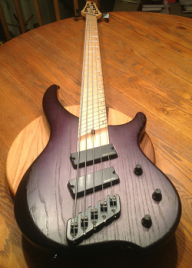
This is extremely gorgeous!

file.jpg