
Man, I am just totally digging this AB1 with the Tone Capsule in it! It really rocks the socks!

TalkBass has been independent since 1998. Add your voice.
Create a free account to reply to discussions, view embedded media, and browse with fewer display ads.
Join free Log in
Want zero display ads or expanded classifieds tools? Compare plans.

Makes me really glad I ordered the ABZ with the tone capsule!Man, I am just totally digging this AB1 with the Tone Capsule in it! It really rocks the socks!
Makes me really glad I ordered the ABZ with the tone capsule!
More like all Smiley faced. Kinda like an affirmation "Yeah, you done good!" After seeing your tastes in Bass, I'm fairly certain if you like it I will too!Does it make you all giddy inside?
More like all Smiley faced. Kinda like an affirmation "Yeah, you done good!" After seeing your tastes in Bass, I'm fairly certain if you like it I will too!

Makes me really glad I ordered the ABZ with the tone capsule!
I can't wait to get my NG2 4 string with the tone capsule. This will be my first Darkglass loaded bass.
I anticipate you having one big smile after the first 5 minutes with this bass. We have a NG2 in stock and IMO Sheldon made one of his best marketing decisions to include the Darkglass Pre.I can't wait to get my NG2 4 string with the tone capsule. This will be my first Darkglass loaded bass.

I'm kind of a dumbass.
For whatever reason, I thought Pi (blue Afterburner 1) had the factory battery compartment since it's active. Just realized that it doesn't. Oh well, I can still do the proof of concept work on Pi, and then when my 6 string comes in (hopefully December) I can work on the revisions.
Unless I buy something else in the meantime >.>
I have found that regardless of how much experimentation that I do, in the end, Sheldon seems to have identified the sweet spots in the tone in the options he provides. I have come to the point where I trust in that implicitly.

What then is your favorite set-up for combining them? Do like them in series with each other or in parallel?changing the neck pickup from parallel to series is the best move I've made with my Combustion. Loving it with neck series and bridge parallel.
Neck solo, which is higher output and more P-like than it was wired parallel, yet still gives a nice cutting tone. And neck-bridge in series, which is fatter with more top and bottom, but still a nice grind in the mids. I don't use the other two options... if the bridge was re-wired series my hunch is I would get more useable (for me) tones out of it, but I don't want to lose the current neck-bridge series tone.What then is your favorite set-up for combining them? Do like them in series with each other or in parallel?
I have a P-tone pickup that I STILL have not installed in my ABZ. I have found that I actually love the internally parallel pups in parallel with each other a lot. Its kind of like a Jazz on steroids, with kind of a burpy low-mid growl with great definition, and sweet highs. Ghost notes jump off of the bass, and it has this great attack on the notes. Of course, I combine this with a Monique which tends to be a bit darker and tubey, and my Genzler BA stack or my Baer ML115, none of which have a tweeters.
I used to be a more P-Bass oriented guy, but I swear this ABZ has totally made me appreciate that Jazzier tone and attack.
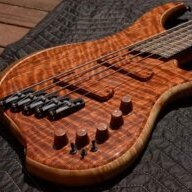
It absolutely isn't solving any problem - there isn't any with the current system. I'm just going for something more renewable (less wasteful, at least how many 9v batteries a single person uses, which is unmeasurably tiny), and with an built in idiot light. For me, it'll be a better system all around. For the overwhelming majority of players, it's more complication where none is needed, to solve nothing. If I can get away from buying 9v batteries for my instruments again, cool! I can't imagine more than a few other people really caring at allIt seems like a whole lot of work for limited improvement from a standard Dingwall 18v setup? Beyond the life of the batteries, what's the benefit? Because I change the 2x9v twice a year on my main playing bass and carry spares in my gig bag and haven't ever needed them. I would move over to decent rechargeable 9v's but haven't really had the need or motivation.

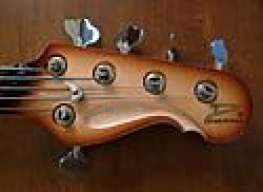
What then is your favorite set-up for combining them? Do like them in series with each other or in parallel?
I have a P-tone pickup that I STILL have not installed in my ABZ. I have found that I actually love the internally parallel pups in parallel with each other a lot. Its kind of like a Jazz on steroids, with kind of a burpy low-mid growl with great definition, and sweet highs. Ghost notes jump off of the bass, and it has this great attack on the notes. Of course, I combine this with a Monique which tends to be a bit darker and tubey, and my Genzler BA stack or my Baer ML115, none of which have a tweeters.
I used to be a more P-Bass oriented guy, but I swear this ABZ has totally made me appreciate that Jazzier tone and attack.

I guess what I have discovered is that, no doubt, the series settings provide a stronger and bigger signal, with of course some differing emphasis of the frequencies, but that I can also boost the volume while in parallel to get back to bigger and fatter, but with a different frequency response that is still useful. The volume of my ABZ (the overall amplitude of the output signal) no doubt drops when I am in parallel, but if I boost the volume up to compensate I can get back to really big and fat, but the lows remain more tight and defined, and never get boomy, and the highs tend to sound to my ear, more musical and sweet rather than snarly and nasally, which always sent me off trying to EQ that out to some extent.Neck solo, which is higher output and more P-like than it was wired parallel, yet still gives a nice cutting tone. And neck-bridge in series, which is fatter with more top and bottom, but still a nice grind in the mids. I don't use the other two options... if the bridge was re-wired series my hunch is I would get more useable (for me) tones out of it, but I don't want to lose the current neck-bridge series tone.
All in all the bass is a lot bigger and fatter than it previously was, but still there is plenty of cut and grind available.
I hear ya!! I use to run my Dingwalls in series almost exclusively as well, but I was always trying different strings because I was always trying to tamp the upper mids back down. With my ABZ, I was experiencing the same thing, and one day, I put it in parallel and wasn't thrilled being there. I left it and forgot. When I came back to it, I turned up the volume and as I noodled around, I started returning the on-board Glock to flat. I have not gone back to series but once, and as soon as I did, I remembered why I left it in parallel, and I haven't been back to series since.I used to almost always run my SJ5 pickups in series with each other, but have been going parallel lately. Beautiful tones!

I hear ya!! I use to run my Dingwalls in series almost exclusively as well, but I was always trying different strings because I was always trying to tamp the upper mids back down. With my ABZ, I was experiencing the same thing, and one day, I put it in parallel and wasn't thrilled being there. I left it and forgot. When I came back to it, I turned up the volume and as I noodled around, I started returning the on-board Glock to flat. I have not gone back to series but once, and as soon as I did, I remembered why I left it in parallel, and I haven't been back to series since.
I guess what I have discovered is that, no doubt, the series settings provide a stronger and bigger signal, with of course some differing emphasis of the frequencies, but that I can also boost the volume while in parallel to get back to bigger and fatter, but with a different frequency response that is still useful. The volume of my ABZ (the overall amplitude of the output signal) no doubt drops when I am in parallel, but if I boost the volume up to compensate I can get back to really big and fat, but the lows remain more tight and defined, and never get boomy, and the highs tend to sound to my ear, more musical and sweet rather than snarly and nasally, which always sent me off trying to EQ that out to some extent.
BTW, I do realize that the P-tone (or just internally series) setting would help improve the tone of the neck pickup solo. I am going to try it for that reason. But I am a bit concerned what it will do to the my favorite parallel setting. If the P-tone makes the neck solo tone more P like, and also improves or at least doesn't adversely affect my parallel tone, I would be very happy about that!