• TalkBass has been independent since 1998. Add your voice.
    Create a free account to reply to discussions, view embedded media, and browse with fewer display ads.
    Join freeLog in
    Want zero display ads or expanded classifieds tools? Compare plans.

Dingwall Owners Club

This post contains mild rambling that isn't overly important to anyone. Feel free to skip this or add your own two cents!

Maple would be nice since all of my basses (and single guitar) have rosewood necks. If I went maple, I'd definitely want something like this:
Invalid Link Removed

I've always wanted wenge fingerboards though.

Something like this ? ;)

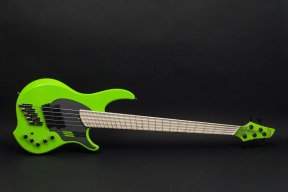
fullrange_z3_full_shot_312.jpg
 
Yeah, that one is color. I really like two inlays on that bass. It's classy.

In this video is that a custom top for an ABI? It says, "Maple Burl Burst". I thought they were only flamed and quilted maple...


Traditionally, the AB I only came with flame maple top or a plain alder body with no top. Somewhere along the line, Sheldon agreed to do a few 'limited' AB-1's with quilt for Ed Roman, and then he did a few variants for Jong at Jivesound that had a few extra features and different tops. So yes, there are a few out there, but as to getting one, there's only one guy who can give you that answer. ;)
 
I never understood how the bass with the offset/diagonal frets really work. I mean does it make it easier to play?.. I've never played a bass like such but been very interest on how they feel.
The idea is twofold. One, it's supposed to help get each string closer to the length associated with the fundamental note (e.g. lower notes should be on longer strings), which is a compensation for the inherent imperfections of the "twelve tone equal temperament" system. The second is, it's suppose to follow the natural tendency of your hand to rotate as you move in/out from your body.

Mainly tho, I think it's the compensating thing, the net result of which should be purer notes... more of the fundamental and fewer of the overtones. I think it works. The actual name of the system is the "Novax fanned fret system".
 
I never understood how the bass with the offset/diagonal frets really work. I mean does it make it easier to play?.. I've never played a bass like such but been very interest on how they feel.

There's no difference in playability (harder or easier). What you do get is even string tension across the neck, and even tone across the neck. No longer do you have to hit the strings differently on the low strings as compared to the high strings. And the timbre is even, so the low strings talk cleanly and clearly. So you can play fast and tightly on the B string just like the G string.

Egonomically, I find the fanning to be comfortable...my hand moves that way anyway.

Of course that's the most noticeable part of Dingwall basses, but keep in mind that the woodwork, finishing and attention to detail is second to none and every small feature has been scrutinized and improved upon. Also Dingwall electronics for the most part are done in-shop and are NOT your average electronics or pickups.
 
I'll add 2 cents on the reasoning behind our using the Novax Fanned-fret system among other tweaks we do. The fanned-frets help the strings to have not only more equal tension as Burningskies mentions but also more equal timbre in a couple of ways.

Typically the timbre of each string is different. This makes it hard to mix the bass so that each string is equally audible. The fanned-frets help minimize this difference by allowing longer scale lengths for the lower strings.

Secondly the timbre of each string also changes the higher up the neck you play. If you notice, the timbre changes more on the B and E-strings than the G. The B-string will usually have an out of tune warbling sound in the upper frets.

Again, having longer scale lengths on the lower strings makes the change in timbre on each string more equal as you go up the neck.

So the end result is more even timbre across the strings and up the neck meaning all the notes on your fingerboard are more equally voiced and therefore easier to mix.
 
For pricing and options please contact our sales manager Barry Lamb. His email sales@... ... .com can be found on our website.

We can be flexible on some of the options if we feel they will not upset the apple cart too much. Unfortunately blocks aren't one of them. There are only so many production hours in a week so we have to limit the available options on lower price point models or we'd be falling behind. We do enough of that already.
 
I like the blocks on my Super J, very classy!

Truth be told I really like the totally unmarked fretboards on my AB-1. Just the side markers and nothing on the front.

The whale pool blue is deep and rich, like tropical water. One guitar player said it looked like a Ferrari Formula One car.
 

Attachments

  • Dingwall Super J 5.jpg
    Dingwall Super J 5.jpg
    25.5 KB · Views: 54
  • Dingwall Whale Pool Blue Six String.jpg
    Dingwall Whale Pool Blue Six String.jpg
    32.5 KB · Views: 64
I like the blocks on my Super J, very classy!

Truth be told I really like the totally unmarked fretboards on my AB-1. Just the side markers and nothing on the front.

The whale pool blue is deep and rich, like tropical water. One guitar player said it looked like a Ferrari Formula One car.

I like the plain AB neck as well. My problem was that I was playing with a bunch of players who counted me to anchor them on stage (keep in mind, in reggae, many classic riddims can be played in whatever key the singer calls). I found on multiple occasions that guitar players and keyboardists got 'lost' for two reasons, the first being that with no neck markings they couldn't gauge where I was on the neck, and second, because I play a 5, and most of them are still used to 4's the extra string would throw them off when trying figure out what key I was in.

When it came to ordering my Z, I ordered it with no neck markers. Half way into the order process, I realized that having at least markers at 5 and 12 would give other people on the bandstand half a chance. Sheldon was the one who proposed the blocks, so that there was more visual impact, and it was the right choice.
 
I tune down a half step, so, if they are looking at me for what to do, we're in big trouble! I tell them to take a look at my Korg rack tuner, you can see that thing from 20'. Big letters!

I've gotten used to the whole down tuning thing, and I really like the looser feel.

One bad habit is I tend to read it and play it as written, rather than shifting up a half, but I'm getting that figured out too. Luckily I don't have to read much.
 
I see ABI's with three knobs, three knobs and a switch, and four knobs. Are they all from different runs?

If I had one with three switches and a knob, the controls would be:
Volume
Passive Tone Control
BluEQube
4-Way Pickup Selection

Right?

I'm sure there has been discussion on it before, but what exactly does the BluEQube do?

I am almost done planning out my ABI.

EDIT: Also, out of curiosity, have many Dingwalls been made with two different neck woods? Like wenge/bubinga? I think I saw one or two, but don't remember fully.