
Enjoy the benefits of a premium membership!
Upgrade Account
-
TalkBass has been independent since 1998. Add your voice.
Create a free account to reply to discussions, view embedded media, and browse with fewer display ads.
Join free Log in
Want zero display ads or expanded classifieds tools? Compare plans.
You are using an out of date browser. It may not display this or other websites correctly.
You should upgrade or use an alternative browser.
You should upgrade or use an alternative browser.
Disadvantages to headless basses?
- Thread starter foothilla
- Start date
More options
Who Replied?


After wracking my brain, I thought of (2) disadvantages: You cant hit a false harmonic And then “bend” the note up by the string tree like you can on a Fender, there is no extra string exposed. Steinberger had a bass trans-trem whammy bar system, but rare as hens teeth, and difficult and expensive to get parts for it now. You could drop the whole tuning. They had a Drop-D only version too, still available for outrageously high prices if you can find one.
Status Graphite has a 'Bendwell' that simulates a string tree beyond the nut and allows for tremolo effects. This feature is only available for their medium scale (32") basses and features a nicely crafted roller nut system.

When discussing Steinbergers, you should know the neck is mostly wood - the graphite is a thin u shaped cross section that stiffens things. If it were all graphite composite, the thing would neck dive, as it'd be about 3x heavier than a wood neck.
Dude, where are you pulling this from? I've had the fingerboard off mine. L-series Steinbergers are ALL Kevlar/resin. Not a damn bit of wood on them.

Oh, my Marusczcyk is a fretless. Love it. And, double ball end flats are pretty easy to find....don't know about tapewounds (with I also love and use on the fretless). Bass on!
I am going to start searching online for 32" scale, medium-heavy gauge, double ballend tapewounds, with a high C. That would give me an option. But I fear they might be a tough find.
Sounds like my regular tapewounds are going to be an issue.
Last edited:

Dude, where are you pulling this from? I've had the fingerboard off mine. L-series Steinbergers are ALL Kevlar/resin. Not a damn bit of wood on them.
Sorry - recent models (not the original series) are built around wood cores - which actually makes a lot of sense; the stiffness and strength are primarily in the outer layers of a rod type structure, so if you want it strong, stiff,and light, light, then hollow construction, or with a less dense core makes a lot of sense. Original ones are more simplistic/less optimized, and no doubt heavier. They're probably nominally stronger, but unless you're using the thing as a weapon, and it's a really long hard fight, it's probably not a practical difference.
The original ones were graphite composite. Some sources say there was fiberglass, but I haven't seen any that mentioned Kevlar.
Last edited:

That's an interesting mix of trad and modern looks.I built me one recently. I really like it. No disadvantages other than the wall hanger issue.
View attachment 3626751
Unlike others, I have no trouble with double ball strings, can tune with my right hand easily, and am not plagued by dead spots.
What are you using for the tuner/bridge/headpiece?


- Apr 18, 2008
- 16,013
- 1
- 31,724
- Disclosures
- I'm highly opinionated and extremely self-assured
That's an interesting mix of trad and modern looks.
What are you using for the tuner/bridge/headpiece?
Thanks! It actually began life as a traditional headed instrument, but I just didn’t bond with it in that configuration.
Life is way too short to fool with dodgy headless hardware. I sprung for the ABM kit. It’s gorgeous and bulletproof.

I don't own a headless, though I get gas from some headless creations in LC.
The way the non-ball end is fixed could make stringing a pain. My understanding is that it depends on the system used. It would be unfortunate to string something slightly off and have to toss the string.
The system used in the current NS Radius basses is amazing:

No, just the headstock at the nut.....So on a on a regular bass is your hand smacks the tuners?
Non-existent problem.

I had a couple of headless basses- both Steinbergers - the Synapse and the newer XQ25A. Both had issues unique to them, the Synapse being the worst of the two. The biggest issue was finding double ball strings that I liked - I think I bought an add-on that allowed me to use regular strings.
... can't hang them up on the wall on the wall hangers I already own.
My brand new Miller em4 headless is hanging up nicely in the hallway, thanks to its ingenious little 'neck flare':
4.4 pounds, and it NEVER goes out of tune

and no doubt heavier.
Imagine my shock. I'd been playing mine for over a decade. The L2 series are known for being extremely comfy.
Put it on a scale. Over 10 pounds.
The boomerang strap system is that good. You'd never know that.
As to what they're made out of, I asked Ned about that and got the Kevlar/resin answer. Truth is, only he knows. You pop one open and have a look at the inside (which is partially hollow, BTW, can't imagine what it would weigh if it wasn't) and you can see what looks like a bunch of shredded cloth (it's not fiberglass!) in a resin matrix. Which as it turns out is what it is. Looks nothing like a Modulus neck (chunks of CF in resin) or a Status (cloth weave impregnated by resin, like a CF bike or snowboard). It's actually ugly stuff, grey, and the bass needs that gelcoat to hide it!
Still flat out the best bass ever made, the L/XL Steinbergers. Someone else on the thread commented that they sound like a piano. They do. You can get them to sound like whatever you like but straight out, full on, into a dead-flat channel strip, they sound like pianos.
d
Ok,...that video made me want one of those as well. That is just awesome!
You dudes are giving me major GAS!
The system used in the current NS Radius basses is amazing:
Ok,...that video made me want one of those as well. That is just awesome!
You dudes are giving me major GAS!

The system used in the current NS Radius basses is amazing:
Dang, I'd love to play one of those, but nobody anywhere near me has one in stock. You can order one, but nothing to try out. Ned is a friggin' Genius. He must have got tired of hearing people whine about double-ball strings (which I find far superior to single-ball, BTW), so he designs that incredible bridge system.
On another note, there is no technical reason why a full-blown faux headstock acting purely as a string anchor can't be used with a headless bridge tuner system, I've seen it done on a few custom builds, actually considering trying that myself. It adds an entirely unnecessary counter-weight to the neck end, but might get people stuck on the traditional image to see the light aesthetically.

I think the "fiberglass" notion comes from people who saw the inner core and assumed they were looking at fiberglass. What I saw inside my XP-2 neck looked like alternating layers of CF cloth and random-strand CF "mulch", a lot like the fiberglass repair cloth and mulch, but this stuff was a grey-green color, and had a nasty habit of getting into my fingers, like metal splinters. Ned was really closed-mouth about how he built the necks, and notice he didn't allow neck layup to be filmed in the factory tour videos, that was his proprietary stuff, and you have to destroy or badly damage a neck to see what's going on inside. The CF cloth could be mistaken for Kevlar, it's damn near as bulletproof. The fingerboard itself is black Phenolic. The frets are stainless, and still in really good shape, but I've read it's difficult to re-fret the old fingerboards, they tend to chip out like ebony. Hopefully I'll never have to! It's got enough meat on the frets I could level it at least a couple times, at which point it's not my problem, cause I'll be dead.Sorry - recent models (not the original series) are built around wood cores - which actually makes a lot of sense; the stiffness and strength are primarily in the outer layers of a rod type structure, so if you want it strong, stiff,and light, light, then hollow construction, or with a less dense core makes a lot of sense. Original ones are more simplistic/less optimized, and no doubt heavier. They're probably nominally stronger, but unless you're using the thing as a weapon, and it's a really long hard fight, it's probably not a practical difference.
The original ones were graphite composite. Some sources say there was fiberglass, but I haven't seen any that mentioned Kevlar.
A few years ago, I swapped the neck, hardware, and electronics from the "flying vee" shaped XP-2 body, (which is hard rock maple with some kind of two part epoxy paint) for a home-made one piece mahogany body in a slightly more traditional shape. I kept the body and any un-used parts like the pickguard and knobs in case I ever want to sell it. It fits perfectly in a standard guitar case.

As to what they're made out of, I asked Ned about that and got the Kevlar/resin answer. Truth is, only he knows.
If there's stuff in there besides carbon fiber, it might be to get a bit of damping, so the thing won't ring like a bell. Or to make it more bulletproof ;-).

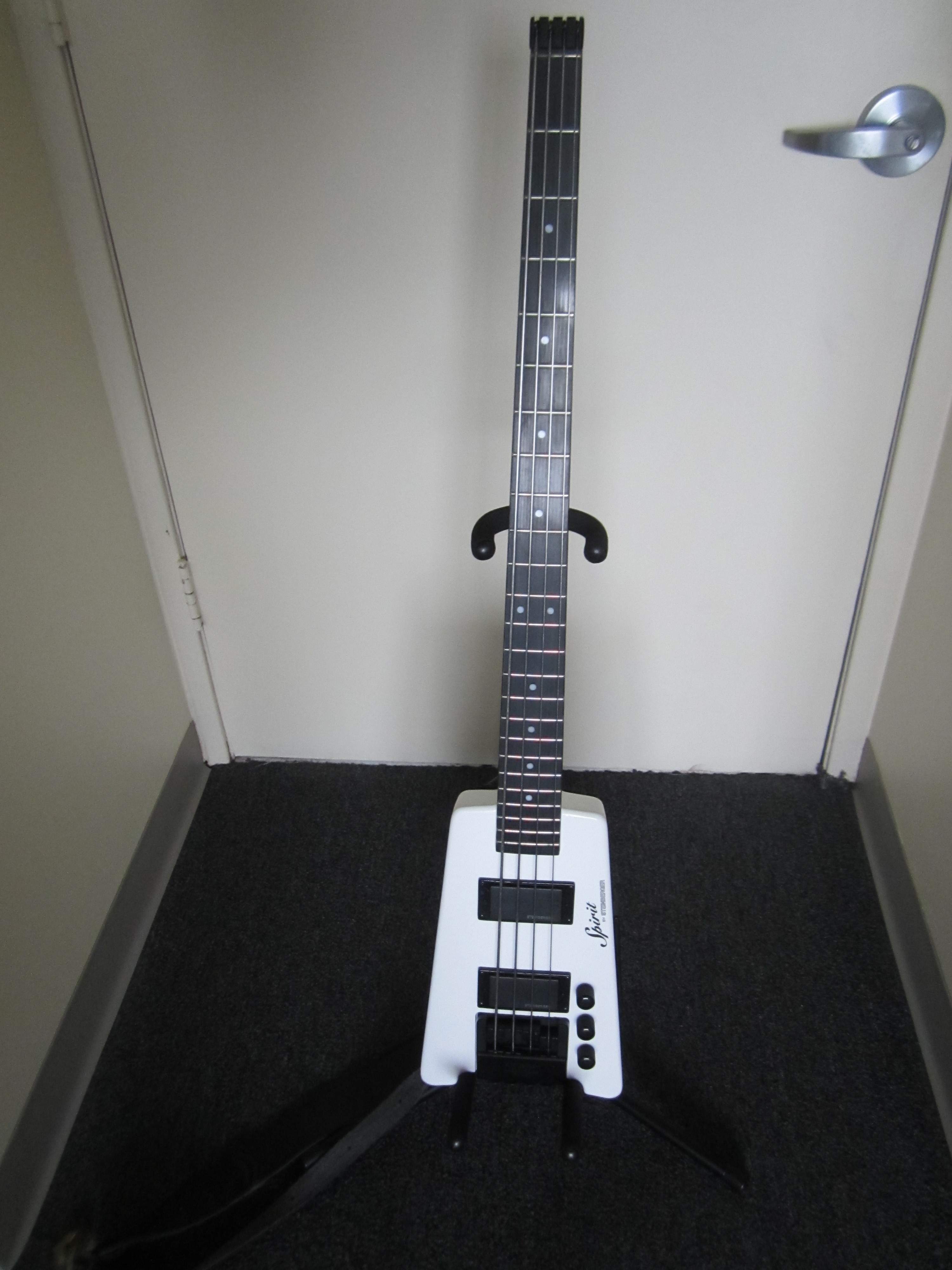
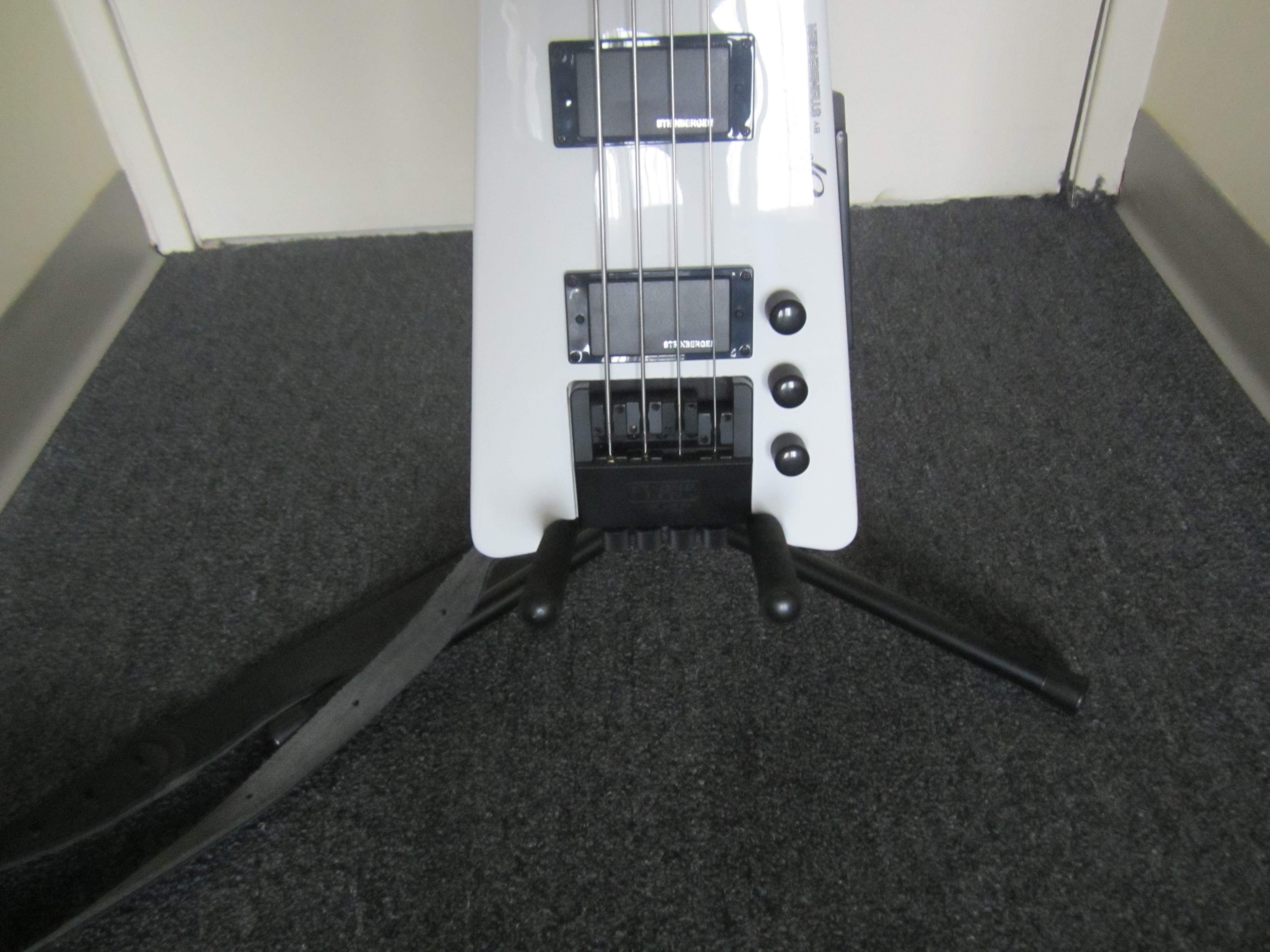
I know some of you have said there is not a stand that will fit a Steinberger. Have you tried one of the adjustable A-frame stands that fit acoustic guitars, mandolins and ukuleles. I took an existing stand, removed the bottom fork, removed the foam covers and put it in a vice and gently bent the wire to conform the width of the bass as shown below. Works like a charm.
Last edited:


