• TalkBass has been independent since 1998. Add your voice.
    Create a free account to reply to discussions, view embedded media, and browse with fewer display ads.
    Join freeLog in
    Want zero display ads or expanded classifieds tools? Compare plans.

Disadvantages to headless basses?

Ahhh... what was the question again????????????????? Oh yeah...... sometimes they are hard to make fit on a guitar stand.
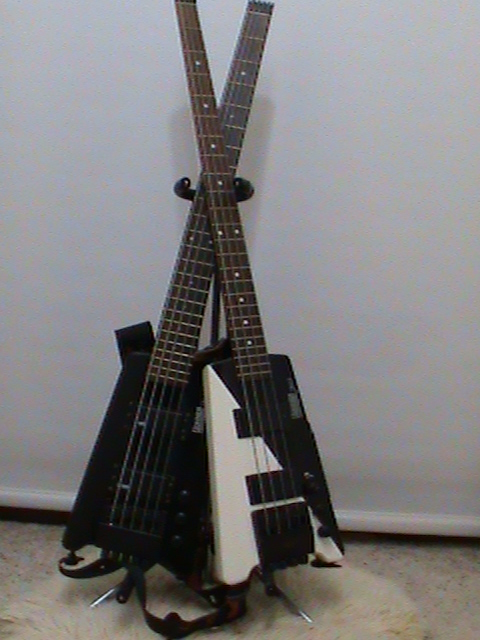
upload_2019-12-11_9-30-49.png
 
I have a headless bass and a headless electric guitar, and both are great. They both sound good (albeit they aren't my No. 1's), the weight and balance savings are tremendous, and they hold a tuning better than any of my "headed" instruments.

The only downsides IMO are (1) some headless systems make changing strings difficult, although that is a case-by-case issue (my headless bass is a pain to change strings, but my guitar is easy), and (2) can't hang them up on the wall on the wall hangers I already own.
 
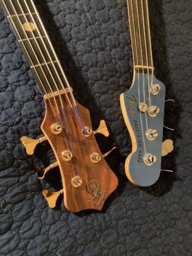
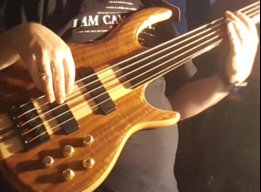
View attachment 3626676 View attachment 3626677 View attachment 3626678
There are only two negatives to headless, imo:

1) some people don’t like the look and will tell you so.

2) can’t use a standard wall hanger

Beside that, every other aspect is an improvement IME: balance, weight, portability, tuning stability, easier to wield in tight spaces like a home studio.

Also, for me, tuning at the bridge is a godsend. With my shoulder issues, reaching out to tune at the headstock is painful.

Another weird but useful benefit is you can set a lot of headless models on the floor without a stand, due to the way the bodies are shaped at the bridge.

I have two headless muckelroy 4’s and a kiesel vader 8 (guitar) and they are all I play now.
That quilt top Muckelroy sure is pretty! You guys are making me want like 5 headless basses now!
 
  • Like
Reactions: ThinCrappyTone
Did you get to "test drive" the headless bass that you are gonna buy?


View attachment 3626779

Unfortunately, no. That's why I am here bugging you guys for input.;)

It would be a custom made Marusczcyk. So it would be a lot of $$$, without being able to play it first.

....although now Alper has me wanting to look into those Foderas. The simplicity of that bass is REALLY appealing to me, and I have always liked Foderas. Not sure how that model flew under my radar when I was researching headless basses.
 
  • Like
Reactions: bassdude51
Awkward psychologically or physically?

I haven't played a headless bass, but my main bass doesn't give me any tactile indication I'm near the headstock unless my thumb goes as far as or past the point on the back of the neck behind the nut, which it never does (except just now when I tried it to see if I could feel where the headstock starts).

It feels physically awkward.

I like the look of the VB5's quite a bit. Are you pretty happy with it?

Kiesel seems to be doing some really nice work for a very reasonable price. But, the VB's are the only ones that have a look that appeals to me.

I like it a lot. I never thought I would own a headless bass but these things looked really good and I'm a fan of lighter, smaller basses. So I decided to give it a try.

Assuming the nuts have minimal friction, yes.

When discussing Steinbergers, you should know the neck is mostly wood - the graphite is a thin u shaped cross section that stiffens things. If it were all graphite composite, the thing would neck dive, as it'd be about 3x heavier than a wood neck.

Graphite rods are made from heat treated fibers (polymer fibers baked without oxygen) and epoxy. A roasted neck is heat treated fibers (cellulose fibers baked without oxygen) - the baking also crystallizes and hardens the lignin in the wood, which is the "glue" the holds the fibers together. The materials are different, but not that different.

So, comparing a graphite reinforced wood Steinberger neck to my graphite reinforced roasted wood Warmoth necks, you shouldn’t be too surprised that they are both pretty darn stable.

Huh, I always thought those Steinbergers were woodless.
 
I've owned a LOT of headless basses. None have had problems with dead spots that I recall....

One was steinberger (no issues at all, amazing), 2 were hohner steinberger licenced copies (also really good instruments for the price, surprisingly enough, just lacking in stock electronics), even the crappy old 1980s cort p bass with steinberger headless system (body was made of plywood, super heavy, terrible balance) didn't have dead spots of note. Crap instrument, but great hardware.

My aria sinsonido doesn't seem to have dead spots, it's headless. Sooo... don't freak about dead spots.

You buy headless because you like balance better, size better, convenience, looks. not to avoid dead spots, which are mostly cured by build material, not by avoiding a headstock.
 
I've had a Steinberger since the mid 80s and have a Marusczcyk as well. I played the Stein solely for a few years and can't think of any problematic issues (once you get used to having no headstock). My Maru is not headless, but it's a very nice quality bass with no notable issues. I'd say....DO IT! Get you one!
 
Well guys,..thank you so much for the input. I am going to get my build request off to Adrian @Marusczcyk today, along with a list of questions.

My biggest concern, by far, is not being able to use tapewounds/flats with his headpiece. In my mind, tapewounds are what I planned on primarily using with this bass. I absolutely love the sound and feel of tapewound strings on a fretless.
 
After wracking my brain, I thought of (2) disadvantages: You cant hit a false harmonic And then “bend” the note up by the string tree like you can on a Fender, there is no extra string exposed. Steinberger had a bass trans-trem whammy bar system, but rare as hens teeth, and difficult and expensive to get parts for it now. You could drop the whole tuning. They had a Drop-D only version too, still available for outrageously high prices if you can find one.

The original graphite/CF necks had non adjustable relief molded into them, I think mine is about .012” at the 7th fret, so if your a relief-fiddler, get one of the newer hollow CF necks with a truss rod. Never felt any need to adjust mine, it’s just always the same, every time I play it.
 
  • Like
Reactions: Winslow