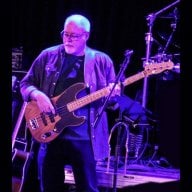
i've known some impressive guitar and bass players who knew little to no theory.
Indeed. In the same way, I've known musicians who have a lot of theory but are short on musicality. They've tried to 'learn themselves better', but ultimately they aren't wired up to make music that is in any way moving or nuanced. At times I've found that these guys tend to put an emphasis on speed or complexity-for-the-sake-of-it, over raw musicality.
I think it probably helps if one doesn't view any one bit of being a musician as something that falls into 'essential' and 'avoidable' buckets. Does a player want to avoid theory simply because it seems a bit like hard work, a bit too academic or because
Famous Player X couldn't even read notation? It depends on what you want out of it! I've met players who are peversely entitled about their ability to read music, or the fact that they can't read music; each wearing this fact like a badge of honour. The same maybe applies for a lot of theory. At the same time it is hard to know what you actually need to learn. When I studied music theory (as a kid, alongside learning the violin) I had to memorise reams of Italian phrases among other things, and was taught musical concepts as though music
had to adhere to a rigid framework of rules.
I wonder how much theory you pick up along the way, anyway. And how big the difference is between grasping a theory concept and either being able, or not being able, to explain the concept. So many guitarists know which chords work well together, but they likely couldn't explain fully why these chords work. My limited theory studies only told me which chords should and shouldn't be strung together, after all! It is a bit like artists or photographers claiming that a good photo or painting must contain the Golden ratio in it somewhere, and that we such art or photography pleasing as a result of this. Don't you have to first learn what the Golden ratio is, actively seek it out in artwork, and don't some of the best artists break these rules anyway?
A young Frank Zappa apparently sought out a compositional text book, and headed to the section of the book that covered things to avoid doing when composing music. He then played all these inadvisable combinations of notes and chords!
Maybe it depends ultimately on who you are playing with. Extensive theory knowledge is probably great if every player you're with is on the same page, and you can simply call out chord progressions on the fly and everybody can keep up. Probably this is good for session work where you have to learn a number of tunes in quick succession. However it might not be as helpful at an open mic night, or round the campfire. This is the difference between saying "A string, fourth fret!", "A major with a C# in the bass" or "A major, 1st inversion" I guess! It depends on the player.