This is my experience as well.Many people claim that on a Stingray, the entire G string is weak in comparison to the other strings. That was my experience when I had Stingrays.

TalkBass has been independent since 1998. Add your voice.
Create a free account to reply to discussions, view embedded media, and browse with fewer display ads.
Join free Log in
Want zero display ads or expanded classifieds tools? Compare plans.
This is my experience as well.Many people claim that on a Stingray, the entire G string is weak in comparison to the other strings. That was my experience when I had Stingrays.








I very much doubt that Roger (or anyone else at Sadowsky) sits there checking to make sure there are no dead spots on his basses in order to weed out any potential offenders. Any luthier who does that is likely to go out of business quickly.I’m surprised Roger would let that out of his shop. Did you contact them about it?

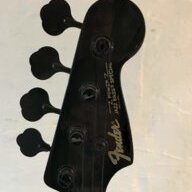
Do Stingrays have a dead spot at the 5/6 fret on the G string (or anywhere else for that matter?) like most Precision style basses?? Or does the smaller headstock move it elsewhere?? Or.....???
Thanks for any insight.
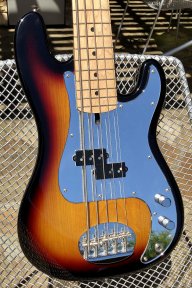
The Tony Franklin has the distinct advantage of being a fretless - as every other note also has less sutain, a dead spot is less noticeable in the grand scheme of things.
I've had much more luck mitigating dead spots by reducing headstock weight than by increasing it. If done in conjuction with lighter, stiffer necks (see my previous post) it's a reliable strategy for reducing the effect of the neck's resonance in that area.
You might be right, you might not be.
My fretless has an ebonol fingerboard (very good sustain and mwah for a fretless,which makes any reduced sustain more notecable), It has Hipshot ultralite tuners. The dead spot/reduced sustain area is very minimal. The reason people think that adding mass is the right thing to do is that you can buy a Fatfinger....and sometimes it helps
. You can't, however buy a simple, cheap device that subtracts mass from your headstock. If you could, people would be less sold on the idea that adding mass is always the way to go.
While that might be true, for the dead spot/area condition of the neck of my Am Pro J Fender gets a blot I'm never forgetting. Worst equipment mistake I've made, by far.Any luthier who does that is likely to go out of business quickly.

I went through 2 EBMM Stingray Specials and had to return them both due to unacceptable dead spots on the G string. They were all around the 7th to 9th fret on the G string. By unacceptable I mean they instantly faded into harmonics. Absolutely no fundamental on those notes. Tried new strings and a proper setup. I get that all wooden basses have some degree of dead spots on them but I've never experienced anything like this. The entire body of the basses shook violently when the offending note was played. It's really too bad as I loved them otherwise.

This was my experience too. That weak G string was not caused by neck resonance though, that was some issue with pickups or the preamp.Many people claim that on a Stingray, the entire G string is weak in comparison to the other strings. That was my experience when I had Stingrays.
What about the EBMM Sterling bass?