
I have not had any problems with any of the half dozen Rays I have owned.

Enjoy the benefits of a premium membership!
Upgrade Account
-
TalkBass has been independent since 1998. Add your voice.
Create a free account to reply to discussions, view embedded media, and browse with fewer display ads.
Join free Log in
Want zero display ads or expanded classifieds tools? Compare plans.
You are using an out of date browser. It may not display this or other websites correctly.
You should upgrade or use an alternative browser.
You should upgrade or use an alternative browser.
Do Stingrays have the infamous dead spot??
- Thread starter pingvuiini
- Start date
-
- Tags
- stingray dead spot
More options
Who Replied?

Do Stingrays have a dead spot at the 5/6 fret on the G string (or anywhere else for that matter?) like most Precision style basses?? Or does the smaller headstock move it elsewhere?? Or.....???
Thanks for any insight.
I don't think it's down to any specific design. Some basses do have noticeable dead spots, others not so much. I've experienced Fender Precisions/Jazz with dead spots and others where I could not tell. Same with Stingrays. My 2002 has a bit of a dead spot on the A in the E string. It's not terrible, but it dies a lot faster than other notes, it's ok for most things but if I need that note to ring I'll have to play the open string. I experimented adding a small vice to the headstock to simulate what a 'fatfinger' would do and it did alleviate it... so I guess if you have a bass with a deadspot in an annoying place but otherwise love it, you can try adding some additional mass to the headstock and see where you can move the dead spot to. In my case it was not worth doing, it's still my #1 bass.
Another thing to try if you have a bass with an annoying dead spot is to loosen up the neck screws a bit, wiggle it and try to make it fit as snuggly as possible and retighten the screws, one bit at a time on each. It sometimes helps too, as small changes in how tightly the neck fits can have marked effects on how the neck resonates.
In short: it's down to individual instruments, so you need to try and see. Different woods, and even how tightly the neck fits (for bolt-on instruments) can affect that and it's hard to predict.

Exactly the same. My '79, all my EB and Precisions have it.I have five Sting Rays (including a late 1978 Pre-EB). They all have a dead spot around the 5th, 6th or 7th fret on the G string.

To this day, unnoticed on my SterCrapling...And won't certainly go looking deliberately for any! 


For perspective, my early 2000s Stingray 4H suffered from the "weak G string" effect and after years and years of ownership and trying various things I just couldn't get it evened out (using various string gauges, raising pickup height at the G string side etc). Thus I couldn't remark on whether that bass had a dead spot because I generally avoided a lot of play of the G string when there were fuller options up the neck on the first three strings.
Years later, I obtained a Stingray Special 4HH and in ALL pickup selector positions the G string is completely even volume/fullness-wise with the other strings (stock strings as well as multiple DR and GHS strings). Additionally I haven't found any dead spots. I've been generally impressed with the note quality and consistency as well as sustain.
The low weight of the Special in comparison is the kicker, because it doesn't leave me with a sore shoulder like my prior model!
Years later, I obtained a Stingray Special 4HH and in ALL pickup selector positions the G string is completely even volume/fullness-wise with the other strings (stock strings as well as multiple DR and GHS strings). Additionally I haven't found any dead spots. I've been generally impressed with the note quality and consistency as well as sustain.
The low weight of the Special in comparison is the kicker, because it doesn't leave me with a sore shoulder like my prior model!
The C at the fifth fret of the G string has always seemed just a little less resonant than the other notes on my Ray 5.
Running through the compressor setting on my Boss multi-pedal it is not noticeable.
Running through the compressor setting on my Boss multi-pedal it is not noticeable.

Not in my experience. Ive had a ‘95 Sterling for decades...no dead spots! I’ve played several others over the years and have always been pleased. One had the G side of the pickup a bit higher than the E, so I suppose the owner was compensating for to even the output.What about the EBMM Sterling bass?

I did not own this bass or gig it but a few years ago I was very tempted by a 90s fretless Stingray in a music shop in Ireland. They are very hard to come by here IME and the deadspot in the classic 5th (fret) C on the G string was enough for me to leave without it. I cannot stress the G.A.S I have for a fretless SR.

No dead spot on my EBMM Ray, nor most of my Fenders with the exception of one Mexi Jazz

I own 3 stingrays (2 x 4H's and 1 x Classic 4). I've previously owned another 4H and another Classic. No dead spots noticeable on any of them with a variety of strings and different tunings.
The only bass I've owned with a problematic dead spot was a Sadowsky Will Lee Metro downtuned a half step. It didn't respond to any of the common treatments. The dead spot was bad enough that I was unable to use it.
I’m surprised Roger would let that out of his shop. Did you contact them about it?

I'm just thankful I'm one of the people who don't notice a dead spot. The only issues I've ever had were with basses that I tried to set the action too low on, then I might find a high fret that would choke off lower notes... but when adjusted to compensate for it (or the offending fret was leveled) it went away.
The little strings do sound a tiny bit weaker but nothing a good compressor cant fix. I use to own two and its not a deal breaker.

Leo realized that the MM headstock did not affect the likelihood of a dead spot being prominent.What about G&L?
He must’ve preferred the aesthetics of the inline headstock a lot though to abandon the weight distribution benefit of non-inline headstocks.
[edit- look at G&L headstocks from their first couple of years... it definitely was an aesthetic choice.]
~~~
Just got a Tribute G&L Fallout (short scale) and its dead spot is higher up at F on the G string. Not terrible, but it’s there.
I imagine many shorties, if theirs is discernible, it’ll be around the 9th-11th fret instead of the 34ers’ 6th-8th.

I have a 2004 Stingray. I don't notice any dead spots and I don't think that there are any. I do have it strung with flat wounds.
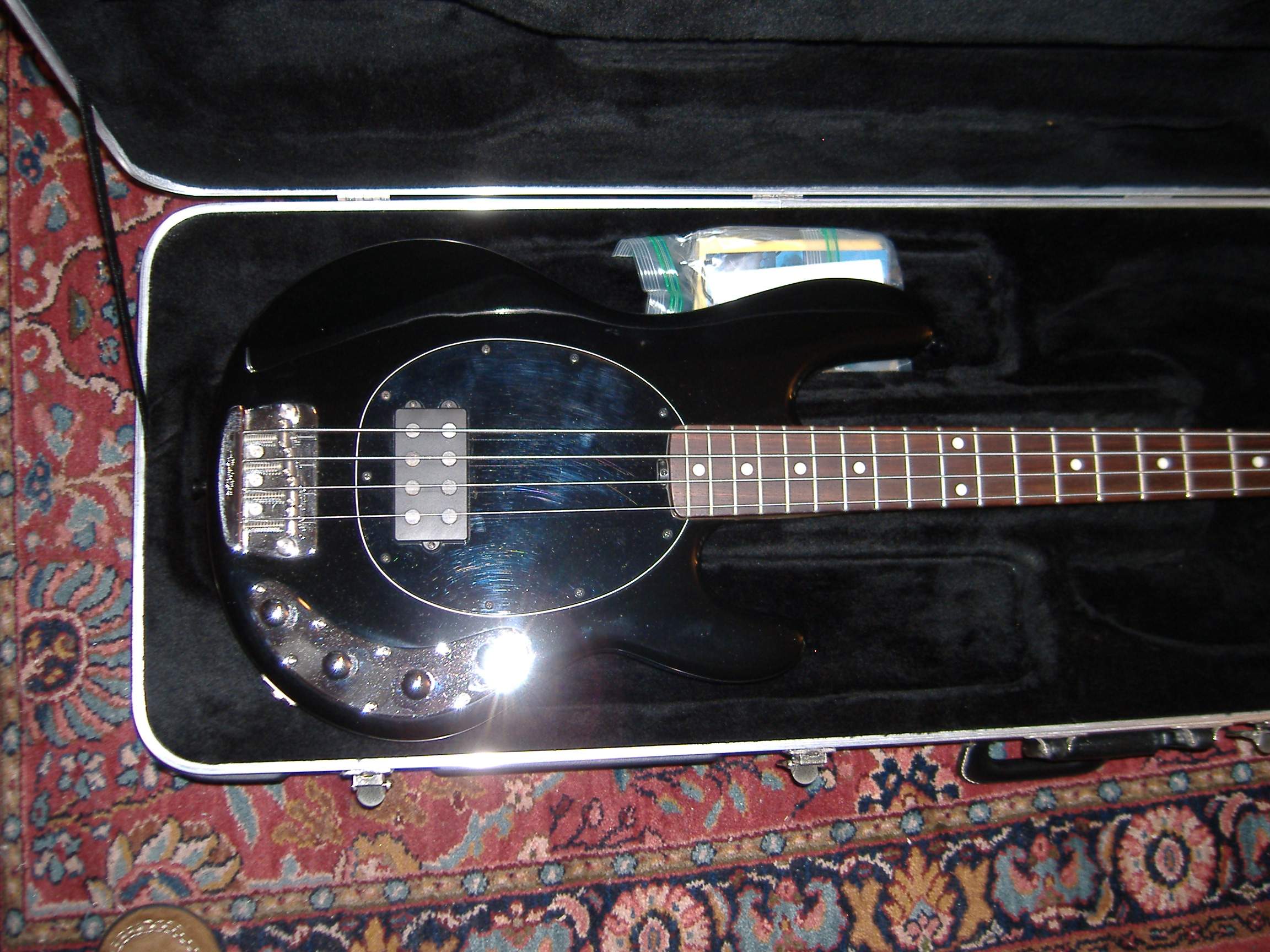
One thing that I've notice with Stingrays is that the G string just nips the edge of the magnet poles. Maybe that's a reason for those dead spots.
I spread the strings out on my 'Ray by putting a slant on the G and E saddles. Dropping the height screw down on the far edge of the saddles. And adjusting the A and D saddles accordingly to get the 19 to 19.5 mm spacing. This saddle adjustment gets the strings better centered over the poles.
I've often wanted to put Fender treaded saddles in place of the OEM saddles for easier string centering of the poles. (I'm kind of anal about strings over the center of the magnets. YMMV)
(Photo doesn't reveal saddle slant spread but a better centered G and magnets is seen to some degree. Camera shot is not straight down and the G string is actually fairly centered over the poles.)
One thing that I've notice with Stingrays is that the G string just nips the edge of the magnet poles. Maybe that's a reason for those dead spots.
I spread the strings out on my 'Ray by putting a slant on the G and E saddles. Dropping the height screw down on the far edge of the saddles. And adjusting the A and D saddles accordingly to get the 19 to 19.5 mm spacing. This saddle adjustment gets the strings better centered over the poles.
I've often wanted to put Fender treaded saddles in place of the OEM saddles for easier string centering of the poles. (I'm kind of anal about strings over the center of the magnets. YMMV)
(Photo doesn't reveal saddle slant spread but a better centered G and magnets is seen to some degree. Camera shot is not straight down and the G string is actually fairly centered over the poles.)

Do Stingrays have a dead spot at the 5/6 fret on the G string (or anywhere else for that matter?) like most Precision style basses?? Or does the smaller headstock move it elsewhere?? Or.....???
Thanks for any insight.
I find that most of time there is a dead spot. It’s an acoustical phenomenon that is the reason, not a defect of the instrument. You may want to try to see if it’s the bass by playing it unplugged first.
It's a resonance, at that frequency, at that location. If it isn't there in one bass but is there in another of the same model, I'd call it a defect.
If the neck is too flexible (for example my Am Pro J which now has an Allparts P-thickness neck, which fixed it), it can undermine solidity all over the neck, not just at the dead/weak spots. This isn't often mentioned but I can't accept it, myself. So I wouldn't even try a 1.5" nut 34" scale any more.
For 34" scale my overkill solution involved bubinga, but I'm mostly short scale now, partly for these reasons.
So if I get a Stingray it will be short scale.
If the neck is too flexible (for example my Am Pro J which now has an Allparts P-thickness neck, which fixed it), it can undermine solidity all over the neck, not just at the dead/weak spots. This isn't often mentioned but I can't accept it, myself. So I wouldn't even try a 1.5" nut 34" scale any more.
For 34" scale my overkill solution involved bubinga, but I'm mostly short scale now, partly for these reasons.
So if I get a Stingray it will be short scale.
Last edited:
A comment about the Stingray 3 + 1 headstock. I doubt if there is any definitive reason that can be found on Google as to why Leo went that configuration. I highly doubt that there is anything mechanical or acoustical about it.
IMO, I simply think that he went 3 + 1 because he was into straight string pull and because the original Fender headstock shape was sold to CBS and he didn't want to violate copy write law.
Thus, we've heard of the early G&Ls with "pre lawsuit headstocks".
IMO, I simply think that he went 3 + 1 because he was into straight string pull and because the original Fender headstock shape was sold to CBS and he didn't want to violate copy write law.
Thus, we've heard of the early G&Ls with "pre lawsuit headstocks".

G&L's have all the same issues as Fenders with respect to whether or not there's a "dead spot" - they're made of the same materials, in pretty much the same shape, and the headstocks have pretty much the same mass loading (4 big clunky steel tuners). Every (and I mean every) Fender or G&L (and pretty much any bass with roughly the same design) will have an area of the neck with reduced sustain on the G string - it's simple Physics; the logo on the heasdstock won't change this. Whether or not your particular reduced sustain area has the sustain reduced enough on any given note to qualify to you as a "dead spot" is part how the neck and related stuff is built, part luck, and part psychoacoustics.
I have a bunch of basses I made - made with 5 string (bigger cross section = stiffer) Warmoth necks with graphite reinforcement (again, stiffening). They're made of roasted maple (which stiffens and lightens the wood). I use Hipshot ultralite tuners (which reduce the mass loading on the neck). All of those things move the resonance "up" the neck ( to the area of the 8th fret), where its effect is less noticeable. Do I have dead spots? Excellent question - most of you would probably say no, as there aren't any "thud" notes. Do my necks have areas of reduced sustain? Yep.
I have a bunch of basses I made - made with 5 string (bigger cross section = stiffer) Warmoth necks with graphite reinforcement (again, stiffening). They're made of roasted maple (which stiffens and lightens the wood). I use Hipshot ultralite tuners (which reduce the mass loading on the neck). All of those things move the resonance "up" the neck ( to the area of the 8th fret), where its effect is less noticeable. Do I have dead spots? Excellent question - most of you would probably say no, as there aren't any "thud" notes. Do my necks have areas of reduced sustain? Yep.


