
Enjoy the benefits of a premium membership!
Upgrade Account
-
TalkBass has been independent since 1998. Add your voice.
Create a free account to reply to discussions, view embedded media, and browse with fewer display ads.
Join free Log in
Want zero display ads or expanded classifieds tools? Compare plans.
You are using an out of date browser. It may not display this or other websites correctly.
You should upgrade or use an alternative browser.
You should upgrade or use an alternative browser.
Do you believe in "sweet spots" for pickups?
- Thread starter GwennyT
- Start date
More options
Who Replied?

Actually, most guitar players don't generalize like that at all. At least not the ones I know. Lots of guitarists who love Les Pauls don't like SGs at all (and vice versa), exactly because of the different neck pickup positions. The tone you get from an SG neck pickup and a Les Paul neck pickup is quite different, even if the pickup itself is identical.
Of course, this is a matter of personal taste and not necessarily about a universally "ideal" pickup position or a "sweetspot". Like you said, play what sounds good to you.
But even a subtle difference in pickup position can make a HUGE difference and I do understand the use of the word "sweetspot". I never reach for my otherwise AMAZING Sandberg VS (P-bass split coil configuration) because the pickup is around 8-9 mm further back towards the bridge than the classic P-bass pickup position. Unfortunately I wasn't aware of this when I ordered the bass, which was a custom order passive. This was before Sandberg actually started selling passive versions so I had no chance to test if. I loved the necks and build quality of Sandbergs and figured I would get rid of the overly bright tone of the active ones if I custom ordered a passive, with a pickup of my choice. Huge mistake. It feels like all the weight and "heft" of my tone is gone when I play that bass with a band. And this is a passive Sandberg, with a vintage voiced P-bass pickup (Kloppmann PB63). I've even replaced the pots/cap with classic Fender values. You would perhaps expect it to sound like a P-bass but it really doesn't. Especially in the context of a mix/band. It just doesn't work for me at all. Those 8-9 mm of difference makes it a COMPLETELY different instrument than a classic P-bass and it's NOT just a subtle difference. So for ME there's definitely a sort of "sweetspot" at the traditional P-bass pickup position. It gives me the perfect balance between upper midrange presence and "heft" in the lows/low mids for MY tonal needs.
I've had similar experiences, but due to the pickup being closer to the neck (not Sandberg basses).
I had 2 P/J basses that I generally really liked, but that sounded a little flabby in the mids. It was not overwhelming, but enough that I ended up selling each pretty quickly. It was only later that I learned the P on each was a bit closer to the neck than on a standard bass.
I don't think it was coincidence—I've never had that issue with any bass where the P is in the standard (Fender P) position.

I think there is a "sweet range" for pickup placement where I prefer the tone. The 70's Tele basses with the big chrome mudbucker is out of the range a little (but a different type of pickup in that spot could be "in range"). A pickup too close to the bridge is out of the range, but can be useful when blended with another pickup that's on the other side of the "range".
What I think is that the magnetic field of a pickup is larger than the physical size of the pickup and putting a pickup almost anywhere within a specific range (a specific length / area centered under the strings between the bridge and the end of the neck) will generally achieve close to the same tone. I think that "length" is fairly small, possibly 1/2" or less, but could vary in size depending on the type of pickup being placed in that range. Putting a pickup at one edge of that range (toward the bridge or toward the neck), is the closest thing to a "sweet spot" I could imagine.
What I think is that the magnetic field of a pickup is larger than the physical size of the pickup and putting a pickup almost anywhere within a specific range (a specific length / area centered under the strings between the bridge and the end of the neck) will generally achieve close to the same tone. I think that "length" is fairly small, possibly 1/2" or less, but could vary in size depending on the type of pickup being placed in that range. Putting a pickup at one edge of that range (toward the bridge or toward the neck), is the closest thing to a "sweet spot" I could imagine.


Personally, I do not. If a sweet spot is based on a specific part of the string being over the pickup, would it not change every time you fret a note?
Edit: If a Sweet Spot is the best spot for a pickup to be placed to rest the thumb on, well now that's just purely subjective.
I'm sure some people have a preference, but it really doesn't matter to me. I can usually get what I need from a bass regardless of where the pickup are.
Frankly, a lot of that nuance is lost when you are playing with others. IMO, that is the whole point of being a bassist. So most of my time is spent making sure I'm prepared, and it's, granted making sure my timbre is appropriate for the job at hand, but my main focus is on musical preparation.

Here's a couple curves to ponder:
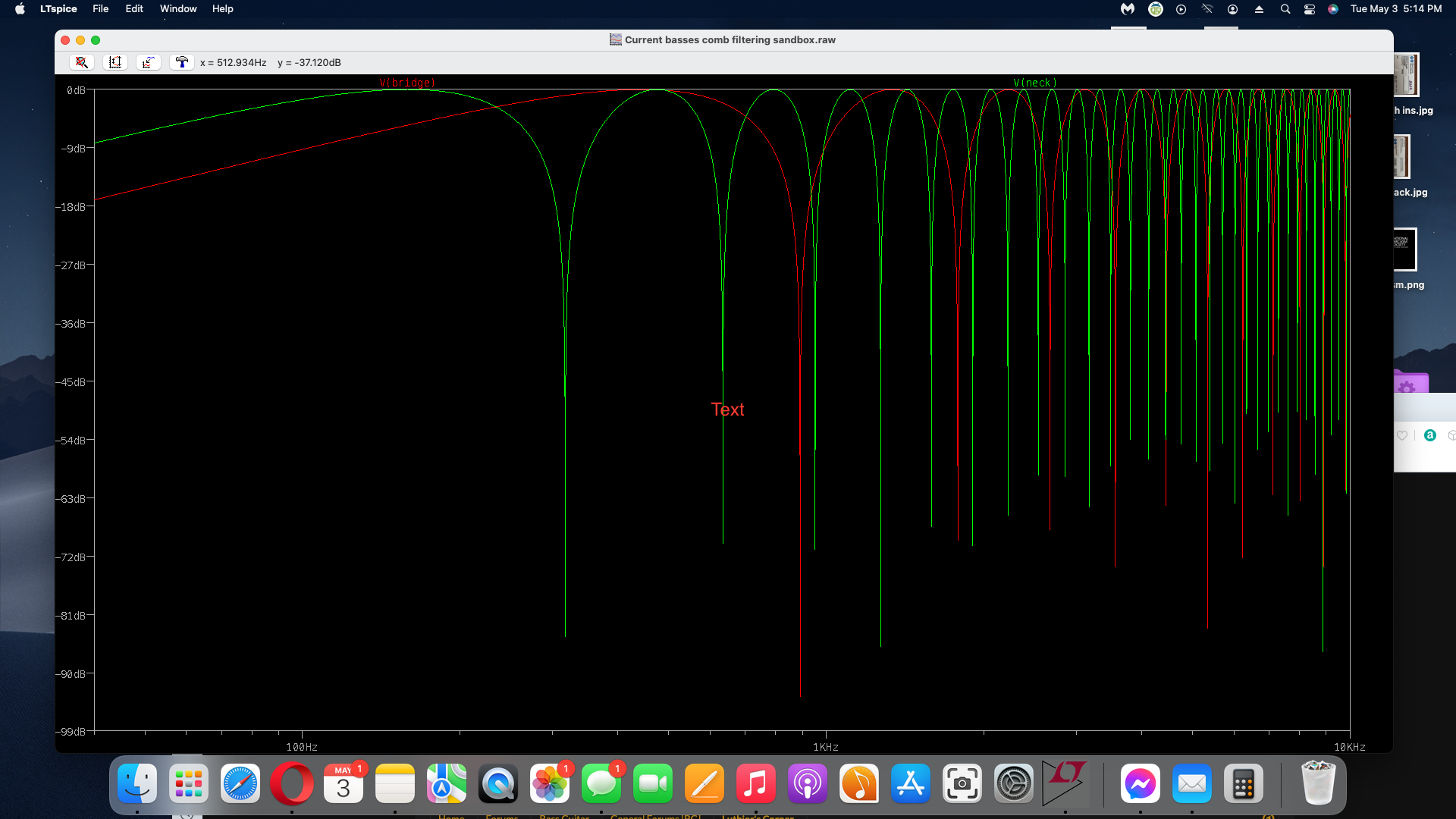
The green curve is the response you get from a pickup in the neck position due to pickup position alone, the red curve is for a pickup in the bridge position. Note that they are the same shape, but displaced left and right from each other. This is for an A string - the curve for a different string will be similar, the same shape, but the curve moves left or right depending on the tuning of the string. There are peaks and dips in that curve - the fundamentals are all at the left end of this curve on that initial slope, the dips affect the harmonics much more than the fundamental. If the frequency of a dip coincides perfectly with a harmonic, it will be gone - essentially inaudible if things line up just right. You can observe this on a '51 P - on those basses, the pickup is 1/5th of the way from the bridge to the nut. If you play the harmonic at the 4th fret of an open string (it usually works best on the G string, due to intonation things - the bridge saddles aren't all lined up), you can clearly hear it acoustically. In the electrical output, however, you won't hear it - it's gone. So yes, the whole thing about harmonics matters, but it isn't something that kills certain harmonics of every note - it kills certain frequencies, and what frequencies are cancelled depends on the pickup position, and what string you are playing.
Most of us have noticed that, when you play the same notes on different strings, the timbre of the two positions sounds different. The curves explain this - If you had the curves for every string, they look the same on a log scale, but they are shifted left and right. Playing higher on a string moves you up the slope on the left end of the curve - it gives you more fundamental if you play on the lower string, but up 5 frets position wise. One real reason to play a 5 is that the E on the B string has more oomph than an open E string (the same thing happens with the other notes you typically play on the E string). As it happens, the curves for different pickup positions do the same thing.
The frequency ratio between any two strings tuned in fourths is 4:3 - the wavelengths go the other way, and it's the wavelengths that determine what frequencies get cancelled at a given pickup position. What that means is that pickup position and string tuning are linked and swappable - if you have one bass with a pickup 4 inches from the bridge, and another one with an identical pickup 3 inches from the bridge, the timbre of a note played on the A string of the first will match the timbre of the same note on the second bass if you play it on the E string. If you build a bass with a pickup at 5.33 inches from the bridge, that bass will sound the same as the first one's A string notes if you play them on the D string.
There is real science behind all of this - pickup positions do matter, and they give real sonic differences - they do much more to influence the sonic character of your bass and low and mid frequencies than anything else. Is there one "magic" place where everything aligns? No, the idea of a "sweet spot" is Marketing, but that doesn't mean it's not important stuff - just because there isn't a magic point doesn't mean that pickup location isn't an important part of a bass's sound - it absolutely is.
Leo Fender had a test mule that he used to determine pickup locations - it allowed someone to move a pickup to varying locations, and hear the difference. The positions he used weren't determined by mathematics, they were determined by listening. The differences are very real, but in the end where you want your pickup is an aesthetic choice.
The green curve is the response you get from a pickup in the neck position due to pickup position alone, the red curve is for a pickup in the bridge position. Note that they are the same shape, but displaced left and right from each other. This is for an A string - the curve for a different string will be similar, the same shape, but the curve moves left or right depending on the tuning of the string. There are peaks and dips in that curve - the fundamentals are all at the left end of this curve on that initial slope, the dips affect the harmonics much more than the fundamental. If the frequency of a dip coincides perfectly with a harmonic, it will be gone - essentially inaudible if things line up just right. You can observe this on a '51 P - on those basses, the pickup is 1/5th of the way from the bridge to the nut. If you play the harmonic at the 4th fret of an open string (it usually works best on the G string, due to intonation things - the bridge saddles aren't all lined up), you can clearly hear it acoustically. In the electrical output, however, you won't hear it - it's gone. So yes, the whole thing about harmonics matters, but it isn't something that kills certain harmonics of every note - it kills certain frequencies, and what frequencies are cancelled depends on the pickup position, and what string you are playing.
Most of us have noticed that, when you play the same notes on different strings, the timbre of the two positions sounds different. The curves explain this - If you had the curves for every string, they look the same on a log scale, but they are shifted left and right. Playing higher on a string moves you up the slope on the left end of the curve - it gives you more fundamental if you play on the lower string, but up 5 frets position wise. One real reason to play a 5 is that the E on the B string has more oomph than an open E string (the same thing happens with the other notes you typically play on the E string). As it happens, the curves for different pickup positions do the same thing.
The frequency ratio between any two strings tuned in fourths is 4:3 - the wavelengths go the other way, and it's the wavelengths that determine what frequencies get cancelled at a given pickup position. What that means is that pickup position and string tuning are linked and swappable - if you have one bass with a pickup 4 inches from the bridge, and another one with an identical pickup 3 inches from the bridge, the timbre of a note played on the A string of the first will match the timbre of the same note on the second bass if you play it on the E string. If you build a bass with a pickup at 5.33 inches from the bridge, that bass will sound the same as the first one's A string notes if you play them on the D string.
There is real science behind all of this - pickup positions do matter, and they give real sonic differences - they do much more to influence the sonic character of your bass and low and mid frequencies than anything else. Is there one "magic" place where everything aligns? No, the idea of a "sweet spot" is Marketing, but that doesn't mean it's not important stuff - just because there isn't a magic point doesn't mean that pickup location isn't an important part of a bass's sound - it absolutely is.
Leo Fender had a test mule that he used to determine pickup locations - it allowed someone to move a pickup to varying locations, and hear the difference. The positions he used weren't determined by mathematics, they were determined by listening. The differences are very real, but in the end where you want your pickup is an aesthetic choice.
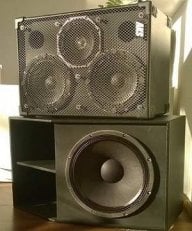
Depending on the type of pickup, most bass players want them to be on a subjective sweet spot since that gives them their desired tone.
Last edited:

I have and still do own multiple Stingrays. I also owned Laklands and a Tobias Growler which have MM pickups that are about 1/2" away from the Stingray position. Big difference in tone. I even swapped Stingray OEM pickups into the Growler and Lakland, still a big difference.
I have owned a few Schecters with P pickups about 3/4" further back than the Fender P location. Again, very noticeable tone difference.
Sweet spots? Maybe, maybe not. But pickup position matters. A lot.
I have owned a few Schecters with P pickups about 3/4" further back than the Fender P location. Again, very noticeable tone difference.
Sweet spots? Maybe, maybe not. But pickup position matters. A lot.
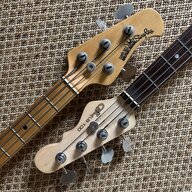

I once played a modded Telecaster bass at a local shop. The original pickup had been replaced with an EMG J-bass pickup. When I went to tune it up, I discovered one of the harmonics was silent through the amp! Apparently the pickup was situated directly under a node on the string where there was no vibration.

Personally, I do not. If a sweet spot is based on a specific part of the string being over the pickup, would it not change every time you fret a note?
Edit: If a Sweet Spot is the best spot for a pickup to be placed to rest the thumb on, well now that's just purely subjective.
Are we talking about pickup placement or where to pluck?

I don't believe in fixed spots in matters of rigidity but pickup placement is important and plays a major role in terms of what tone you get from your bass.
For example, you can place a split coil (p-bass type) pickup near the bridge and it won't sound like a precision bass, it will bring up more mid range and more brightness.
This is a well discussed subject among TB users and usually generates a lot of debate, but for me the two major elements in bass tone are electronics and strings. I'm not saying that things like body wood and fingerboard don't play a part but it's very small compared to these other elements.
In the electronics department, pickup placement clearly affects the tone of the bass and, like some have stated above, that was demonstrated with basses that use movable pickups.
There are certain pickup positions that were found to produce specific tones with certain pickups and that has determined some conventional spots that have been reproduced through time. If those are sweet spots is debatable since what one considers "sweet" is very subjective, but you couldn't get those specific tones unless you use that pickup in that spot.
For example, you can place a split coil (p-bass type) pickup near the bridge and it won't sound like a precision bass, it will bring up more mid range and more brightness.
This is a well discussed subject among TB users and usually generates a lot of debate, but for me the two major elements in bass tone are electronics and strings. I'm not saying that things like body wood and fingerboard don't play a part but it's very small compared to these other elements.
In the electronics department, pickup placement clearly affects the tone of the bass and, like some have stated above, that was demonstrated with basses that use movable pickups.
There are certain pickup positions that were found to produce specific tones with certain pickups and that has determined some conventional spots that have been reproduced through time. If those are sweet spots is debatable since what one considers "sweet" is very subjective, but you couldn't get those specific tones unless you use that pickup in that spot.
So like, Don't Fear the Reaper and American Band are just wholesale promoting cherubs?I believe in miracles.
I believe in wood.
I believe in little tiny frets.
I believe in fretless.
I believe in magnet positioning.
I believe that every time a bell rings,an angel gets their wings.

Mudbuckers are too muddy for many and the nasal bridge pickup thing isn't for everyone either.
Sometimes I find it's best not to overthink these things.
If you really can't get over it, maybe go with a piezo bridge pickup. Problem solved! (With the right implementation they can actually sound pretty darn good.)
Sometimes I find it's best not to overthink these things.
If you really can't get over it, maybe go with a piezo bridge pickup. Problem solved! (With the right implementation they can actually sound pretty darn good.)

No, it's based on the distance from the bridge. As my geometry teacher in HS would say, NBFC, no basis for claim. He was a funny guy, a chalk thrower too if you were drifting off. Anyway, bridge distance doesn't change when a note is fretted. Obviously, different frequency curves come from differend points on the string. We don't need to debunk everything, especially without thinking it through. It isn't a matter of faith either.If a sweet spot is based on a specific part of the string being over the pickup, would it not change every time you fret a note?
Thanks for this! Really interesting and useful. Some years ago in preparation for ordering a high-end custom I machined a "swimming pool route" into a cheap bass so that I could test precise pickup locations. These curves seem to corroborate my experience which was that:
(1) With a single, soloed pickup, the closer you get to the bridge (as the end of the vibrating string), the more the same distance made a difference when moving that pickup. In other words, moving a pickup 5mm within roughly the neck position made less audible difference, while moving a pickup in nominal bridge position 5mm made a bigger difference in tone.
(2) When both pickups were enabled, the differences were much more pronounced (presumably because the overall soundwave generated involves a far more complicated/detailed interplay between the two?), but bridge proximity is still a significant factor. I.e. moving the P pickup of a P-J affects the tone A LOT more when combined with the J than when soloed, but moving the J pickup in a P-J has even MORE impact.
Would you say this experience is supported by these data?
Last edited:


Do you believe in "sweet spots" for pickups?

Of course! Pickup position matters! A lot!!!
790 mm between the nut and the pickup's center line! (for those who know )
)
edit: ooops it's actually 770 mm ( nut / centerline)
Wise(b)ass
Of course! Pickup position matters! A lot!!!
790 mm between the nut and the pickup's center line! (for those who know
)edit: ooops it's actually 770 mm ( nut / centerline)
Wise(b)ass
Last edited:
790 mm between the nut and the pickup's center line! (for those who know
That's about 4mm bridge-ward of a standard MM rear coil position, but 9mm neck-ward of a 60s J pickup

Some kind of hybrid sound?


