Dont forget RW strings changed things a lot.It does still sound like a bass. Players are just exploring the limits of the instrument and finding that it is capable of being very versatile.

Enjoy the benefits of a premium membership!
Upgrade Account
-
TalkBass has been independent since 1998. Add your voice.
Create a free account to reply to discussions, view embedded media, and browse with fewer display ads.
Join free Log in
Want zero display ads or expanded classifieds tools? Compare plans.
You are using an out of date browser. It may not display this or other websites correctly.
You should upgrade or use an alternative browser.
You should upgrade or use an alternative browser.
Do you think the scale will ever tip back towards hi-fi/active basses?
- Thread starter Just Wrong
- Start date
More options
Who Replied?

Absolutely...im a diehard Gibson guy (im old) but its remarkable what Carol was able to achieve...without a doubt a P bass and a pick is still a benchmark and she played sitting down which myself learning trumpet early 70s i was taught to practice sitting down....we were told to play either a Getzen trumpet or an Olds Coronet as well.There were other basses sold/played in the '60s - hollow-bodies of a few different brands were very popular. (as in, players did have a choice) But a Fender bass was the bass of choice by the industry at large, and put an indelible stamp on a decade of some of the best music ever made/recorded. Paul McCartney is "know" by his Hofner bass even though he also played a Fender J, and a Ric to name two. So yes, I know she kept playing and played basses other than a P but all I was inferring was that the iconic Carol Kaye is know by her Fender P.
View attachment 5264795
In jazz band the Fender J bass was specified early 70s as well!
Damn kids with their playing above the 5th fretmodernaires want a bass to sound like anything BUT a bass, vintage bass is becoming lost in the noise.
It's largely genre-specific IMO. I've been in LA for about 20 years now (and for a time occasionally moving around in some of the same circles as people like Hurley, JMJ, etc), and IME in the studio it was always about passive traditional-leaning basses. Not just P's though--look at the rack of instruments those cats bring to a session and it's P's, Hofners, Mustangs, Casadys, all manner of shorties and hollowbodys. But that's rock/pop/indie/singer-songwriter that as others have described has a "classic" or even "retro" bent to it. The instruments are like a cast of characters in a production, and those basses are right for the parts. Same with the guitar choices, or snare drums, or whatever. My understanding is it's pretty much the same in Nashville.There's that story of Sean Hurley moving to L.A. with a five-string active Lakland to become a session player just to realize it's a P-bass world out there. It wasn't always the case though. There was time when hi-fi or active basses were all the rage, like Warwicks, Ken Smiths, Alembics, Tobias, Zons, Spector etc.
In RnB, neo soul and hip hop though there were always active hi-fi fivers around (but with more and more passive FSOs showing up, but again that's the "classic/retro" influence--aka Pino
 ). I have no idea about metal or genres like that, but I imagine the active hi-fi basses have always been there in those genres.
Last edited:

...so that they can spend six hours on getting a good drum sound...Producers are familiar with P basses....i've read stories of bassists coming in with all kinds of basses but engineers need to get a working, pleasing sound quickly...
BTDT, so I really do speak from experience.


Old Fender Precisions sounded great both live and in the studio decades ago... and this will continue to be the case for the foreseeable future.
Yes, but with live drums, you're making a commitment to a sound(and performance) that is a lot harder to change after the fact, in the mix, etc. You can always re-track a bass guitar--easy peasy!...so that they can spend six hours on getting a good drum sound...
BTDT, so I really do speak from experience.
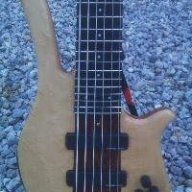
I never knew they had tipped forward or away from active basses. Both my 6ers are active. My fretted is active pickups with an active preamp and my fretless is passive pickups with an active/passive preamp. My fretted can sound exactly like a P bass if needed and can get pretty close to a jazz or other bass tones. Anyone at an audition or recording studio who would tell me I need a p bass or a jazz bass without even listening to my bass, is a closed minded person. Basing the sound of the bass on the looks of it is pure  IMHO.
IMHO.
IMHO.
My point was that Sean Hurley is playing sessions in an environment where the people paying him are asking for a certain thing explicitly. In my experience, and I think in his, it’s a better move to play the bass they say they want than to convince them you can get the tone they asked you for from something else.Being active or passive for a bass doesn’t have much to do with the role one wants to give to the instrument in a musical context in my opinion.

If you're hired as a session musician, the producer or the artist might tell you to play a certain instrument. They might ask you to play a P w/ flats w/ a pick for instance, and you cannot say "no", or you won't get the gig. P and J basses have been in a lot of the recordings that they actually kind of defined how a bass should sound like, and they will never get old IMHO.

It really doesn't matter what you play, if you can't hang, play, and "put out" in a studio or even live. Stop worrying, go practice.

I had a brief conversation with Chuck Rainey at a bass clinic. He said that when he's in the studio he goes for an upright bass tone so that the engineer can add or subtract whatever he wants to his signal. If his tone was too brassy or muddy the engineer would limited in what he could do with it. So in that sense IMO the P Bass would be ideal in this scenario. It does generic real good.
Opel Kadett 1972.
what kind of car is that vintage one?

Bass is about as far away from having a prevailing taste consensus as it's possible to be.There's that story of Sean Hurley moving to L.A. with a five-string active Lakland to become a session player just to realize it's a P-bass world out there. It wasn't always the case though. There was time when hi-fi or active basses were all the rage, like Warwicks, Ken Smiths, Alembics, Tobias, Zons, Spector etc.
Do you think the scale will ever tip back towards hi-fi/active basses? If so, how do you think it'll happen?
To the public, we're the guitarist who stands in the back, doesn't get as much camera action as the other guitarist, and doesn't take solos (or god help us if we do).
To other bassists, we can all agree in theory on a P bass decked out in tort (kind of like the mythical brown diesel station wagon with a manual transmission), but almost nobody actually plays one. Instead, they just play the thing they have - active, passive, or intermittently working.

My experience where I was asked to not play the Stingray was when I played with Stan Ridgway of Wall of Voodoo. He cannot stand the sound. Luckily I have a cheap Fernandez Jazz that saved the day. It was not only him that complained of how boomy it was, but he was the most vocal. It was my prettiest bass at that time. I finally sold that SR5 and did not get another one until a SR5 Special this year (18 years later). The Neo-Mags, and roasted neck and pre-amp is different.
Honestly even with all the StingRay love here, I still have lukewarm feelings for this one. I only really like the middle position and cut a tad from the TMB controls. It did work well in the one gig I did - but no better than my modded Squire Jazz V with EMG JAX5. Why they use 17.5mm spacing and not offer wider on a 5 is a head scratcher for me. It will be here just in case, but will not achieve primary status.
I do have a 6-stringer from Tune upgraded with Delanos and a Pope. Well - I always was underwhelmed by the Pope, but figured it out. There is a reason Fodera uses them
Honestly even with all the StingRay love here, I still have lukewarm feelings for this one. I only really like the middle position and cut a tad from the TMB controls. It did work well in the one gig I did - but no better than my modded Squire Jazz V with EMG JAX5. Why they use 17.5mm spacing and not offer wider on a 5 is a head scratcher for me. It will be here just in case, but will not achieve primary status.
I do have a 6-stringer from Tune upgraded with Delanos and a Pope. Well - I always was underwhelmed by the Pope, but figured it out. There is a reason Fodera uses them
D
I played active Basses for a lot of years. The lazy answer for me. I dont want to deal with batteries anymore. Remotes, smoke detectors, garage door opener,,,I now hate batteries, also, Im quite old now.
D
My experience where I was asked to not play the Stingray was when I played with Stan Ridgway of Wall of Voodoo. He cannot stand the sound. Luckily I have a cheap Fernandez Jazz that saved the day. It was not only him that complained of how boomy it was, but he was the most vocal. It was my prettiest bass at that time. I finally sold that SR5 and did not get another one until a SR5 Special this year (18 years later). The Neo-Mags, and roasted neck and pre-amp is different.
Honestly even with all the StingRay love here, I still have lukewarm feelings for this one. I only really like the middle position and cut a tad from the TMB controls. It did work well in the one gig I did - but no better than my modded Squire Jazz V with EMG JAX5. Why they use 17.5mm spacing and not offer wider on a 5 is a head scratcher for me. It will be here just in case, but will not achieve primary status.
I do have a 6-stringer from Tune upgraded with Delanos and a Pope. Well - I always was underwhelmed by the Pope, but figured it out. There is a reason Fodera uses them
Everyone knows Stingrays don't sound good on Mexican Radio.
Latest posts
-

-

-

-
De-fretting - How much fretboard chipping/removal is expected on a Jatoba neck?
- Latest: bass player 53
-
