

Enjoy the benefits of a premium membership!
Upgrade Account
-
TalkBass has been independent since 1998. Add your voice.
Create a free account to reply to discussions, view embedded media, and browse with fewer display ads.
Join free Log in
Want zero display ads or expanded classifieds tools? Compare plans.
You are using an out of date browser. It may not display this or other websites correctly.
You should upgrade or use an alternative browser.
You should upgrade or use an alternative browser.
Does a bass being a lightweight indicate a negative?
- Thread starter FishDub
- Start date
More options
Who Replied?
Again, a production decision. Not an engineering decisionI've read in multiple places that decision was highly influenced by the need to replace just the neck when an instrument got broken.
Neck dive is a question of balance, not weightOnly if there is neck dive
I've seen a lot more light basses than heavy basses with neck dive issues since the necks are usually about the same weight and the bodies differ greatly.Neck dive is a question of balance, not weight

Extend the upper horn(if there is one)enough to cancel neck dive.Neck dive is a function of balance, not weight
Seeing that we all realize this.....I wonder why this is not solved in the prototype phase of bass production of most makers.
Last edited:

Off topic question: Been wanting to ask how it is playing the Dingwall with the fret configuration, especially on the high end. I have thought about picking one up but have some concerns about the frets and going back and forth between that and other five strings with the typical fret configuration.View attachment 4423992 View attachment 4423993 My Dingwall Abz is a very comfortable 8.2lbs... (light to me)
& it’s a tone monster ! Lots of Dingwall bases tend to be on the light side, they definitely don’t lack tone !
Four hour gigs with a Jazz V turned out to be too much weight for me. My G&L 2400 is lighter but not what I could call a lightweight. Weight is one of the reasons I am having Cindy Hulej from Carmine Street Guitars make a bass for me. They use aged wood from old NYC buildings and the instruments are known to be much lighter and the ones I tried in their store were indeed lighter, and great tone and action. Now, if only it wasn’t taking two years…I ask this because I have read many threads on two different views of this, particularly in the classifieds. The first is that a nice, heavy, thick slab of wood in excess of 10-12 pounds accounts for unmatched, resonate tone quality(IE-Vintage Fenders/Musicmans). The other is the ongoing question of "weight?"...Weight isnt really a deal-breaker for me personally if I like the tone and balance, but I dont gig for hours either. So do most ask the weight because they want a heavy, resonant slab of wood OR do they ask because they want a super lightweight, or a bit of both? My Fender P/J is on the heavier side of 9.5-10 lbs but I love the tone. But, my 80s Japan Tune maniac is a featherweight at 7.5 lbs and that thing kills. Been curious about this..
That may be true. The neck dive issue is a matter of balance and where the strap buttons are located, not a function of weight, per se. My favorite bass weighs 5 pounds 9 1/2 ounces and balances beautifully. If it had a body shape like a gibson eb-o "SG", the neck would dive like a fighter jet. Again, it is balance, not weight.I've seen a lot more light basses than heavy basses with neck dive issues since the necks are usually about the same weight and the bodies differ greatly.
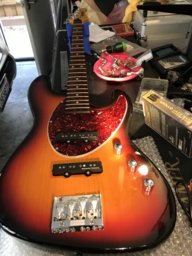
If manufacturers didn't get so locked into 'iconic' body shapes, maybe they could allow horn length to vary more smartly across their product lines. This Rockbass Corvette is an example. There was troublesome neck dive with an Alder body, unsurprising since the horn barely reaches the 14th fret. Also, the lower frets were a long reach. I put a flush mount Dunlop on the butt end in a new location, and a dual-design on the horn, with a 3/4" epoxy-filled, brass tube extension (note: the diameter is 3/8" so a flush-mount can go in if this ever comes out). There is almost 1.5" of extra extension now, past the 13th fret. It balances adequately now and the lower frets are a lot closer. Couldn't Warwick have spec'd the horn with an extra inch and still called it a Corvette body? I guess it might have balanced fine with a solid Bubinga body, but switching to Alder or Ash from a heavier body is going to change the required horn length. In an ideal world each body shape could allow for a longer or shorter horn depending on weight. This is one of my 'test project' basses, and I have no plans to sell it--this can be done with any bass, but I would hesitate for any I expect to resell.That may be true. The neck dive issue is a matter of balance and where the strap buttons are located, not a function of weight, per se. My favorite bass weighs 5 pounds 9 1/2 ounces and balances beautifully. If it had a body shape like a gibson eb-o "SG", the neck would dive like a fighter jet. Again, it is balance, not weight.
Your assessment is spot-on. You nailed it!If manufacturers didn't get so locked into 'iconic' body shapes, maybe they could allow horn length to vary more smartly across their product lines. This Rockbass Corvette is an example. There was troublesome neck dive with an Alder body, unsurprising since the horn barely reaches the 14th fret. Also, the lower frets were a long reach. I put a flush mount Dunlop on the butt end in a new location, and a dual-design on the horn, with a 3/4" epoxy-filled, brass tube extension (note: the diameter is 3/8" so a flush-mount can go in if this ever comes out). There is almost 1.5" of extra extension now, past the 13th fret. It balances adequately now and the lower frets are a lot closer. Couldn't Warwick have spec'd the horn with an extra inch and still called it a Corvette body? I guess it might have balanced fine with a solid Bubinga body, but switching to Alder or Ash from a heavier body is going to change the required horn length. In an ideal world each body shape could allow for a longer or shorter horn depending on weight. This is one of my 'test project' basses, and I have no plans to sell it--this can be done with any bass, but I would hesitate for any I expect to resell.
View attachment 4431441

I think you answered your own question. I've had heavy basses that were crap, and have lighweight ones that sing. And vice versa. Each bass is the sum of it's parts and weight and tone come from whatever that mixture is.
There are a-holes everywhere who believe that there is only "one way" for a bass to sound good. Truth is, there are many way fro basses to be great, and IMO there's no one factor that makes one better than another. if a bass is better than others, it just is.
I'm a devotee of the lightweight basses, but they have to be designed and made for it. Sandberg does it like no other. G&L is good, but they pretty much just put a paulownia body on whatever they have. They can be great, or not. But the Sandberg SLs are designed to be ultralight, like in the 6 lb range, and are consistently very highly rated. I have two and they are smokin good. And my G&L Empress Jazz at 7.5 lbs is also good. And my part built paulownia basses ae also good.
This debate will never end.
Empress / Paulownia. Same thing. EDIT: 'Empress' is the trade name for Paulownia tomentosa
Last edited:
My BB2000 is up in the 12-13 lb and is also the most 'alive' sounding bass I've ever laid my hands on. Punchy, resonant, warm, articulate. I think the neck-through design contributes significantly to the quality of the tone. A large bass though, bigger than a Fender Jazz, but at 6'5 it fits me like a glove.
On the other hand, my CS '59 precision is in the low 8lb range and while the tone is also sublime, I find it a little difficult to play standing because it's so *light* LOL .
On the other hand, my CS '59 precision is in the low 8lb range and while the tone is also sublime, I find it a little difficult to play standing because it's so *light* LOL .

Hmmmm..? I just looked up a for sale Sandberg Lionel short scale figuring it would be extra light as a shorty. -Not so; 8.8lbs on that stock one. That's medium weight AFAIC, -not very 'lightweight' at all IMO. To me, 'lightweight' begins at an upper limit of 7 lbs and works downward from there..Empress / Paulownia. Same thing
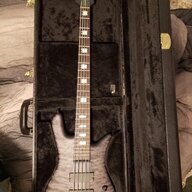
Don't forget Spector lolEmpress / Paulownia. Same thing

 weighing in at just under 9 pounds...
I think I was just trying to keep straight that g&l uses the term empress. But yeah, same thing. Isn't the Paulownia tree sometimes called "empress something or other?"Empress / Paulownia. Same thing. EDIT: 'Empress' is the trade name for Paulownia tomentosa
The new Spector Euro RST has empress woodI think I was just trying to keep straight that g&l uses the term empress. But yeah, same thing. Isn't the Paulownia tree sometimes called "empress something or other?"
Empress treeI think I was just trying to keep straight that g&l uses the term empress. But yeah, same thing. Isn't the Paulownia tree sometimes called "empress something or other?"

Off topic question: Been wanting to ask how it is playing the Dingwall with the fret configuration, especially on the high end. I have thought about picking one up but have some concerns about the frets and going back and forth between that and other five strings with the typical fret configuration.
This was my first fanned fret foray (say that 3 times fast as u can lol) and in all honesty, it felt completely natural when I first picked it up & played it. Maybe 5 minutes & I was good to go! One amazing thing about Dingwall , & I’m paraphrasing something I read here,” they have the unique ability to sing & sound like a harp up in the high register , while simultaneously roaring on the low end, & somehow sounding completely balanced across the strings” I’m absolutely loving the fanned frets! Dingwalls are really checking all the boxes for me- light weight (mine is 8.2lbs). Monster tone.. killer aesthetics.. go for it, life is short !
Edit: Lee sklar is playing a Dingwall here & sounds absolutely superb !
For sure, I love the 3 pickup configuration.. Lee Sklar’s Dingwall here at this Toto concert, has just two pickups and I really love his tone. Can’t go wrong with a Dingwall Imo !3 pickups don’t hurt either


