^^ thisSeems to me that most folks ask about the weight because they hope to avoid an aching back after standing up at a gig for two hours with your bass strapped on. Ouch!

TalkBass has been independent since 1998. Add your voice.
Create a free account to reply to discussions, view embedded media, and browse with fewer display ads.
Join free Log in
Want zero display ads or expanded classifieds tools? Compare plans.
^^ thisSeems to me that most folks ask about the weight because they hope to avoid an aching back after standing up at a gig for two hours with your bass strapped on. Ouch!


My 7lb (1973) PBass sounds phenomenal as does my 7.2lb Sadowsky.

Exactly!From a musical acoustics perspective it is the boundary conditions that rule sustain. If the bridge and the nut are extremely stiff and do not wiggle then the sustain goes on for a very long time. If they are loose not so much. Could a heavier bass be stiffer - yes but so could a graphite neck or an aluminum neck. When the boundary points move too much they absorb energy and take it away from the vibrating string, when they are very right the string keeps its energy. This one is simple laws of physics - the degree to which a string is damped and how long a vibration lasts until it drops by a given percentage is very measurable and objective.
The issue tone is far more complex in part because of how subjective tone is and also there are no units of tone so it is incredibly hard to measure. I have half a dozen basses and a dozen guitars and think (again subjectively) that the majority of the tone is in my fingers. And after that in the strings - skinny strings do not have now end, they do not sound "fat", same for soap bar pickups versus humbuckers. Bottom line is I think tone depends less upon the wood than on your fingers, strings and pickups. But clearly the mass (weight) matters because almost no one in the world plays semi hollow basses even if they weigh less. Why is that? I suspect for the same reason that hollow body guitars do not sound like solid body guitars. but this may be more about sustain than tone.
Instrument Weight is not a deal breaker for me, but amp and speaker cabinet weight sure increasingly are. In my teens and twenties it did not matter but in my fifties and sixties they sure do. But the weight of an instrument not so much. Then again I now play jazz which means I can always sit down.
My two cents but I have been a professional acosticican once upon a timer fifteen years.


1999Woodstock build by Mr.Spector himself (blue bass near the Center) Issue number “18”!! Still a great player but a tad heavy.What Spector do you have? Mine isn't that heavy. Yours must be solid maple maybe? I have the 2020 euro and this thing is amazing!View attachment 4429474
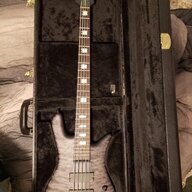
Very awesome!1999Woodstock Bullus by Mr.Spector himself (blue bass near the Center) Issue number “18”!! Still a great player but a tad heavy.

Interesting reply. I build neck- thru basses to avoid any resonance-robbing Interaction.With a bolt-neck instrument, you have two different pieces of wood, each with its own resonant frequency that affect the response of the vibrating string. A dead spot on the G string is caused by the resonant frequency of the neck absorbing the note. I believe it's the balance of the way the two pieces interact with the string, rather than weight alone, that produces tone in a bolt-neck instrument. I had a Tele bass that weighed 13 pounds, sounded smooth as a sax and sustained like a grand piano, with a wolf tone on the 4th fret of the G string. I had a P-bass that weighed 7 pounds (!) and had a beautiful peak in the mids, but a monster wolf tone around the 6th and 7th frets on the G string. Set necks smooth out the resonances.

It’s a Dingwall gigbag, very thick & heavily padded... thanks, I’m absolutely loving my Dingwall!the dingwell looks really cool. Is that a real case it is in? It looks like it. Not a 'gigbag' I hope.
My opinion is that Leo designed bolt on necks purely as a production enhancer, not a tone enhancer
With a bolt-neck instrument, you have two different pieces of wood, each with its own resonant frequency that affect the response of the vibrating string. A dead spot on the G string is caused by the resonant frequency of the neck absorbing the note. I believe it's the balance of the way the two pieces interact with the string, rather than weight alone, that produces tone in a bolt-neck instrument. I had a Tele bass that weighed 13 pounds, sounded smooth as a sax and sustained like a grand piano, with a wolf tone on the 4th fret of the G string. I had a P-bass that weighed 7 pounds (!) and had a beautiful peak in the mids, but a monster wolf tone around the 6th and 7th frets on the G string. Set necks smooth out the resonances.
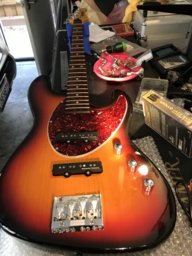
My neck throughs have maximum phase cancellation at higher spots, usually at the G string 10th-13th fret vs. 4-9 for bolt-ons. However, the spot is usually narrower, shallower, and rarely affects the D-string. Lightweight bolt-ons are the worst on average, but there's quite a lot of unit-to-unit variation for identical models. Even for bolt-ons, I think deep set 5 and 6-bolt designs help reduce the severity of 'wolf' tones. Love that term! I played one lightweight bolt-on recently and the E and F on G string 9-10 switched tuning from the fundamental to the 5th in less than a second. I watched on a real-time analyser and both the fundamental and first-octave overtone cancelled so quickly that the tone becomes almost identical to the harmonic above that fret.Interesting reply. I build neck- thru basses to avoid any resonance-robbing Interaction.