
Enjoy the benefits of a premium membership!
Upgrade Account
-
TalkBass has been independent since 1998. Add your voice.
Create a free account to reply to discussions, view embedded media, and browse with fewer display ads.
Join free Log in
Want zero display ads or expanded classifieds tools? Compare plans.
You are using an out of date browser. It may not display this or other websites correctly.
You should upgrade or use an alternative browser.
You should upgrade or use an alternative browser.
Does Alder or Ash Matter?
- Thread starter Dr. Cheese
- Start date
More options
Who Replied?

I used to play a mid-'70s Jazz Bass: 1-piece ash body with urethane finish; maple fingerboard; 3-bolt neck, '70s pickup placement and hardware.

Now I'm playing a mid-'60s Jazz Bass: 1-piece alder body with nitro finish; rosewood fingerboard; 4-bolt neck; '60s pickup placement and hardware.

They sound totally different. How much of that difference is due to body wood? Who knows?
I don't think it's any single factor. But, taken together, the differences add up to the point where one sounds like Marcus Miller's funk machine and the other like Bobby Vega's stack-knob.
Now I'm playing a mid-'60s Jazz Bass: 1-piece alder body with nitro finish; rosewood fingerboard; 4-bolt neck; '60s pickup placement and hardware.
They sound totally different. How much of that difference is due to body wood? Who knows?
I don't think it's any single factor. But, taken together, the differences add up to the point where one sounds like Marcus Miller's funk machine and the other like Bobby Vega's stack-knob.



Look again at answer post #3.
Ash or alder you ask------either one means nothing to the sound. The electronics do it (yeah yeah, HOW you play/technique, string type, etc affect things) . Unless of course if it is an acoustic...there you can get some tonal differences altho, again, even there, 99.99% of listeners would not hear the difference attributable to the wood species of the acoustic. Pretty much the same 99.99 would not hear a bit of diff between wood. Any diff they hear will be from other things, but often they will vehemently claim the wood is doing it. Whatever pulls their trigger I guess. Who cares.
Playing an enjoyable bass well is what means anything.
I can tell the tonal difference between solid and laminate tops on acoustics. That's about it though.
I've seen one video where they tested two wood choices on the same model of guitar, and you could kinda tell the difference there, however they were using two different guitars. There are too many variables that could be different. Maybe one of the pickups on one model was wound slightly differently. Also, two different players, two different techniques!
Last edited:

Not in any predictable, meaningful way. Predicting sound based on wood type, IMHO, is like astrology....it's fun and that's all. 2 pieces of the same wood species can differ widely in density and resonance and 2 basses made of the same body wood are just as likely to sound different (or the same) as 2 made from different woods. In theory, the shape of a side view mirror will affect the acceleration of a car due to wind drag......so there's that. In the real world, however, I advocate choosing the one that's lighter or the grain that's prettier. YMMV.

I used to play a mid-'70s Jazz Bass: 1-piece ash body with urethane finish; maple fingerboard; 3-bolt neck, '70s pickup placement and hardware.

Now I'm playing a mid-'60s Jazz Bass: 1-piece alder body with nitro finish; rosewood fingerboard; 4-bolt neck; '60s pickup placement and hardware.

They sound totally different. How much of that difference is due to body wood? Who knows?
I don't think it's any single factor. But, taken together, the differences add up to the point where one sounds like Marcus Miller's funk machine and the other like Bobby Vega's stack-knob.
The number one difference for your tone I'd say is the pickup position, and the pickups. The 70s position should be more slap happy.
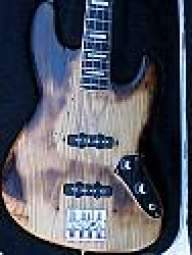
i think the wood affects the sustain more than anything else ... vibrations transferring thru the body , back thru the bridge , back to the strings ... where the tone is more string material and pickups .. ?
but as with ' the force ' ... the power of suggestion and the placebo effect are strong .. !
but as with ' the force ' ... the power of suggestion and the placebo effect are strong .. !

It all matters. The difficulty lies with being able to predict what impact the wood will have on the sound of a finished bass. By choosing a certain kind of wood you are, perhaps, stacking the odds in your favour but there are no guarantees. Having said that, I have experience with switching necks out on basses and have noticed changes in sound but have never switched out a body.
Yeah...that's the standard answer here at TB.The number one difference for your tone I'd say is the pickup position, and the pickups. The 70s position should be more slap happy.
But if I solo the neck pickups, they still sound very different. The ash/maple '70s Jazz always has a "wider spectrum" sound with more lows and snappier highs. The alder/rosewood '60s Jazz always has a more midrangey tone with softer highs and rounder lows.
So, it's not all pickup placement! Like I said...it's everything taken together.
True. This is part of the reason it can be really tricky predicting how a bass will sound.Wood is an organic material - every piece is different from every other piece - sometimes by a large amount.
There is probably s much difference between 2 pieces of the same wood as there is 2 pieces of different woods.

I've come to the opinion that the effect on sound of different woods is only negligible, whether you are discussing body wood, fretboard wood, etc.
It is much less marginal when it comes to acoustic instruments.
If you are playing totally clean, solo, for yourself and straining to hear a difference, it is likely you will hear a difference.
If you are playing solo electric bass transcriptions of Bach pieces in wonderful concert halls, maybe you and the audience will hear (or imagine you hear) a difference.
If you are playing in a band with anything in your signal chain (or not) at a bar or any venue in which people are talking, drinking, etc., nobody is going to know or care. For one thing, they are there to have fun and hear some good music. They aren't there to marvel at your magical bass tone.
In nearly any live situation, the audience isn't going to know or care (or be able to tell the difference, even if you tried to point it out to them) whether you are playing a $200 plywood Asian knockoff or a $4000 custom boutique build.
Between variations in technique, EQ, amp settings, effects pedals, not to mention modelers, you can get a huge variety of sounds out of any electric bass. As long as it is comfortable to you, intonates and holds tune and has reliable electronics, you're good to go.
Obviously a passive fretted 4-string P bass isn't going to sound much like an active fretless six string, but if you compare apples to apples (say a cheap off-brand P bass with a much more expensive name brand or custom P bass--both fretted, passive 4 stringers), in most any situation in which you are playing with others, there's not going to be a significant variance. IME and IMO. Particularly if you have similar pickups and electronics in them both.
Heck, I've had plywood/laminate electric guitars and basses that (to my ears as well as those of my bandmates) sounded as good or better than other much pricier and "better" or name brand instruments. It happens.
(Of course "better" is a very subjective term.)
It is much less marginal when it comes to acoustic instruments.
If you are playing totally clean, solo, for yourself and straining to hear a difference, it is likely you will hear a difference.
If you are playing solo electric bass transcriptions of Bach pieces in wonderful concert halls, maybe you and the audience will hear (or imagine you hear) a difference.
If you are playing in a band with anything in your signal chain (or not) at a bar or any venue in which people are talking, drinking, etc., nobody is going to know or care. For one thing, they are there to have fun and hear some good music. They aren't there to marvel at your magical bass tone.
In nearly any live situation, the audience isn't going to know or care (or be able to tell the difference, even if you tried to point it out to them) whether you are playing a $200 plywood Asian knockoff or a $4000 custom boutique build.
Between variations in technique, EQ, amp settings, effects pedals, not to mention modelers, you can get a huge variety of sounds out of any electric bass. As long as it is comfortable to you, intonates and holds tune and has reliable electronics, you're good to go.
Obviously a passive fretted 4-string P bass isn't going to sound much like an active fretless six string, but if you compare apples to apples (say a cheap off-brand P bass with a much more expensive name brand or custom P bass--both fretted, passive 4 stringers), in most any situation in which you are playing with others, there's not going to be a significant variance. IME and IMO. Particularly if you have similar pickups and electronics in them both.
Heck, I've had plywood/laminate electric guitars and basses that (to my ears as well as those of my bandmates) sounded as good or better than other much pricier and "better" or name brand instruments. It happens.
(Of course "better" is a very subjective term.)
Warmoth has pretty good descriptions of the tone of various woods. As a practical matter, alder is easier to finish (tighter grain) and ash looks more interesting with natural and transparent finishes because of the deep sweeping grain patterns. Most could not hear the tone differential.
I'm new to this, but I assume it is impossible to make a sandblast finish in an alder body right?
Also, to all the guys who argue "it's all pickups," have you considered this:
There is much less variation in pickups than other factors. Pick up two '70s Jazzes built in the same year. One sounds like a dead log, the other bright and lively. Pickup placement is obviously the same. Pull the pickups out and measure them: I bet they measure the same. So it can't be that simple.
As an example, I had two '90s Gibson Les Paul Specials. One sounded phenomenal ... like a P90 Les Paul should. The other sounded lifeless. I liked the looks of the "bad" one better than the "good" one ... So I swapped the pickups and electronics.
Guess what? The good one still sounded good and the bad one still sounded bad. How do you explain that?
There is much less variation in pickups than other factors. Pick up two '70s Jazzes built in the same year. One sounds like a dead log, the other bright and lively. Pickup placement is obviously the same. Pull the pickups out and measure them: I bet they measure the same. So it can't be that simple.
As an example, I had two '90s Gibson Les Paul Specials. One sounded phenomenal ... like a P90 Les Paul should. The other sounded lifeless. I liked the looks of the "bad" one better than the "good" one ... So I swapped the pickups and electronics.
Guess what? The good one still sounded good and the bad one still sounded bad. How do you explain that?
Last edited:
Yeah...that's the standard answer here at TB.
But if I solo the neck pickups, they still sound very different. The ash/maple '70s Jazz always has a "wider spectrum" sound with more lows and snappier highs. The alder/rosewood '60s Jazz always has a more midrangey tone with softer highs and rounder lows.
So, it's not all pickup placement! Like I said...it's everything taken together.
Oh yeah. The pickups might be wound differently was my other thought (which is why I said pickup placement and pickups themselves), also the 60s bass probably has pickups with more time to demagnetize a little.
Another factor is that tone capacitors have some tolerance, so even if you buy two .1 uF capacitors one could actually measure as 5% different than another one due to manufacturing tolerances.
Anyway, it's all together, like you said.
Also, to all the guys who argue "it's all pickups' have you considered this:
There is much less variation in pickups than other factors. Pick up two '70s Jazzes built in the same year. One sounds like a dead log, the other bright and lively. Pickup placement is obviously the same. Pull the pickups out and measure them: I bet they measure the same. So it can't be that simple.
As an example, I had two '90s Gibson Les Paul Specials. One sounded phenomenal ... like a P90 Les Paul should. The other sounded lifeless. I liked the looks of the "bad" one better than the "good" one ... Sonic swapped the pickups and electronics.
Guess what? The good one still sounded good and the bad one still sounded bad. How do you explain that?
Did you also swap the electronics harness, or was it just a pickup swap? Tone capacitors rated at the same number can actually be different when you measure them.
Are the bridges the same? Are the nuts made of the same material?
I think wood would have some minor effect, but not enough for the vast majority of people to notice. I'm not saying you didn't notice this, someone with a well trained ear might notice a 1% difference. It's similar to how well trained players notice the difference between a 1000 dollar bass and a 1500 dollar bass. Both might feel roughly the same to most people, but someone with trained fingers might really notice the 5-10% difference in comfort/playability.
Last edited:

actually, most solid-color Stingrays are poplar. Nobody ever asks about that, though.
key words: 'used to be'
EBMM has reported several times that since Y2K they changed to doing everything ash (save for mahog on some LE's).

It depends on the Ash sub species. Sure heavy ash will be heavier than Alder, but proper sourced swamp ash is like balsa wood in comparison...it's like magic...it has hardly any weight to it at all.placebo effect ... buy what you prefer. Normally Alder will be lighter than Ash otherwise it is a matter of look to me.

With a couple exceptions for example I've never played a basswood body bass I liked. I really don't think the body wood is as big a deal as the neck . My stringray is ash, had a warwick corvette FNA that was ash with a maple top. I've had two fenders with alder. But none of them had matching electronics and the the necks were different. I think the body woods impact on the instrument is debatable. But it has to have some impact as basses I don't like tend to be made out of the same materials like basswood and agithis.
As some have said, just buy what you like. I have owned enough of the same model bass to know what I believe...that wood matters, and no one here is going to change my mind on it.
Now I'm also of the train of thought, that if it sounds great that's all that matters.
Now I'm also of the train of thought, that if it sounds great that's all that matters.


