Nah, he just regurgitates what everybody else says.
He's a member now? Does he play flats?

TalkBass has been independent since 1998. Add your voice.
Create a free account to reply to discussions, view embedded media, and browse with fewer display ads.
Join free Log in
Want zero display ads or expanded classifieds tools? Compare plans.
He's a member now? Does he play flats?
Nah, he just regurgitates what everybody else says.


Thank you Good sir, beautiful explanation that is easy to understand and I appreciate the clarification.


Class Q: quantum power, infinite wattage but if you run a load under 2 ohms you may produce a singularity (not recommended)


Your cables must be made by spiritually pure monks from oxygen free copper.
What about Class G for "gagsters"?There's also Class H for hipsters...
A quick google brings up the manual for the Genz Benz Shuttlemax 9.2.So are you gonna tell us the manual you quoted?

ZE hills?If I say, "yes" can I run for something?

A post from Mr. Agedhorse.
Is it just me or are newer lighter rigs just lacking 'balls'?
I hate to break the bad news to you, but class AB amps also switch on and off, the positive going waveform devices shut off and hand off to the negative going waveform devices which turn on and then switch off as they hand the signal off to the positive going devices as the waveform becomes positive again. This happens at all frequencies simultaneously, at twice each signal's audio frequency component.
For all the snake oil discussions about class AB being continuous and class D being a switching amp, most neglect to mention that class AB/G/H are also switching amps of sorts. Managing the crossover artifacts at the hand-off points can be a bit of a challenge since they vary with temperature too.
I've designed both class AB/G/H amps and class D amps, each have their benefits and drawbacks, both can be difficult to design if looking for good, reliable results.
Here's what the current waveform looks like on a class B amp:
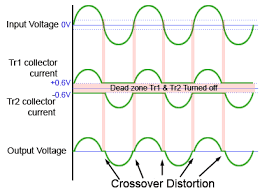
Class AB overlaps the dead zones by slightly forward biasing each half of the output stage, it's close but not perfect. This shows each half conducting with a slight bit of overlap:

Class D doesn't suffer from signal crossover issues, it's all based on differentiation and integration which results in a continuous signal from top to bottom and bottom to top. The switching occurs at roughly 350kHz, much faster than a typical analog to digital converter:
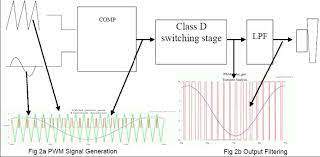
Here's a class G/H amp which has the same signal crossover issues as above plus additional switching of the high and low rails in and out at audio frequencies. The venerable and often worshiped CA-9 has 4 rail switches plus the signal crossover switching. If you look on a scope, the switching artifacts are visible, but like with class D, it's not audible in well executed designs.

I see what you’ve said here.I always thought that Class D was the one that took the short bus.
Is he a supporting member?He's a member now? Does he play flats?
Just remember those friendly words of advice on the front cover…”Don’t Panic!”Class Q: quantum power, infinite wattage but if you run a load under 2 ohms you may produce a singularity (not recommended)

Winner, winner, chicken dinner!!!A quick google brings up the manual for the Genz Benz Shuttlemax 9.2.