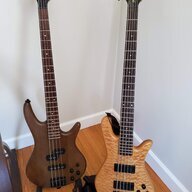
Guitarists - I guess they think the job will just wait while they change a string...
And that it's over if it's anything deeper than that.
Probably the same guitarist who tells everyone else to shut up while he tunes his guitar.

TalkBass has been independent since 1998. Add your voice.
Create a free account to reply to discussions, view embedded media, and browse with fewer display ads.
Join free Log in
Want zero display ads or expanded classifieds tools? Compare plans.
Guitarists - I guess they think the job will just wait while they change a string...
And that it's over if it's anything deeper than that.


Well, not every one of us does what Rinus Gerritsen of Golden Earring did for decades.A guitarist with two instruments? Sure, pretty standard, on occasion a third like slide or 12-string. No biggie. I usually have two basses, although most of the time it’s a fretted/fretless duo. Sometimes a 5 with a different feeling 4. Sometimes two different feeling/configured 4’s. I can never understand what the big issue about all of this is for some people.

Well, good for him. But maybe not everybody digs Danos. Maybe not everybody likes to deal with two necks, let alone the neck weight/dive potential. Maybe, if one is satisfied with long scale, they have no use for short scale. Maybe a player doesn’t feel comfortable with a body that extends downward like that. All sorts of reasons why that’s not a prevalent trend.Well, not every one of us does what Rinus Gerritsen of Golden Earring did for decades.

Because this twin neck bass combined two VERY different basses into one instrument.
The top neck is a long scale Fender and the bottom neck is a short scale Danelectro with a Kahler whammy bar. But that lower neck also was hollowed out, so there's this swimming pool rout underneath that pickguard. The pickups went to different amps in stereo. With the soapbars for the low end and the lipsticks for the high end.
Note also that it has only Master volume and tone and selector switch to switch necks. There was no way to select individual pickups on this bass.
He'd use this twin neck for decades as his main stage instrument, never even bothering to have a back-up. Because what's the point if the back-up is already there in his hands. One half of the twin neck goes bad, just switch to the other, DONE! You don't even need to take the instrument off.




Pet pieve. I dont run boards or stack 3 plus gtrs, plus 2 for the 2nd gtr...but I'm at fault for bring two basses..
My guitarist brings 3-4 to every gig. Not sure why so many. Tone I guess.

A string breaking is the least of my concerns. Stopping mid set to change a string and rearranging breaks is a pain but the show goes on. Its other failures that can't be fixed mid gig are the real issues. Having a spare for a broken string is just gravyYeah, no fault there. Had an input jack break on a gig - box of NOS '60s Switchcraft jacks at home, but gigs aren't so conducive to unplanned breaks and soldering fumes. Backup bass is much easier.
A string breaking is the least of my concerns. Stopping mid set to change a string and rearranging breaks is a pain but the show goes on. Its other failures that can't be fixed mid gig are the real issues. Having a spare for a broken string is just gravy
I know, but everyone else is talking stringsYeah/no - I was talking about input jacks, not strings