• TalkBass has been independent since 1998. Add your voice.
    Create a free account to reply to discussions, view embedded media, and browse with fewer display ads.
    Join freeLog in
    Want zero display ads or expanded classifieds tools? Compare plans.

Eden WT800 settings

I play a wt800d thru 2 410xlt's. I cant remember if these cabs are 4 or 8 ohms each. whatever they are, i do know that they are matching. I have always run this setup dual mono.

My question is if i can/should run my setup bridged? I know this greatly depends on my cab impedance, but in either case is this something i can do? If so, how?

again, sorry i cant remember. ive had this setup for about 7 years now.

The WT800d is a version of the WT800A. It cannot be bridged into less than 5.6 ohms (610XLT).
So two 8-ohm cabs (4 ohms parallel) is out, AFA bridged mode. Fine in dual-mono, though.
 
Actually, with the cabs I use, it sounds like a waste of time on stage.

Way out on the floor, it's not a waste. There is far less interference between the different size drivers in the mids. Makes having a wireless worth it. :D

Disagree. Driver size has VERY little to do with midrange response, and if the cabs are stacked vertically, it is pretty much a zero issue. By biamping, you are removing the low end from a cab that can handle it, putting all the low end strain (where the meat of your tone is) through a single cab. Makes no sense at all IMO.

Bi-amping the upper mids and treble into a small driver at low power does make sense. Dividing your amp in half and arbitrarily sending the bass and lower mids through one full range cab and the mid mids on up into another full range cabinet is not a positive thing. I think this idea originally made sense when there was more of a correlation between driver size and bass response (i.e., before there were 10's and 12's that could really kick down low). Today... not so much.

Bi-amping cabs of different design DOES indeed remove the phasing issue (note, not polarity issue, not dispersion issue). Because the two cabs now do not share any overlapping frequency.

This is, however, not an efficient setup, when the two cabs are both designed to go full range.
 
Guys,

Thanks for some valuable info.....I do play mostly with a pick about 70% of the time. I play a Peavey Dyna bass and a Music Man Sterling which jumped into my arms at GC and after trying 14 other basses sounded the best.

How do I know if it is an A B or C model? - I just replaced one side of the power amp with an updated PS. I would like to run in Bridge mode if I can run both cabs, again 2 8 ohm cabs.

So if i understand this right - if I have the B or C amp...still checking on that - I can run both cabs off the bridge connections....yes?? If I have the A model....SOL...:-0

Thanks!!
 
Guys,

Thanks for some valuable info.....I do play mostly with a pick about 70% of the time. I play a Peavey Dyna bass and a Music Man Sterling which jumped into my arms at GC and after trying 14 other basses sounded the best.

How do I know if it is an A B or C model? - I just replaced one side of the power amp with an updated PS. I would like to run in Bridge mode if I can run both cabs, again 2 8 ohm cabs.

So if i understand this right - if I have the B or C amp...still checking on that - I can run both cabs off the bridge connections....yes?? If I have the A model....SOL...:-0

Thanks!!

Look on the back of your amp for the date built. If it is March 15, 2005 or later, you have a B or C.
 
Thanks for the clarification and yes mine was dated on 1997 - so I do have the early version. I just changed the power block (not sure that matters) PN PM500 not sure if that makes a difference. From reading the replies looks Like I should just run it mono for both cabs and tweek the tones....I have have leraned plenty from those chimming in and thank you for that. Very much appreciated.
 
Bi-amping cabs of different design DOES indeed remove the phasing issue (note, not polarity issue, not dispersion issue). Because the two cabs now do not share any overlapping frequency.

This is, however, not an efficient setup, when the two cabs are both designed to go full range.

Yup. The 15s I use are just that. No 6", no tweeter, no fEAR. The 2x10s I use flat out die below 45 Hz or so, like 30 db down by 35 Hz. They sound great up where the 15" gets flappy sounding. I posted what I use earlier, and I drive them to best use 'em. In this case, biamping makes sense with the crossover point I use.
 
Bi-amping cabs of different design DOES indeed remove the phasing issue (note, not polarity issue, not dispersion issue). Because the two cabs now do not share any overlapping frequency.

This is, however, not an efficient setup, when the two cabs are both designed to go full range.

+1... but the phasing issues in most cases with bass guitar backline are minor, and you are losing WAY more than you are gaining biamping two full range cabs. Makes little sense.
 
How do I know if it is an A B or C model? - I just replaced one side of the power amp with an updated PS. I would like to run in Bridge mode if I can run both cabs, again 2 8 ohm cabs.

BTW, which specific Mesa/Boogie cabinet models are you using?

Unfortunately, your amp is the older A version which was not designed to bridge into 4 ohms (two 8 ohm cabinets in parallel). The B and C models use the PM500 power modules which have extra output transistors, plus a somewhat beefier power supply and better cooling to cope with the higher current demands of bridging into 4 ohms. An older WT-800A with two PM500s plus better cooling should be able to bridge into 4 ohms without a problem.

Generally speaking, the best setup for an older A-series Eden is to use either two 4 ohm cabinets, or one 8 ohm cabinet run bridged. Running two 8 ohm cabinets doesn't make use of all of the available power. Still, it will produce close to 2/3 of the available power into 8 ohms, so the difference would only be an issue if you're running right at the limit. At this point, I'd suggest using it with one cabinet hooked up to each side, trying each cabinet on both sides to see which works best (because you've got two different power modules). Probably best to avoid bi-amping.

From what you've written, it would appear that your WT-800A has one original PM400 and one new PM500 power amp module; these modules have somewhat a different design and specifications (440 W into 4 ohms and 2 ohm capability for the PM500). Why was the original power amp module replaced? Was it blown? Given that your amp now has two different power module types, I'd worry that bridging might not produce a symmetrical signal across the two power amps (bridged amplifiers generally employ two identical amplifiers working together).

Some years ago I emailed Eden and asked about bridging the older WT amps into lower impedances and was told by David Nordschow that the amp might shut down from thermal stress, but that it shouldn't be harmed. I've used my old WT-500 bridged into 4 ohms many times without a problem, but if you try it, do so knowing that it puts a greater strain on the amplifier. Also, the WT-500 produces less power, and therefore less current and less heat, and less stress on the output transistors. I've also upgraded the cooling on mine.

Where I think I'd focus now is in trying to find the best EQ settings to meet your goals. The bass control on the Eden boosts a lot of low, low, bass, and can rob a lot of power and punch, plus makes the speakers jump like crazy. This advice might sound counter-intuitive, but a lot of the punch is in the upper bass and lower midrange, not the low bass region. So, try turning the Enhance off, maybe even roll the bass back a tick, then try boosting in the 100 - 130 Hz range to fatter things up. Also try cutting a little in the midrange. One way to do this is boost the midrange EQ all the way and sweep around until it sounds the worst... then cut a little right there.
 
  • Like
Reactions: Ross Whitfield
Guys,

Thanks for some valuable info.....I do play mostly with a pick about 70% of the time. I play a Peavey Dyna bass and a Music Man Sterling which jumped into my arms at GC and after trying 14 other basses sounded the best.


I used to own a WT550, and had good results with the following settings.
With a bright bass, turn down the shelving treble control 2-3 notches.
With a mellow bass, turn down the shelving bass control 2-3 notches.
To add extra punch, 2-3 notches boost around 800-1100
Of course, Enhancer all the wat to the left.
 
It's interesting that everyone here recommends turning the "Enhance" knob to 0. I hated it from day one. The salesmen were always praising it but I could always hear the tone come to life as I turned it down.

Some of those enhance/contour circuits can be useful at low settings. (the GK contour and the Markbass VPF can be very musical at low settings with some cabs and basses). The Eden enhance is awful though, and is a pure 'mid sucker' at even low levels IMO.
 
Thanks for the advice, couple things..my Mesa Cabs are the older EV speakers Diesel cabs. The amp started to crackle on one side but not the other, so I knew it was time to bring it in. First time I had a problem in 12 years so that's not bad :-) I will try and see which way works best but from hearing from you guys, run it normal not bridged or bi-amped one speaker per side and go from there. Some of the tone suggestions have been good. I did not know about the enhancer sucking the mids out. I have adjusted that. Thanks!

 
Thanks for the advice, couple things..my Mesa Cabs are the older EV speakers Diesel cabs. The amp started to crackle on one side but not the other, so I knew it was time to bring it in. First time I had a problem in 12 years so that's not bad :-) I will try and see which way works best but from hearing from you guys, run it normal not bridged or bi-amped one speaker per side and go from there. Some of the tone suggestions have been good. I did not know about the enhancer sucking the mids out. I have adjusted that. Thanks!

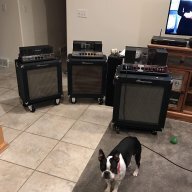
You might be good to go with that enhancer tweak. Should sound great, even though you aren't taking full advantage of the wattage. Try bumping up those low mids just a touch and it should punch like crazy.
 
... that 'punch and definition' factor that the OP is missing will GREATLY improve with more headroom.

[...]

...if you run it in dual mono into two 8ohm cabs, the output level is lame. Yes, you will get loud, but it will be a thin and 'compressed on the transients' loud.

...just looking at the 2db volume increase really does not describe the impact if you have ever compared the TONE of the WT800 at 400 vers 800 watts.

HUGE difference in punch, articulation, and the quality of the low end.
+1

I recently replaced my 8-ohm cabs with 4-ohm cabs and the difference was shocking. I thought the rig might just get a bit louder, but the quality of the tone changed dramatically. Greater harmonic content, more punch, more growl, more purr.

In my experience, the difference in running my WT800A in 4-ohms as compared to 8-ohms was huge.

Regarding the OP's original question, these are the settings I'm using right now - lots of punch (with a bit of sparkle):
(Fender Jazz>WT800>115+210)

Gain: ~12:30
Enhance: 9:00 (yes, I'm one who digs the enhance knob)
Bass: ~12:30 - 2 clicks up
Low Freq: ~125Hz (~10:30)
Low Gain: not quite 1:00 - 3 clicks up
Mid Freq: ~1000Hz (~11:30)
Mid Gain: 11:00
High Freq: 6.6 (12:00)
High Gain: ~12:30 - 2 clicks up
Treble: flat

Running this @ 4-ohms per side sounds amazing.

And, just for reference, here's a pic indicating all of the frequency points on the Eden EQ (The "Bass" knob operates @ 30Hz; the "Treble" knob @ ~2000Hz):
ParaEQ_Freq_labels.jpg
 
I recently replaced my 8-ohm cabs with 4-ohm cabs and the difference was shocking. I thought the rig might just get a bit louder, but the quality of the tone changed dramatically. Greater harmonic content, more punch, more growl, more purr.

In my experience, the difference in running my WT800A in 4-ohms as compared to 8-ohms was huge.

I'm a little concerned about possible confounds in this comparison. Although there ought to be an audible difference, again I'm wondering if the impedance was the only variable at work here. It is possible that the 8 ohm cabinets were somewhat worn out after years of service, partially explaining the difference in tone. Also, it could be that the manufacturer changed drivers since the original cabinets were built. The best way to compare would be by using new same-model cabinets that vary only in impedance.
 
I'm a little concerned about possible confounds in this comparison. Although there ought to be an audible difference, again I'm wondering if the impedance was the only variable at work here.
Certainly a valid point.
But what I found is exactly what KJung described:
What is clear from many years of experience with this amp, is that if you run it in dual mono into two 8ohm cabs, the output level is lame. Yes, you will get loud, but it will be a thin and 'compressed on the transients' loud.

...the 2db volume increase really does not describe the impact if you have ever compared the TONE of the WT800 at 400 vers 800 watts.

HUGE difference in punch, articulation, and the quality of the low end.


It is possible that the 8 ohm cabinets were somewhat worn out after years of service, partially explaining the difference in tone.
Not likely, though; those cabs didn't see much action.

Also, it could be that the manufacturer changed drivers since the original cabinets were built.
True; the 8-ohm cabs were a few years old

The best way to compare would be by using new same-model cabinets that vary only in impedance.
And, that they were.
 
Hey guys, I realize this is an old thread, but I’d like to throw this question out to you. I reciently was able to repurchase a nice Wt800B, a 8 ohm D210t, and a 4 ohm D410XLT. What are your though on running them together which would be a 6 ohm load? I realize the 410 cab more than likely handle my needs, but curiosity is- would they work well together if needed? Thanks, Ken