
Enjoy the benefits of a premium membership!
Upgrade Account
-
TalkBass has been independent since 1998. Add your voice.
Create a free account to reply to discussions, view embedded media, and browse with fewer display ads.
Join free Log in
Want zero display ads or expanded classifieds tools? Compare plans.
You are using an out of date browser. It may not display this or other websites correctly.
You should upgrade or use an alternative browser.
You should upgrade or use an alternative browser.
Double Bass Ehrlund "Sweet Spot", anyone?
- Thread starter William Hoffman
- Start date
More options
Who Replied?
Actually, this thread has been deserted, due to lack of putty.
Ric

The comments are useful and interesting. But I was wondering about a different aspect to Ehrlund's "sweet spot": the preamp. I understand you can use any preamp with the EAP, but [Invalid or Expired Link Removed] Ehurlund's preamp is "pretty strongly" recommended.
Can anyone comment on how important Ehrlund's preamp is to achieving optimal tone? Curious about what "tailoring" Ehrlund has injected into the box. My preference is to use another preamp. I definitely want to avoid stacking multiple preamps.
Also included with the EAP is the Ehrlund Preamp. It was designed to be used with the pickup, it features simple adjustments: a Volume Control, a "High/Low" Switch (Ehrlund recommends "low" for upright bass), and a Phase Switch for helping to reduce feedback or for switch phase to match a second pickup/microphone, if applicable. It also properly buffers the signal for whatever you're plugging into.
Ehrlund pretty strongly recommends that you use his preamp for the best possible results, particularly if you play arco. And, since it's INCLUDED, you might as well use it!
While it seems to be a pretty simple device, we suspect that Göran Ehrlund has carefully tailored the preamp's setup to specifically suit his pickup - it really does seem to sound better through the Ehrlund preamp than any other we've tried.
If you choose not to use the preamp in favor of another (or none at all), you certainly can. Important note for use with another preamp: if it has phantom power capability, you should turn it off when using the Ehrlund pickup, as it can cause a failure of the pickup (Goran says that it's a temporary failure that corrects itself, but I personally wouldn't want to test that theory on my pickup.) Otherwise, use whatever preamp you want - you won't break anything!
Ehrlund pretty strongly recommends that you use his preamp for the best possible results, particularly if you play arco. And, since it's INCLUDED, you might as well use it!
While it seems to be a pretty simple device, we suspect that Göran Ehrlund has carefully tailored the preamp's setup to specifically suit his pickup - it really does seem to sound better through the Ehrlund preamp than any other we've tried.
If you choose not to use the preamp in favor of another (or none at all), you certainly can. Important note for use with another preamp: if it has phantom power capability, you should turn it off when using the Ehrlund pickup, as it can cause a failure of the pickup (Goran says that it's a temporary failure that corrects itself, but I personally wouldn't want to test that theory on my pickup.) Otherwise, use whatever preamp you want - you won't break anything!
Can anyone comment on how important Ehrlund's preamp is to achieving optimal tone? Curious about what "tailoring" Ehrlund has injected into the box. My preference is to use another preamp. I definitely want to avoid stacking multiple preamps.

The comments are useful and interesting. But I was wondering about a different aspect to Ehrlund's "sweet spot": the preamp. I understand you can use any preamp with the EAP, but [Invalid or Expired Link Removed] Ehurlund's preamp is "pretty strongly" recommended.
Also included with the EAP is the Ehrlund Preamp. It was designed to be used with the pickup, it features simple adjustments: a Volume Control, a "High/Low" Switch (Ehrlund recommends "low" for upright bass), and a Phase Switch for helping to reduce feedback or for switch phase to match a second pickup/microphone, if applicable. It also properly buffers the signal for whatever you're plugging into.
Ehrlund pretty strongly recommends that you use his preamp for the best possible results, particularly if you play arco. And, since it's INCLUDED, you might as well use it!
While it seems to be a pretty simple device, we suspect that Göran Ehrlund has carefully tailored the preamp's setup to specifically suit his pickup - it really does seem to sound better through the Ehrlund preamp than any other we've tried.
If you choose not to use the preamp in favor of another (or none at all), you certainly can. Important note for use with another preamp: if it has phantom power capability, you should turn it off when using the Ehrlund pickup, as it can cause a failure of the pickup (Goran says that it's a temporary failure that corrects itself, but I personally wouldn't want to test that theory on my pickup.) Otherwise, use whatever preamp you want - you won't break anything!
Can anyone comment on how important Ehrlund's preamp is to achieving optimal tone? Curious about what "tailoring" Ehrlund has injected into the box. My preference is to use another preamp. I definitely want to avoid stacking multiple preamps.
The pickup works really well with any preamp that has a suitable input impedance. However, the Ehrlund pickup and buffer preamp were designed specifically to work together as a system, so they represent sort of the designers choice of ideal impedance buffering.
I have never owned an Ehrlund personally but I worked with someone who went down the rabbit whole of trying a bunch of different pickups. He initially bought just the Ehrlund pickup and it was a huge improvement over anything he had used previously. Later he bought the Ehrlund buffer preamp, and the sound was even better. That is not to say that everyone will have the same results as there are lot's of different preamps and I don't remember specifically which model he was using for sure, but I think it was one of the old style analog Fishman Platinum Pros' that looked like this.
I didn't think the Fishman was a particularly great sounding buffer preamp to begin with. The Fishman had 10meg input impedance. Per the EAP manual, the input impedance for the Ehrlund is 4.7meg. The difference in input impedance alone can make a noticeable difference as it impacts the frequency response and dampening of the pickup. With some piezo's 10meg is a bit too high and the sound tends to be a bit loose and woolly (underdamped).
Another little part of the puzzle is my friend spent a couple of hours with a stethoscope and a partner narrowing in on the best location for the pickup. I believe his placement was a bit lower than most, but I don't think that really matters, as the optimum position is likely to vary from one bass to the next, and also it will vary upon what you think a bass should sound like. IMHO, the resultant sound through the Ehrlund was very close to a mic'ed bass, but rejection of the sound from surrounding instruments and gain before feedback were both very good.
The one bit of advice I have heard, is don't choose and Ehrlund for a crappy sounding bass as it will reproduce the crappiness authentically.

I’ve gigged with the Ehrlund EAP for 10 years. It definitely needs a preamp, so the simplest solution is to purchase Ehrlund’s, because it costs less.
However. I prefer the Headway EDB-2, because it’s tone shaping, EQ section and feedback controls are better. The price difference is worth it. Both the Ehrlund
preamps I owned failed, one after dropping less than 1 ft onto the carpet one just failed. Their U.S. distributor can be very difficult to deal with so IMHO it is easier to return
them to Sweden, for evaluation and repair. Just my take
P.S. Somewhere in the Ehrlund threads, there’s a frequency shaping analysis posted, it’s a clean boost of the entire frequency range with very low distortion.
However. I prefer the Headway EDB-2, because it’s tone shaping, EQ section and feedback controls are better. The price difference is worth it. Both the Ehrlund
preamps I owned failed, one after dropping less than 1 ft onto the carpet one just failed. Their U.S. distributor can be very difficult to deal with so IMHO it is easier to return
them to Sweden, for evaluation and repair. Just my take
P.S. Somewhere in the Ehrlund threads, there’s a frequency shaping analysis posted, it’s a clean boost of the entire frequency range with very low distortion.
Last edited:
The Ehrlund Preamp is pretty nice.. but with my Felix the Ehrlund PU is even "nicer"...  as said before it works with any preamp using an input impedance, that is "high enough"...
 and the Felix offers additionally the possibility to mix the Ehrlund with my Remic
as said before it works with any preamp using an input impedance, that is "high enough"... and the Felix offers additionally the possibility to mix the Ehrlund with my Remic 
The Ehrlund preamp is mostly an impedance buffer with 4.7 MegOhms i put impedance, a switchable fixed highpass filter (for higher sounding instruments) and a phase flip.
So it is not far from a HPFpre. The 10 MegOhms input impedance can easily be changed to a 5 MegOhms impedance by soldering a second 10 MegOhms resistor in parallel to the existing one. Put a switch at it and you can switch between 10 and 5 MegOhms (can inject some noise if open). that would be cheaper than the Ehrlund preamp and you get a more helpful highpass filter for DB.
EQ in a preamp can easily introduce noise (Fishman) or is rather expensive (Grace) or something in between.
So it is not far from a HPFpre. The 10 MegOhms input impedance can easily be changed to a 5 MegOhms impedance by soldering a second 10 MegOhms resistor in parallel to the existing one. Put a switch at it and you can switch between 10 and 5 MegOhms (can inject some noise if open). that would be cheaper than the Ehrlund preamp and you get a more helpful highpass filter for DB.
EQ in a preamp can easily introduce noise (Fishman) or is rather expensive (Grace) or something in between.
The Ehrlund Preamp is pretty nice.. but with my Felix the Ehrlund PU is even "nicer"...
Absolutely, since the Grace what's essentially a pair of their M101 microphone preamps with added EQ controls, HPF, Notch Filter 48 volt phantom, Channel Switching, and a signal boost. It gets the most out of the EAP.
The Ehrlund preamp is mostly an impedance buffer with 4.7 MegOhms i put impedance, a switchable fixed highpass filter (for higher sounding instruments) and a phase flip.
So it is not far from a HPFpre. The 10 MegOhms input impedance can easily be changed to a 5 MegOhms impedance by soldering a second 10 MegOhms resistor in parallel to the existing one. Put a switch at it and you can switch between 10 and 5 MegOhms (can inject some noise if open). that would be cheaper than the Ehrlund preamp and you get a more helpful highpass filter for DB.
EQ in a preamp can easily introduce noise (Fishman) or is rather expensive (Grace) or something in between.
I tried the EAP with both the HPF Preamp and the Ehrlund Preamp. The HPF just didn't have enough gain to ( I believe it's 2 DB) to drive the EAP into the Walter Woods amps, I was using at the time. The Ehrlund Preamp did, but boosted
the low frequencies to much for my taste. Either the Headway or the Grace work very well.
So it sounds like there are two preamp issues related to Ehrlund tone shaping. One is providing an adequate boost in signal strength. The other is impedance. If Ehurlund uses 4.7MegOhms, and if a preamp's input impedance is 10MegOhms, then it's all good? Or does the input impedance have to exactly match 4.7? I get it if the input impedance is too low, such as 1 or 2 MegOhm.
no is has not be the "exact" impedance... the higher, "the clearer"...but if the input impedance gets higher, it becomes also more sensitive for interferences and cable length and so on.......If Ehurlund uses 4.7MegOhms, and if a preamp's input impedance is 10MegOhms, then it's all good? Or does the input impedance have to exactly match 4.7..?
A factor of two makes a difference ... up to the point where only the sensitivity to noise raises. A difference in between (times square root of two) might make sense too, but finer than that doesn’t matter for most of us.
A few piezo foil pickups work best with 22 MegOhms, but above that are typically condenser mics with a GigOhms resistor on the cable from capsule to (internal) amplifier towards ground.
A few piezo foil pickups work best with 22 MegOhms, but above that are typically condenser mics with a GigOhms resistor on the cable from capsule to (internal) amplifier towards ground.
I said basically. The Ehrlund uses OP-amps which can deliver a higher voltage amplification than the HPFpre design.I tried the EAP with both the HPF Preamp and the Ehrlund Preamp. The HPF just didn't have enough gain to ( I believe it's 2 DB) to drive the EAP into the Walter Woods amps, I was using at the time. The Ehrlund Preamp did, but boosted
the low frequencies to much for my taste. Either the Headway or the Grace work very well.
It basically it is a current (impedance) and voltage (signal level) amplifier with no EQ except for the switchable filter.
So for me the Ehrlund preamp is an impedance buffer with a few extras. Similar to the HPFpre but, of course, not completely the same as the HPFpre.
The Felix, EDB and some of the Fishmans are closer to a preamp (what would be the preamp of your bass amp without EQ?) than the impedance buffers with some extras.
But from a practical point of view Ric is right, specially if your amps gain is maxed out.
no is has not be the "exact" impedance... the higher, "the clearer"...but if the input impedance gets higher, it becomes also more sensitive for interferences and cable length and so on....
Not so far mentioned (I think) is the very easily accesible volume control (I have the Erlund preamp on the afterstrings at the tailpiece) which is much easier to adjust than physically moving to the amp (a Walter Woods in my case) to change volume.
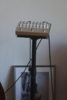
I put the Felix on a misappropriated Box stand, which makes the "physical access" very easyNot so far mentioned (I think) is the very easily accesible volume control (I have the Erlund preamp on the afterstrings at the tailpiece) which is much easier to adjust than physically moving to the amp (a Walter Woods in my case) to change volume.

no is has not be the "exact" impedance... the higher, "the clearer"...but if the input impedance gets higher, it becomes also more sensitive for interferences and cable length and so on....
The interaction between the capacitance of the piezo and the driven device form a high pass filter. Higher input impedance lowers the cuttoff of the HPF. This is one of the reasons piezo sound bad if the input impedance is too low.
The issue I mentioned about dampening is also something that should be considered. If the input impedance is increased too far beyond optimum, the circuit can begin to become underdamped. This is a bit beyond my understanding but I believe underdamped essentially means the circuit starts to become resonant so the frequency response can become uneven and the sound is no longer tight and controlled. One person I respect has said his bass is more prone to feeding back if the input impedance is too high.
Optimum input impedance varies with the type and size of the piezo used in the pickup, since that is what determines that actual capacitance. In other words each type of piezo pickup will have a range of input impedance that is considered ideal. AFAIK 1 Meg is at the low end and 10Meg is too much for many pickups. My guess is the designer felt the sweet spot for the Ehrlund was 4.7Meg.
But obviously some pickups sound great with even more impedance since we have some preamps and buffers with variable input impedance over 20 Meg. Here's a long thread that discusses this matter: Sarno Black Box
Another thing to consider is the difference between 4.7 Meg and 10 Meg may be fairly subtle. I have a Radial PZ DI that has switchable input impedance: 220k, 1Meg, 10Meg. I haven't used this with a piezo yet, but I am told it generally sounds best at the 1Meg setting. 1Meg is the setting I prefer with my active basses, but the difference is very subtle and someone else may prefer a different setting. It's possible the difference would be more noticeable with a piezo pickup, and as I suggested earlier, the best setting could be dependent on the brand and model of pickup.
So it sounds like there are two preamp issues related to Ehrlund tone shaping. One is providing an adequate boost in signal strength. The other is impedance. If Ehurlund uses 4.7MegOhms, and if a preamp's input impedance is 10MegOhms, then it's all good? Or does the input impedance have to exactly match 4.7? I get it if the input impedance is too low, such as 1 or 2 MegOhm.
The issue for me was that using the HPF didn’t sound great and didn’t have enough gain. The Ehrlund Preamp has was to fragile and not easy to get serviced or replaced, so the EDB-2 was a more robust build and design.
The issue for me was that using the HPF didn’t sound great and didn’t have enough gain. The Ehrlund Preamp has was to fragile and not easy to get serviced or replaced, so the EDB-2 was a more robust build and design.
I don't know if it's been mentioned here, but the EDB-2 has a 5Meg input setting.
My EAP arrived. Sounds great. So I'm geeking out technical insights and found this video. It's about Ehrlund microphones, which apparently have triangular capsules (?). The EAP is triangular, but contact derived so I suppose the same principles apply. After watching this, the implication is that all round capsules don't sound as clear as the Ehrlund mics. I hardly think it's that bleak (else I've wasted a lot of money on nice mics!!). But worth a watch if you're into this stuff....


