View attachment 3289185
These may be the body faces, or I may throw them away and make others. That's the beauty of using cheap materials.
I spent about £90 just on the sapele, so less cheap

TalkBass has been independent since 1998. Add your voice.
Create a free account to reply to discussions, view embedded media, and browse with fewer display ads.
Join free Log in
Want zero display ads or expanded classifieds tools? Compare plans.
View attachment 3289185
These may be the body faces, or I may throw them away and make others. That's the beauty of using cheap materials.
View attachment 3328692
The end pin will retract into the neck heel.
View attachment 3328693
Got the neck shaped. It is massive, it weighs almost 4 pounds. The solid plywood body isn't light either, especially with the steel end pin inside. I'm going to put strap buttons on this thing, so you can put it on. That's why I used lightweight tuners. If the body is heavy enough and the strap button is way out there, it just might balance.
View attachment 3328697
The truss rod. No point having it go up to where the neck is double thickness. It may not be any use at all, but I put it in just in case. The headstock reminds my of those old aluminum-necked Kramers. That was an awful idea, but it looked cool.
View attachment 3328698
The back of the neck, shaped mostly by hand with files. This is Home Depot wood. I hope I made the headstock strong enough. It is an inch thick, and I drilled the tuner holes undersized and filed them out for a press-fit, so the tuners will take up some of the load themselves. The heel bump is at the octave.
I have sketched out some wiring channels on the body. I'll rout these in and then glue on the top, this way they will miss the end pin channel. This project is way out there on the weirdness scale for me, I'm just winging it.

View attachment 3337700
The wiring is all in and working. I'm not going to show my un-beautiful soldering. The controls are:
Inside is one of my pre-built piezo buffers. Pulling the wires through was relatively easy, thanks in no small part to having access through the battery cavity. All the wires pass through a bend there. The binding came out nice too. The only thing left is to finish the neck, my usual Minwax satin poly.
- volume (top) tone (bottom)
- pickup selector (parallel)
- series/parallel mode for humbucker
The end pin ( or guitarist poker, as I am starting to think of it ) is some sort of red wood that nicely matches the rest. The whole thing has a nice unplanned coordinated color scheme. I put all the parts on a scale, and it comes to just under 12 pounds. If I had known it would balance so well, I could have chambered-out a pound or two, but too late now. It's primarily a floor-stander anyway.
View attachment 3271824
The other day I cut this fingerboard from a piece of Brazilian Cherry floorboard that I begged from a home supplies place. 6" radius, 36" scale, double-octave. This stuff is super hard, this is not a job I ever want to do again. Fortunately, it came out good, I still need to add the regulation dip in the middle and trim the sides to about 2" at the nut and 3-1/2" at the other end.
Laid out here with my Audiovox templates, and uke bass. I think it will be neat to make a tiny uke and a giant upright from the same body. I will use the 5-string magnetic pickup in the picture, and a pair of piezos in the bridge. I also ordered a cello end-peg. I'll make the bridge from the remainder of the flooring.
The body is going to be as solid and heavy as I can make it. I don't expect this long neck to balance very well, but it would be neat if you could pop it in your lap or even put a strap on it, as well as play it upright. I've never built anything like this before. I chose the specs from looking at commercially available models. The scale should be suitably uncomfortable, but still be able to use normal bass strings. The radius should be good for fingering, I don't care about bowing, and it should work well enough with the pickup.
I've changed my mind about making it lined. I think installing lines on this radius would be very difficult. Instead, I will install dots on the fretboard where the lines would be. I thought that was pretty clever, then I saw that Steinberger already does it. It's still pretty clever, just not as original as I thought. I have a roll of aluminum wire that I use for side markers that will work perfectly. I will also put regular dot markers on it, I'm not going to pretend I can find my way around on one of these things unaided.
Leo Fender's original idea ( or uninformed guess ) was that you would place your fingers there and play with your thumb. Leo's "tug bar" didn't catch on, but luthiery is all about preserving mistakes, so there it is today. Even Fender acknowledged his mistake and moved it to the other side on later models. Leo Fender was very much a loothier, and an inspiration to us all. Gibson, on the other hand, are luthiers of the finest tradition.
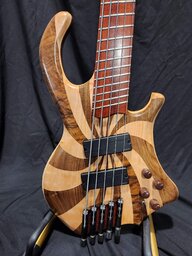
Two steps forward, one step back
I was playing around with my new EUB/UEB*, and realized that one of the tuners was really bad. Too cheap and sloppy even for me. So I took it off and broke it, but I may have learned something. I think the only tension on the post is the round cover that is press-fitted on the back. If that cover is not on quite tight, the post can be loose. A few smacks on that cover with something like a fretting hammer can tighten it up. A few smacks on the post can push the cover off so you can tighten-up the retaining screw, but that may also wreck the tuner. Loctite is apparently not a thing in China.
Anyway, I pulled all the tuners and replaced them with better ones, since this build is actually working out. That took a while carefully filing out the holes on a finished neck, because the new ( but still cheap Chinese ) tuners are beefier than the old ones. The three remaining old tuners will go in the parts box for spares. If I had made the headstock longer and staggered the tuners, I could have used a 15mm socket on the bushings instead of a risky pliers. I got one side with the socket. Little details to remember for later. In a factory setting, that would be a big detail.
I don't mind using cheapo tuners. They get the job done. If I ever want to, I can always replace them with fifty dollar Gotohs, but at that rate I would be building a lot fewer experiments. This entire build came in well under $100, with all the free stuff I scrounged.
Since Rotosound has not acknowledged either of my inquiries, one to the US and one to the UK, instead of replacing one defective string, they can eat the whole set. My return window with Amazon closed today, but last night I arranged the return just in case. Rotosound might answer in a few days, Europeans work on a different schedule than us Yanks, always in a hurry. In that case, I will get a spare G string and put it in the string box for insurance. I think these strings are made no different than the regular scale, but are under greater tension and therefore more likely to fail.
Since this bass is going to be apart for a while now, I took off the drawer pull and tossed it in a jar of acetone to get the icky lacquer off it. I sanded the inside, so now I get a good electrical contact for all the strings, and can put the ground wire back on. With tape-wound strings, it is kind of pointless, but it may not always have these strings on it. I will coat the exterior of the part with good polyurethane, which should age it a bit yellow. I find myself using the drawer pull for a handle quite a bit. It's a good trick to remember.
I found that the tone control does work - it wipes away finger squeaks and line noise, but these strings have so little high end that it doesn't make much difference otherwise.
Finally, I re-oiled the floorboard, and set it aside where I can admire it until my new strings arrive. When I get it back together, I can go back to re-learning I-IV-V patterns and stuff. One thing with a 36" scale - you quickly learn to appreciate open notes. I have a pretty long reach with my pinky, but not that long. If I do another of these, I will give it a regular bass neck.
* I like UBE -- Yoob.

When I got a Stagg EUB I watched the YouTube upright lessons by Chris Fitzgerald (a mod over on the dark side) for basic left and right hand technique. They got me started with the correct technique and no doubt stopped me injuring myself.Right now, trying to play this thing really throws me for a loop. It's going to be a learning curve for sure.