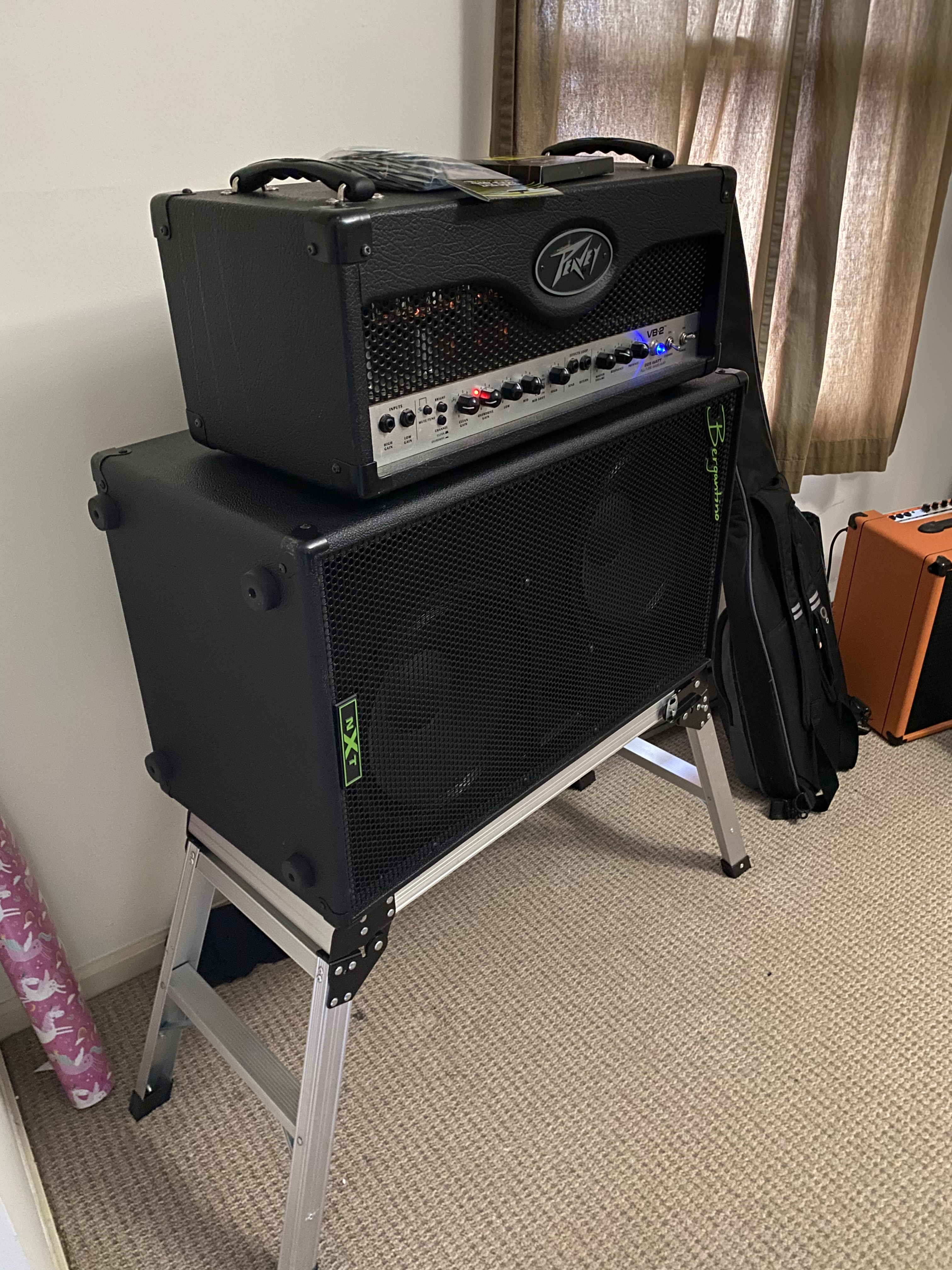
I've never elevated a cab before, but I think it will do the trick for this 212. Last show was a bit boomy, and I've never liked the T configuration that much (thin cab, wide amp). I had a step ladder I was thinking of using. Seems sturdy, but just looking to see what others thought.

Enjoy the benefits of a premium membership!
Upgrade Account
-
TalkBass has been independent since 1998. Add your voice.
Create a free account to reply to discussions, view embedded media, and browse with fewer display ads.
Join free Log in
Want zero display ads or expanded classifieds tools? Compare plans.
You are using an out of date browser. It may not display this or other websites correctly.
You should upgrade or use an alternative browser.
You should upgrade or use an alternative browser.
Elevating cab - thoughts on this setup?
- Thread starter madmarvin
- Start date
More options
Who Replied?

If it were me, I would do whatever I could to get that 2x12 oriented vertically. Muffin top for the win!
Fishheadjoe
Fishheadjoe
If it were me, I would do whatever I could to get that 2x12 oriented vertically. Muffin top for the win!
Fishheadjoe
Why so? I've tried it both ways, this seems to "sound" better with less volume. Less boomy too. It's also in my house in my office which has completely bit me in the ass before, hence getting some thoughts. Got a couple shows coming up and no real time to test it out.
Well, easier to hear as the top 12 will be closer to your ear. Others with more knowledge might chime re combing effect.
I'd use the ladder for the head and the 2x12 on is own, on it's end.
Fishheadjoe
I'd use the ladder for the head and the 2x12 on is own, on it's end.
Fishheadjoe

I would add a pad of some sort under the cab to curb vibration etc.
Well, easier to hear as the top 12 will be closer to your ear. Others with more knowledge might chime re combing effect.
I'd use the ladder for the head and the 2x12 on is own, on it's end.
Fishheadjoe
Ah ok that makes sense. The height of the speakers is about the same as it would be for the top speaker without the step ladder, kind of hard to tell from the picture but the speaker is about 20" off the ground. The head does rest fine on top of it, I haven't had any issues there, so I don't know if I would bring the step ladder just for the head....now standing the whole thing on top of the ladder was something I hadn't considered, but that might be really overkill lol. But thank you, I like what you are saying about getting everything closer to the ear, that was part of my goal. And last show was super boomy, so I'm trying to cut out as much as I can and keep volume levels up.
At least no one so far has said it's a terrible idea lol.

I think it's preferable to the "T" configuration, but elevating the cab won't do anything about the 'boomy'. IME anyway.
Edit: And before too many folks weigh in on 'dispersion', I'll just say that 2 elements don't make much of an 'array'.
Edit: And before too many folks weigh in on 'dispersion', I'll just say that 2 elements don't make much of an 'array'.
Last edited:

I prefer elevating and also tilting my cab towards my ears. IMHO it does make a noticeable change to how the rig sounds and specifically can help with boominess.
Whether it's an improvement or not depends on how you like the bass to sound. I like a very clear, articulate sound so I like it. People that like a deep pillowy sound with not a lot of extension in the highs typically do not like it.
There are two things going on with the elevated cab. First you are decoupling the cab from the floor. You may have heard of mutual coupling. This is what happens when you have two identical speakers tight packed. The mutual coupling occurs for frequencies in which the distance between the drivers is within about 1/4 wavelength. So this means the acoustic coupling happens mainly at low frequencies.
The same thing essentially happens if you have a cab on the floor. The floor sort of functions as an acoustic mirror and reflects the sound back, as if there is another speaker on the other side of the floor. So you get similar acoustic coupling when the cab is on the floor. See this article on "space loading" https://www.prosoundtraining.com/site/wp-content/uploads/2012/03/VOL36_DEC08_Boundaries-1.pdf
When you raise the cab you increase the distance from the floor. Because the sound has to travel a longer distance, the sound decays more so there is less coupling going on. The inverse square law states sound intensity decrease by 6dB for each doubling of distance. Remember the bounce involves a two way trip. The sound travels down to the floor and then bounces back up. At some distance from the floor you enter "whole space" and there is no gain. See the article linked above.
Another thing that happens when you elevate the cab is you get a notch in the low mids that is determined by height. This relates to distance, wavelenght, phase angle, etc. Here's an article on boundary interference that provides a relatively simple explanation: Speaker Placement 101: Is Speaker-Boundary Interference Killing Your Bass? Essentially the notch will occur where the distance between the driver and the floor equals 1/4 wavelength. See attached Frequency Wavelength Chart. I believe the column labeled "Wavelength to Trap in feet" is the relevant column.
In my experience as both a bass player and an audience member, elevating the bass cab can make a difference in cleaning up the sound in a boomy room.
As far as the horizontal VS vertical array. As a bassplayer, the horizontal array may actually be better, especially if you do not move around. This placement will increase vertical dispersion so you can hear better, but it will limit the horizontal dispersion so the cab is less effective at covering the audience. This is not a concern if the PA carries the bass to the audience.
My last last touring rig was encased in a 16-space rolling rack. I stacked an Eden D210XLT vertically on top of the rack with a Countryman Type-85 wedged under the front edge to tilt it back and aim it at my head. We had full PA with subs and monitors for everyone so my rig was only intended to serve my needs. This rig did not provide heavy lows, but it gave me what I needed. With some bands; one drummer in particular, I had to bring out a D410XLT and put it on the floor, because he wanted more lows.
Whether it's an improvement or not depends on how you like the bass to sound. I like a very clear, articulate sound so I like it. People that like a deep pillowy sound with not a lot of extension in the highs typically do not like it.
There are two things going on with the elevated cab. First you are decoupling the cab from the floor. You may have heard of mutual coupling. This is what happens when you have two identical speakers tight packed. The mutual coupling occurs for frequencies in which the distance between the drivers is within about 1/4 wavelength. So this means the acoustic coupling happens mainly at low frequencies.
The same thing essentially happens if you have a cab on the floor. The floor sort of functions as an acoustic mirror and reflects the sound back, as if there is another speaker on the other side of the floor. So you get similar acoustic coupling when the cab is on the floor. See this article on "space loading" https://www.prosoundtraining.com/site/wp-content/uploads/2012/03/VOL36_DEC08_Boundaries-1.pdf
When you raise the cab you increase the distance from the floor. Because the sound has to travel a longer distance, the sound decays more so there is less coupling going on. The inverse square law states sound intensity decrease by 6dB for each doubling of distance. Remember the bounce involves a two way trip. The sound travels down to the floor and then bounces back up. At some distance from the floor you enter "whole space" and there is no gain. See the article linked above.
Another thing that happens when you elevate the cab is you get a notch in the low mids that is determined by height. This relates to distance, wavelenght, phase angle, etc. Here's an article on boundary interference that provides a relatively simple explanation: Speaker Placement 101: Is Speaker-Boundary Interference Killing Your Bass? Essentially the notch will occur where the distance between the driver and the floor equals 1/4 wavelength. See attached Frequency Wavelength Chart. I believe the column labeled "Wavelength to Trap in feet" is the relevant column.
In my experience as both a bass player and an audience member, elevating the bass cab can make a difference in cleaning up the sound in a boomy room.
As far as the horizontal VS vertical array. As a bassplayer, the horizontal array may actually be better, especially if you do not move around. This placement will increase vertical dispersion so you can hear better, but it will limit the horizontal dispersion so the cab is less effective at covering the audience. This is not a concern if the PA carries the bass to the audience.
My last last touring rig was encased in a 16-space rolling rack. I stacked an Eden D210XLT vertically on top of the rack with a Countryman Type-85 wedged under the front edge to tilt it back and aim it at my head. We had full PA with subs and monitors for everyone so my rig was only intended to serve my needs. This rig did not provide heavy lows, but it gave me what I needed. With some bands; one drummer in particular, I had to bring out a D410XLT and put it on the floor, because he wanted more lows.
Attachments
This part isn't exactly accurate. In a linear array, the dispersion will narrow in the axis of the array, but in the axis perpendicular to the array, the pattern does not widen -- the dispersion stays the same as for an individual element of the array. So in a horizontal array, the dispersion will narrow in the horizontal axis but stays the same vertically.This placement will increase vertical dispersion
But as I say, two elements don't really comprise much of a linear array.
This part isn't exactly accurate. In a linear array, the dispersion will narrow in the axis of the array, but in the axis perpendicular to the array, the pattern does not widen -- the dispersion stays the same as for an individual element of the array. So in a horizontal array, the dispersion will narrow in the horizontal axis but stays the same vertically.
But as I say, two elements don't really comprise much of a linear array.
Sorry, I was speaking figuratively in relative terms rather than in accurate technical terms.
This horizontal arrangement will have wider vertical dispersion
than this vertical arrangement
But if you want to be technical, I agree the vertical arrangement limits vertical dispersion, rather than the horizontal arrangement increasing dispersion, so I stand corrected
 .
.But the intent of my statement stands. The horizontal arrangement may still be preferred by the bass player. It really comes down to how the rig will be used.

This has saved me on many an occasion. I modified a keyboard stand and it works perfectly with my rig. I have been in rooms that were were a bear to dial in. Decoupling from the floor did the trick.

If it’s sturdy it’ll probably be fine. Ive play a lot of gigs using a 15 cab as an amp stand for a 410(15 not even plugged in) helps on shallow stages. But if I was playing where there’s minimal or no bass in the pa id put it on the floorI've never elevated a cab before, but I think it will do the trick for this 212. Last show was a bit boomy, and I've never liked the T configuration that much (thin cab, wide amp). I had a step ladder I was thinking of using. Seems sturdy, but just looking to see what others thought.
View attachment 4213274

Also if you put it on a ladder people might want to walk under it and that is bad luck, I’m told. That’s a big amp. I see your geometric dilemma. It’s not a problem but maybe...
OK OK OK I’ve got it...
Get another matching cab so your stack looks more symmetrical. And then get a smaller amp for smaller gig days. Win-win.
OK OK OK I’ve got it...
Get another matching cab so your stack looks more symmetrical. And then get a smaller amp for smaller gig days. Win-win.

Nice 'ladder.' Your description scared me until the picture came up!!! Not at all what I thought at first! Anyway, I think it'll help quite a bit just as shown. Please bring the thread back up an let us know your results.
Also, as mentioned, I think the drummer being able to hear your cab is something really important that is very seldom brought up in these threads. Especially when not going through the PA. Even our guitar player will occasionally ask me to cant my rig his way just a bit so he can hear me. Funny, I never have any issue hearing either of them!!!
Also, as mentioned, I think the drummer being able to hear your cab is something really important that is very seldom brought up in these threads. Especially when not going through the PA. Even our guitar player will occasionally ask me to cant my rig his way just a bit so he can hear me. Funny, I never have any issue hearing either of them!!!

It would be good to see how loud it can go without rattling - and if it does rattle, can you fox the rattl with some felt or rubber pads.

Buying another Berg 212 is the obvious solution

I use 2 different Berg 2x12 cabs (CN212 and NV212t). I always run them vertically and carry a device (foam wedge usually) to tilt the cab up a bit and I never have an issue with the amp (usually a Mesa WD800 or Walkabout) sliding off (the tilt angle is not too acute) and I can hear myself just fine.
here is an example of a retail version of the wedge (Ampwedge) but you could easily make one out of firm, small cell foam too.
https://www.musiciansfriend.com/acc...2Zc3mmLzbdOMJpcogBUPeNS4aoGWOdi8aAu6GEALw_wcB
here is an example of a retail version of the wedge (Ampwedge) but you could easily make one out of firm, small cell foam too.
https://www.musiciansfriend.com/acc...2Zc3mmLzbdOMJpcogBUPeNS4aoGWOdi8aAu6GEALw_wcB

The horizontal dispersion would be better with the cab mounted vertically.If it were me, I would do whatever I could to get that 2x12 oriented vertically. Muffin top for the win!
Fishheadjoe

I use these: They hold 300 lbs, I have one 9 inches tall and another 16 inches tall.
Place a piece of plywood on it for more area. Super stable and folds up great:
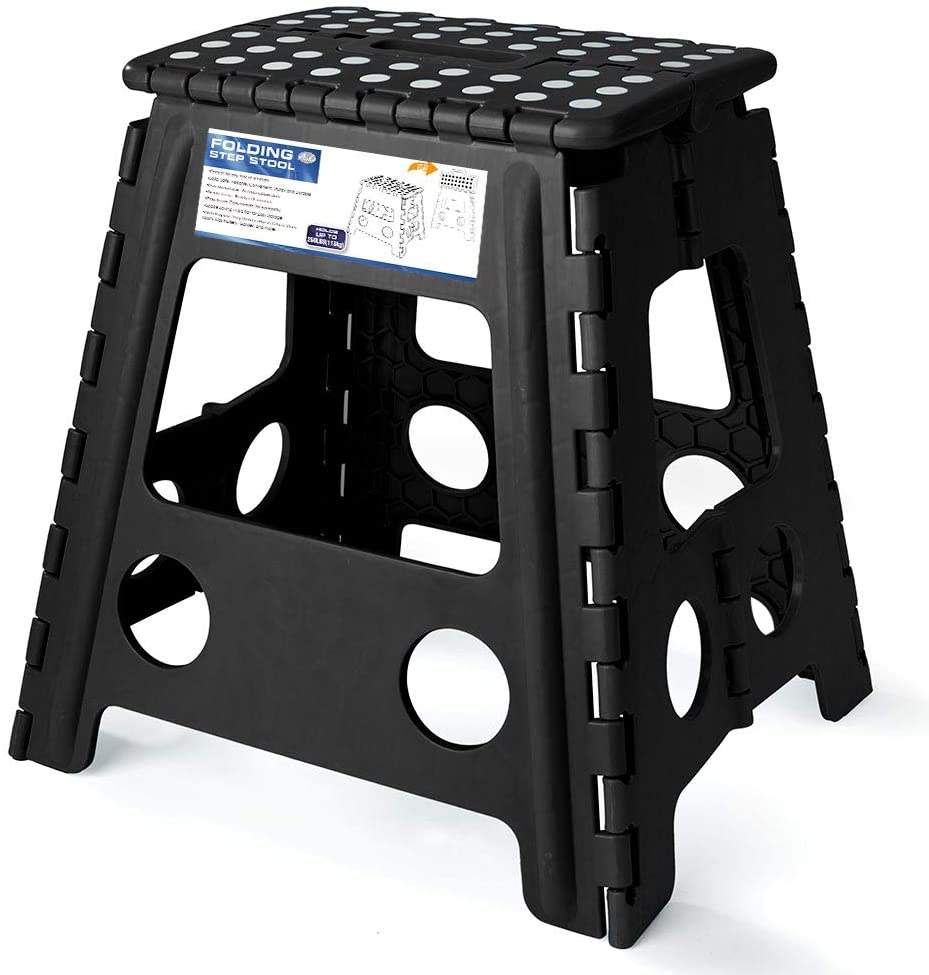
https://www.amazon.com/Acko-Inches-...jbGlja1JlZGlyZWN0JmRvTm90TG9nQ2xpY2s9dHJ1ZQ==
Place a piece of plywood on it for more area. Super stable and folds up great:
https://www.amazon.com/Acko-Inches-...jbGlja1JlZGlyZWN0JmRvTm90TG9nQ2xpY2s9dHJ1ZQ==
As an Amazon Associate, TalkBass may receive commissions from qualifying purchases made via links on this site.

Yeah, that will work in reducing the boom. I've used lots of different things in the past, usually drum cases... yes, the hard ones not the bags.


