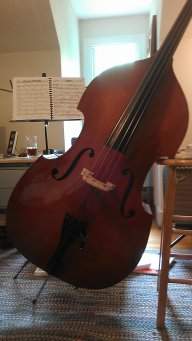
So i have a Fishman Plat Stage running into my GK MB200 head. I've been playing alot with the knobs to dial in a sound that pleases me, between both the head and preamp. While i can dial in a decent tone, i can't help but think an EQ pedal would greatly enhance my ability to do so. The bass/treble/mid sweep on the Fishman seems kind of limiting.
Would an EQ pedal be a worthy addition to the chain or would you think just springing for a beefier preamp would be a better option? Also, any EQ pedals that you might suggest?
The Fishman Platinum Stage has a 10 Meg input. I have recently learned that the ideal loading for a piezo pickup is generally somewhere between 1-3 Meg, and 10 Meg will cause the pickup to be under damped. The input impedance of your MB200 is 1Meg so try plugging straight into the amp to see if it tightens up the sound any.
I believe EQ can be extremely beneficial, but you need to load the pickup with the proper impedance to buffer the signal before sending it to the EQ. Here's a relatively inexpensive K&K preamp with a 1 Meg input and a three band EQ. K&K Sound Pure Preamp at Gollihur Music - Double Bass, Upright Bass, String Bass Specialists
You could use the K&K to drive an EQ like the Empress ParaEQ that @ddnidd1 mentioned.
When I am amplifying a string bass, I tune it for feedback the same way I tune a PA system. Increase the gain until the bass is almost on the verge feedback and make a mental note of any frequencies that ring out. The next steps of the process varies depending upon if I am using a 31 band graphic or a parametric EQ.
With a 31 band graphic I usually run through and boost all of the frequency bands two at a time. The goal is to identify the hottest 4-5 frequency bands and dip them 6-12dB. Usually I go through three adjacent bands before I decide to make a cut. For example, slowly boost 100Hz and 125Hz then move both bands back to zero. Next, slowly boost 125Hz and 160Hz then move both bands back to zero. If you get the same frequency feeding back between all three bands you know to cut the middle band; but sometimes it doesn't work this way. Sometimes you get a different frequency each time you boost two bands.
After covering three adjacent bands, make a judgment regarding how much headroom before feedback is available and which band is closest to the frequency with the worst problem. You may decide no cut is needed, to cut one frequency 12db, to cut two frequencies 6dB, or to cut three frequencies 3dB. With practice, it will become intuitive.
With a parametric EQ, the process is a bit different. Increase the gain till the bass is on the verge of feedback. Next select a medium, narrow band, apply about 6dB of boost and slowly sweep the frequency control. Keep one hand on the gain control so you can cut it quickly if the feedback gets really bad. Note the frequencies that are most prone to ringing and eliminate them by selecting narrow band filters and dipping them 6-12dB.
If a bunch of frequencies ring close together you can use a wider band filter, but you don't want to cut as much. Try 3-4dB. Same goes for hotspots on the instrument that develop too much sustain as you increase volume, try using a gentle broad band cut.
After dialing in the EQ, it's a good idea to boost the volume to see how much gain before feedback you have built into the system. Turn up and play a bit louder than you expect to for a few minutes to make sure you have plenty of headroom and the tuning works well. Sometimes you might decide to zero out the EQ and try again, especially the first few times you tune a bass this way.
Some of these ideas illustrate that EQ may need adjustment if you drastically change how loud you play. In an effort to minimize the amount of energy the amp puts into the body of the bass, I typically elevate the bottom of my amp to about waist level. But I almost always have full PA support so the amp is only there so I can hear myself.
Hope some of this is helpful.
Last edited:





 .
. .
.