• TalkBass has been independent since 1998. Add your voice.
    Create a free account to reply to discussions, view embedded media, and browse with fewer display ads.
    Join freeLog in
    Want zero display ads or expanded classifieds tools? Compare plans.

EV EVM 15L speaker

im just worried about the different tone between a 410 and a 115...115s are deeper right usually?
A 4x10 will move about the same amount of air as 2x15's. Depending on the cabinet/driver matchup, 4x10's can sound just as deep as 2x15's. Often we judge 4x10 by the ones in small cabs that have a sharp peak around 80hz and then roll off sharply. But, if you put 4x10 drivers in a properly vented large cabinet like an Ampeg 410HLF you will hear some serious bottom end. Same thing with 2x10 cabs. They are often just too small to do justice to the drivers. They need room to breath.
 
yeah will have to try it. trying to scale down my 410 and get something smaller....im worried it wont sound as good tho
It will sound completely different. It is a wonderful driver but their power handling full bandwidth is in the 100-150 watt range. They are also very inefficient by today's standards @ 92.5db/1 watt/ 1meter, heavy @ 22lbs. But, I still like their tone just don't ask them to do more than they should.
 
  • Like
Reactions: BasturdBlaster
To slightly change the OP's query: I've a 15" EV Force (4 Ohms) in storage, pulled out of a old, heavy Peavey cab. I've not been successful hunting down the specs for this driver. Mr. Horse, do you know where I might find these numbers?

Thanks, Haroldo
I may have them here sonewhere. Another great sounding driver with some tonal and performance similarities to the Peavey Scorpions. I will look.
 
It will sound completely different. It is a wonderful driver but their power handling full bandwidth is in the 100-150 watt range. They are also very inefficient by today's standards @ 92.5db/1 watt/ 1meter, heavy @ 22lbs. But, I still like their tone just don't ask them to do more than they should.
I don't think the efficiency rating of 92.5db/1 watt/ 1 meter is correct. I've played my cab with 2 of them for decades with an 80 watt Sunn 200S and I was always being told to turn down. I have seen a rating of 93db/ 1 watt/@10 feet.
 
Last edited by a moderator:
There is little real world difference in the power handling of the 200 and 400 watt versions. The 200 watt (series 2) version is conservatively rated and the 400 watt (proline) version is not conservatively rated. The only difference is the VC adhesive/coating. The difference is in large part how the ratings are derived.
 
I used to sell a ton of both the 15B and 15L back in the eighties, and both were good reliable drivers. We put them into Theile alligned boxes. I still have an EVM15B in one of these boxes, and it sounds terrific, and is a good match with my GK MB150B on top of it. I always preferred the throatier sound of the 15B, which was specifically designed for bass guitar, as opposed to the 15L, which was basically for higher-end PA systems.
 
A great speaker for bass guitar. Those were rated at 200 watts @ 8 ohms continuous, but they'll take 500 and love it. I speak from experience. All EV speakers are grossly underrated in terms of power handling. The "L" was the PA speaker while the "B" was their Bass offering; however. the L had the same bass response as the B and more high end which made it the choice for many bass players of the time. I only ever knew of one person using Bs and that was in a Sub. I played through a pair of Ls very happily for many years until I just got away from 15" speakers and moved to 12"s and 10"s.
 
  • Like
Reactions: Jonesy and Gizmot
im just worried about the different tone between a 410 and a 115...115s are deeper right usually?
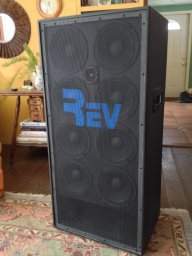
Each cab has it's own inherent sound characteristics and frequently mixing cabs makes for different sounds. 2x10" + 1x18" complement one another even when full range is sent to both. A 4x10" is a pounding focused, low-mid mutha, ball crushing machine and when combined with the mush of a 15" sometimes magic happens.
 
Last edited:
A great speaker for bass guitar. Those were rated at 200 watts @ 8 ohms continuous, but they'll take 500 and love it. I speak from experience. All EV speakers are grossly underrated in terms of power handling. The "L" was the PA speaker while the "B" was their Bass offering; however. the L had the same bass response as the B and more high end which made it the choice for many bass players of the time. I only ever knew of one person using Bs and that was in a Sub. I played through a pair of Ls very happily for many years until I just got away from 15" speakers and moved to 12"s and 10"s.

Don't know where you are getting your information, but they will not take 500 watts and love it, in fact the only one who will love it is the recone shop.

While it appears that the LF response is the same, in fact it is not and their standard cabinet does not take advantage of the different VAS and Qes, Qmech and Qtotal, (due to higher moving mass) which allow for better LF tunings with the B version if you don't mind the tendency to overshoot in smaller cabinets. Many players prefer the mid voicing of the L version, which is why it was so popular.
 
  • Like
Reactions: InhumanResource
My experiences with reconing the 15B an L's was often removing shredded voice coils from the gap.
The 2.5 inch diameter coil didn't dissipate heat nearly as well as a 4 inch coil, and I'm not sure if the glyptal like coating on the voice coil helped or hindered the cooling. The JBL 4 inch drivers, E130/ E140, 2225, 2226, etc. seemed to hold up to much more abuse over the EVs.
 
There is little real world difference in the power handling of the 200 and 400 watt versions. The 200 watt (series 2) version is conservatively rated and the 400 watt (proline) version is not conservatively rated. The only difference is the VC adhesive/coating. The difference is in large part how the ratings are derived.

As discussed before, this simply isn’t true. It may be your impression, but it is incorrect. I worked at EV for years and know firsthand how honestly how both of those were tested and rated.
 
As discussed before, this simply isn’t true. It may be your impression, but it is incorrect. I worked at EV for years and know firsthand how honestly how both of those were tested and rated.
Honestly but differently. Not mutually exclusively.

Coating the voice coil simply doesn't double the thermal or mechanical power handling. The winding height was the same, the wire gauge was the same.

[edit: I went back and looked at my documentation because I knew I was forgetting something important relative to the ratings and how these ratings were derived. The factory test voltage was set to reflect only the minimum impedance of 6 ohms which when applied to the actual average impedance through the test range results in the equivalent power ratings of 150 watts continuous on the Series 2 and 300 watts continuous on the proline. IME, the series 2 were more conservatively rated and the proline less conservatively rated.

I recall doing these tests because of an unacceptably high failure rate when fed with the equivalent of 400 watts continuous per EIA 426A using the actual average impedance of the driver. What it turned out is that the test was misleading unless you knew that they used the 6 ohm minimum imedance voltage levels in the test, overstating the REAL WORLD power by 25% in both cases. The reason I state real world is because amplifier power ratings are stated at 8 ohms and 4 ohms, so if you were to choose an amp rated at 400 watts at 8 ohms it would be delivering 25% more continuous power under identical test conditions.

IMO, this was a bad way to derive ratings, misleading to customers who did not know enough to delve into the details and understand what they meant. There were a lot of there drivers damaged due top overpowering, not the exclusive fault of the user. I know I reconed a heck of a lot of them back in the day.]
 
Last edited:
My experiences with reconing the 15B an L's was often removing shredded voice coils from the gap.
The 2.5 inch diameter coil didn't dissipate heat nearly as well as a 4 inch coil, and I'm not sure if the glyptal like coating on the voice coil helped or hindered the cooling. The JBL 4 inch drivers, E130/ E140, 2225, 2226, etc. seemed to hold up to much more abuse over the EVs.
There were some advantages to 4" VCs and other advantages go to 2-1/2" VCs.

Power handling isn't always specific to VC diameter, wire gauge, winding height and material also affect this. For example a D130 VC would have a lower power handling than the EVM but the 2241 VC would have a higher power handling because its copper (iirc), heavier gauge and with a (much) taller winding height.

Then there's the mechanical geometry differences responsible for maintaining alignment under higher excursion conditions.
 
I'm pretty sure the 2241 was aluminum, and it has milled cutouts in the pole piece that were supposed to help with cooling the coil.

The gap was tighter on the EVs which helped increase the efficiency of the motor, but they also tended to often rub after being overheated, and the former would bubble.
 
Great speakers but, I'm a 12" user myself. ... I have a 12L loaded into a TL cab and that moves a lot of air but, it ain't light. ... Though the wattage of a Portoflex might be underpowering a speaker that size. ... A JBL or Altec might be a better match.
 
Back in the '70's , I was playing an SRO , 215 cab. It had a great sound, but was one of the deepest, heaviest , PITA cabs to schlepp. It was like moving a small refrigerator every night.