I just have the reverb pedal box upstream of the input to the amp. Guitar goes into the verb and the verb plugs into the input of the 100T.
Its not really that odd. Lots of players run some reverb out of their rig and send that to the FOH as part of their overall tone. As I mentioned, Chris Squire of YES runs his stage reverb the same way, although he uses a more expensive version of what I have from T.C. Electronics.
EDIT: Saw your second post just now further down...
Yeah...I just put it before the amp and let the verb get processed by the amp's tone controls and stuff just like the bass tone itself. Works great for me. Wouldn't always use it when recording, but there are some things I am working on right now that I plan to run the verb in the signal onto the recorder because in my mind it is part of the sound of the bass and works with the song better than adding it later in the mix.
There's a major difference. This is way off topic, but others here may be interested in this regarding the use of fx. In recording, the 'normal' way to use reverb on bass would be to add the reverb during the mix, and not to add reverb to the bass in-line before the amp or in the amp's fx loop. The reason is this: the 'normal' purpose of reverb is to create the illusion that the instrument or voice is in a different acoustic environment, anything from a closet to a club to a canyon. In order to get this effect on bass or guitar the reverb is added to the sound of the mic'd or speaker-modeled signal, so it sounds like an amp sitting in a space. Plus, even if you're using a mono input, any quality reverb has stereo outputs in order to correctly simulate an acoustic space. Since the DI of the 100T in the post position is both post power tubes AND speaker modeled, if you record it and add the reverb in the mix you are getting an excellent simulation of an amp in whatever space you set the reverb for. For rehearsing you could also patch the DI to a reverb then stereo out of the reverb to the board, but recording this way you are committing to the reverb. If you add it in the mix you can change it.
However, if you use a reverb pedal before the amp, you are not getting this effect. Not saying it's wrong and that it might not be a cool sound in certain situations, but there's a distinct difference. In this case you have the sound of a reverb'd bass playing through a mono bass amp, and the reverb on the bass signal is also being overdriven and eq'd by the amp and effected by any processor in the fx loop. And it is being distorted by the instrument speakers or speaker modeling. If the reverb is added to the recorded bass track or after the DI, clean reverb is being added to the sound of a bass amp, regardless if it is clean or distorted. And it is in stereo. That's the way it would be in the real world - the reverb itself would not be distorted or eq'd, the amp would. And the reverb would be coming from all around you, not just from the amp. Again, this is if you are going for the REALISTIC sound of a bass amp in a space. But you aren't always going for realistic, especially in recording, so it'd be good to get familiar with both sounds so you know when to use them.
Patching reverb inline before the amp would not work in most loud live situations. The amp is already working too hard to be able to reproduce a more subtle effect like reverb; it would only muddy the sound. In a case like Chris Squire that you cite, it's most likely that aside from his bass pedal rig one of either the Marshall or the Ampeg rigs is an effects amp, so one is always punchy and out front and not softened up by effects. Most of us don't have that luxury, and once you're cranking at volume with a single amp, and once cymbals start crashing, what may sound beautiful in the basement or the studio totally gets in the way live. Patching reverb post-DI or asking FOH to add reverb to your bass might work, but their problem is usually just the opposite; too much reverb already, don't need to add any.
Sorry to drag this so far off topic, but again thought some might be interested.


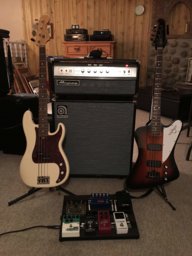



 luckily I have my Hartke a70 down there so I can thump some but geez do I miss hammering my 100t 610 neo!! Nothin like it!
 . I totally want that cab! Thanks for the support. Hey, do you notice any difference using ported cabs with this head? Marc


