
Last I heard there was no guarantee which you’d get.Where would be the best spot to purchase (online) a Rumble 100 with the pre/post switch?
Thanks

TalkBass has been independent since 1998. Add your voice.
Create a free account to reply to discussions, view embedded media, and browse with fewer display ads.
Join free Log in
Want zero display ads or expanded classifieds tools? Compare plans.
Last I heard there was no guarantee which you’d get.Where would be the best spot to purchase (online) a Rumble 100 with the pre/post switch?
Thanks


I would think Fender would know what serial #'s are which feature set.Where would be the best spot to purchase (online) a Rumble 100 with the pre/post switch?
Thanks

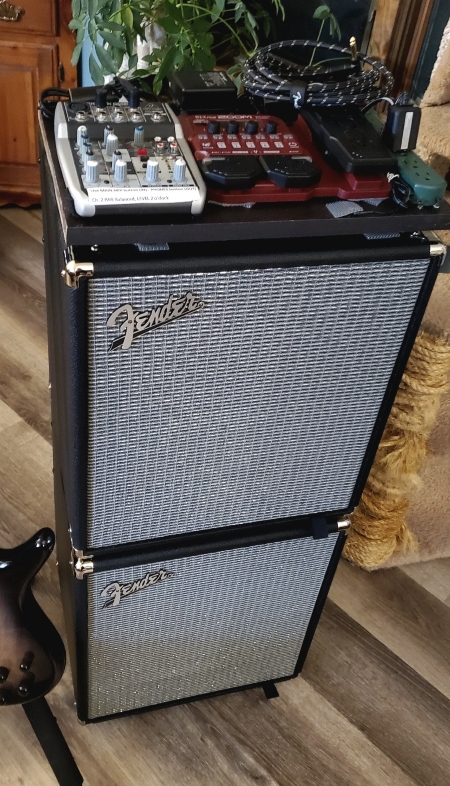
Speaker effiency and cab design are as important as amp power and design. I’m blown away then can do this in so light a package.I really spent a lot of time with my new dual Rumble 100 stack over the last few days.
My thoughts...
I've spent more than 45 years playing through almost every kind of amp/cab, be they separates or combos. A lot of separates were insanely loud onstage because they had to be as I played in a lot of VERY loud bands over the years, even though I also had FOH support. SVT tube heads, 810 cabs, Acoustic amps and 18" cabs or 215's, Sunn Coliseum heads through 412 bass cabs, GK 1001RB heads through 410 cabs, PA high wattage power amp driven fEARfuls, etc. Even plenty of my own cab designs that were intended to be loud, yet modular and driven by separate heads.
I've tried many combos utilizing combinations of 10's, 12's, 15's (both matched and mixed) and I also added extension cabs to those that allowed it. Most combos (even those of higher wattage than the Rumble's 100 watts) didn't quite cut it onstage on their own. Close, but just a bit lacking in some way.
Now granted, I no longer need to be that loud onstage. My single Rumble 100 on it's own is really more than sufficient tonally and volume-wise for most situations I find myself in these days. Even with a full band, rehearsals and small, intimate gigs won't require more than the single combo. The single Rumble 100 can get pretty loud (a subjective opinion for sure) on it's own.
But...when chained together this little "mini rig of doom" has so much depth, clarity and volume it really blows me away. Without even pushing it that hard it is almost unbearably loud. If I were onstage and hid this rig from view while playing, I seriously doubt other bass players would believe I was playing through two little Rumble 100 watt 112 combos. 200 watts? No way. But yes...it is THAT loud and clear. But I want to also point out that the full, dual combo rig also sounds amazing even at low volume, even more so than just one combo (which I still like a lot tonally).
I've played through the single Rumble 100 close enough to my ears while sitting, so it's not just elevating a cab to hear it better. The two combined do more than just double the perceived volume and clarity. The rig is so full of depth across the entire frequency range, from solid lows (even the low B) to a beautifully bright high end without being harsh and mids that simply punch. With Gain and Master Volume at about 10 o'clock, it's already pushing the limits of my hearing tolerance. I don't think I could stand pushing them to their safe max volume.
Two 22 lb. 112, 100 watt combos? I wouldn't have believed it until I tried it.
This famous pic pretty much sums up how I feel in front my full rig while playing...
Yes, it takes the entire package to work together. As a former cab designer I wish I had all the T/S specs on the stock Fender speaker. I'm curious how they managed to produce that tone and volume in such a small, lightweight combo.Speaker efficiency and cab design are as important as amp power and design. I’m blown away then can do this in so light a package.
 I'd have to play with the T/S specs on the 3012LF and the second cab's internal volume and porting to see if the cab is a decent match for the 3012LF. It would be more like a bi-amped rig yet still incredibly light weight.
... ... My single Rumble 100 on it's own is really more than sufficient tonally and volume-wise for most situations ... ... But...when chained together this little "mini rig of doom" has so much depth, clarity and volume it really blows me away. ... ... The two combined do more than just double the perceived volume and clarity. The rig is so full of depth across the entire frequency range, ... ...
Two 22 lb. 112, 100 watt combos? I wouldn't have believed it until I tried it. ... ... ...
... ..., I'm even tempted to reinforce the bracing in the bottom cab, and replace the stock speaker with an Eminence neo 3012LF and a HPF and then crank the Master Volume on it. Not really needed, but to amuse and entertain myself with.
I may not even add a HPF filter anyway as the 3012LF speaker itself has a natural upper mid frequency roll-off. Typically when used as a true subwoofer (when coupled with a mid driver) an internal HPF is used. Without one, I'd be fine with increased power handling in the low end and using the Master Volume on both cabs to blend.Congratulations, Mittle- man! You are experiencing the beauteous bounty of "the cab coupling effect" oft lauded on these hallowed pages. (Not to be confused with the floor coupling effect.) Also, the Rumble design team shared many members with the Bassman Pro design team of the same era. Then, more recently with the change of the R100's speaker from 8 ohm to 4 ohm due to supply issues, the tuning of those cabinets was surely re-visited, as well!
Please be aware, Mitty, that most Rumbles already have a 2nd order HPF included in their internal circuitry, near to the patented Dyna-Comp™ circuit, per their block diagrams. If you want to add another HPF you might oughta determine the setting of the internal HPF (and report it here*, please) to avoid unwanted filtering!
*Although many have asked here what the setting of the internal HPF is, no one with an adjustable external HPF has tested for it and reported it here!
It sounds like you're talking about a LPF, not HPF.I may not even add a HPF filter anyway as the 3012LF speaker itself has a natural upper mid frequency roll-off. Typically when used as a true subwoofer (when coupled with a mid driver) an internal HPF is used. Without one, I'd be fine with increased power handling in the low end and using the Master Volume on both cabs to blend.
I may not do anything with it anyway. It's not like it's even needed. It's just my nature to design and play around with speaker cabs. LOL. And I wouldn't do anything that isn't entirely reversible back to the original cab as is.
Yes, correct. My mistake...been a few years since I've worked on designsIt sounds like you're talking about a LPF, not HPF.
'Pass' being the operative word.
LPF rolls off upper frequencies - in this case (3012LF - a true subwoofer driver) to avoid muddying up the midrange frequencies.
HPF rolls off lower frequencies.


Yes...it being a subwoofer, it's strength is not in the mids or highs. They aren't eliminated completely, but they might as well be.And when you say "rolls off," you mean eliminates, correct?
I don’t know what IR or DG Element represent, but why can’t you just use the Rumble headphones out?Short question for you guys.
I really like my Rumble 100. Do you know where I can find an IR to upload to my DG Element for silent practice?
Thanks.
Though lightweight it is still inconvenient to carry around oftenI don’t know what IR or DG Element represent, but why can’t you just use the Rumble headphones out?

Short question for you guys.
I really like my Rumble 100. Do you know where I can find an IR to upload to my DG Element for silent practice?
Thanks.
Yeah, I'm wondering why you want mess with the signal at all. The Rumble has an overdrive on the amp and also a headphone out jack that cuts the speaker out when used.I don’t know what IR or DG Element represent, but why can’t you just use the Rumble headphones out?

Yes...it being a subwoofer, it's strength is not in the mids or highs. They aren't eliminated completely, but they might as well be.
I'd have dig out the T/S specs and graphs again to see where it's output drops off, but the 3012LF is definitely not a full range bass speaker.
Regardless, I'm not doing anything any time soon...if at all.
What do you mean by mess with the signal, and what has an overdrive to with it all.Yeah, I'm wondering why you want mess with the signal at all. The Rumble has an overdrive on the amp and also a headphone out jack...
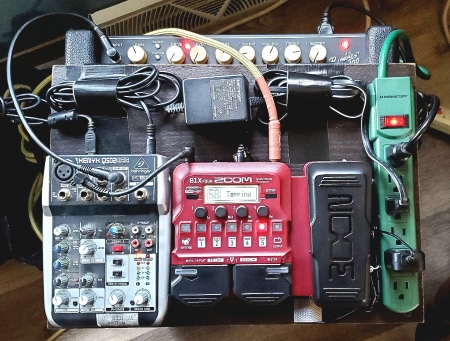
My mistake. I thought you were looking for some OD. The Zoom has all kinds of amp/cab simulations and effects though I use no amp/cab sims with it. So it does what you are wanting with your DG Element. By the way, the way I have my Rumble dialed in, "my" tone is all in my bass and Zoom and it sounds the same, whether through my Rumble, FOH, monitors or headphones.What do you mean by mess with the signal, and what has an overdrive to with it all.
To clarify, totally independent of whatever pedals you use, the sound will be altered by the speaker. This is where something like the Element steps in, where you can load IRs and simulate a specific cabinet.
The headphone out is no help here.
You said “silent practice”. That implies headphones, ear buds, whatever. I said I didn’t know what IR or DG Element are.What do you mean by mess with the signal, and what has an overdrive to with it all.
To clarify, totally independent of whatever pedals you use, the sound will be altered by the speaker. This is where something like the Element steps in, where you can load IRs and simulate a specific cabinet.
The headphone out is no help here.


