I understand trying to match the 100 to the 200. I really love the old school 200 tone.Simple - I almost always use my R200 with the Vintage effect on.
The “classic” bass tone suits my playing style (fingers only) and the music our group plays.
Over the last two years we played two gigs (one outdoors) where my R200 was operating at the “hairy edge” of its capabilities. I like a nice, round tone, with as little distortion as possible, and I was hearing some very unpleasant (to me) “raggedness” on the lowest notes.
I thought the problem could be the “stacking” of the Vintage effect’s compression and the Delta limiter built into the power section.
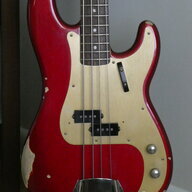
It turned out that the REAL problem was that the E string on my JMJ (a well-broken-in D’Addario Chrome flat) had gone just TOO dead, definitely beyond ITS capabilities. A new string, a bit of Eucerin, and a little time fixed the tone problem.
But I digress…
To address my initial theory that the “stacked” compression effects were the problem, I wondered if it would be possible to set the EQ to get the low-pass tone of the Vintage effect WITHOUT the compression.
The 3 3 12 9 setting did the trick. (Didn’t fix the “raggedness” though. BAD string! BAD!)
btw,
The reason for my trying to match the tone of my R100 to my R200 was simply that when I would have to occasionally use my R100 for practice I “missed” the sound of my R200. Setting the EQ of the R100 to 9 12 12 9 simply makes it sound more familliar.

I don't actually hear the vintage compression much and never thought of it as a problem. Then again, I have low output pickups and tend to keep the gain around 9 which may explain that. I'm still learning about all this and was just wondering...





 Hopefully, we're well past all that now.


 )
)
 You really should put that number in your TalkBass Signature for safe keeping! But, it's always available to be found on