• TalkBass has been independent since 1998. Add your voice.
    Create a free account to reply to discussions, view embedded media, and browse with fewer display ads.
    Join freeLog in
    Want zero display ads or expanded classifieds tools? Compare plans.

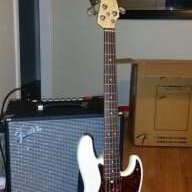
Fender Rumble Club

Now we're back to being serious, most well-designed cabs have all the damping they need. If something needed to be lined or stiffened, the designer already took care of it.

However, some cabs benefit from a little damping, usually boxes built to a low price point. Acoustic lining is part of the equation, but bracing is at least as important. There are a variety of reasons to do this, depending on the proportions of the box and whether it's ported or sealed.

I believe someone else mentioned improving the sound of one of the older Rumbles with acoustic foam.

I had a specific gripe with the V3 100 when I first tested it, but felt that the amp was promising enough (and enough of a steal price-wise), to make it worth a little extra work.

I installed a couple of light-weight braces, lined it to reduce unpleasant midrange reflections coming through the speaker cone, and converted it to a sealed cab. Out of the three mods I performed, the lining made the smallest difference.

I don't know if the end result would float everyone's boat, but a couple of bassist friends heard it both before and after, and they agree that it represents a major improvement.
 
Last edited:
I can understand modification on a build your own but these new rumbles should not need any. Ask fender how they feel about that :bassist:
That's one way of looking at it.

Another is that great gear rarely needs or benefits from unauthorized mods (although the maker of my $2,000+ Dingwall bass actively assists his customers with personalization, providing advice and assistance). OTOH, cheap gear is built to a price point, and often benefits from a little aftermarket assistance.

AFAIC, you've bought the product, and now it's yours. You get to decide how to use it, and whether it meets your needs as-is.

Everyone's comfort zone is different. I would think twice before modding an expensive piece of gear like a Fender tube head while it was still under warranty, but not so much when it comes to a cheap item like my Rumble. Of course, this is affected by life experience, and YMMV.

I bought my Rumble with the express intent of modding it. I felt that with a couple of inexpensive tweaks, it could meet my needs better than more expensive options that were out of my reach, like a Phil Jones Briefcase combo. My decision was influenced by the fact that I'm a qualified tech who has been building, modifying and repairing hand-wired tube amps, speaker cabs and instruments for decades.

It was a bit of a gamble, but one I was prepared to take. In this case, the result was beyond my expectations.
 
  • Like
Reactions: Linnin
Ask the GK MB amp users. They were not only lining the cabs, but bracing them as well, for better performance, more bass, less boom. I believe GK has rectified that with their new line, but as I recall there's a good bit of discussion about it over on the GK forum.
Yeah, I think I'm going to brace/reinforce my Rumble 112's when I go in to line them with Sonic Barrier. Not exactly sure how I want to go about it, as I am not a carpenter.
 
My guess is they would void warranty. :cautious:
This is a valid point, and one that needs to be considered. Especially in the case of a product that has an extended warranty period, like the new Rumbles.

IME, it depends on what you do, and how you do it. Speaking as a tech, Fender isn't going to void the warranty on the neck of your Am Std bass, because of a properly-installed set of strap locks. But they might be tempted if you banged them on using roofing nails, and they see other signs of butchery.

It also helps if you can state your position intelligently. For example, the moment I glued an x-brace into my Rumble 100's cab, I took over responsibility for the woodwork. If the cab develops a buzz, or the Tolex starts to peel, it will be on me. I'm prepared for that.

OTOH, the amp cavity on the back of the Rumble 100 is sealed. Even the hole where the speaker wire enters the cab has a rubber plug. My mods to the speaker compartment don't affect ventilation in any way, and a quick glance inside would be enough to determine that they were carefully applied, in a manner that isn't going to affect the electronics in any way.

If a warranty tech tried to argue that an overheating problem with the head was my fault, I would challenge his call, and take it to a higher authority. Based on past experience, I would expect to win.
 
Last edited:
Yeah, I think I'm going to brace/reinforce my Rumble 112's when I go in to line them with Sonic Barrier. Not exactly sure how I want to go about it, as I am not a carpenter.
If it ain't broke, don't fix it. I would tap-test the panels to determine if bracing was required, paying particular attention to the largest unsupported wall.

Bracing is much more likely to be useful on a lightweight cab like a first generation G-K MB, or the V3 Rumble combos. You can hear the sides and the top of the new 100 ring when you tap them...
 
  • Like
Reactions: Linnin
I batted and braced my first gen mb210 and it made a noticeable difference. It was interesting because I read the thread where RAG said they didn't need it but when I opened mine up it had more bracing than the photos of the earlier versions so apparently they felt it did need more. I stuck an additional cross piece in anyway but I think the foam made the most difference.

I can hear the ring Steve is talking about on the tap test. Don't know if I'll modify it anytime soon. Truth is I forgot to take it on my last gig. We were going to use my k10s as mains but when I got there the drummer had his k12s set up and the one k12 he uses for his own monitor. I fed some bass into his monitor and everything sounded fine.
 
If it ain't broke, don't fix it. I would tap-test the panels to determine if bracing was required, paying particular attention to the largest unsupported wall.

Bracing is much more likely to be useful on a lightweight cab like a first generation G-K MB, or the V3 Rumble combos. You can hear the sides and the top of the new 100 ring when you tap them...
I'll do that. The V2 Rumble Neo cabs were all made in Mexico of lightweight plywood and are constructed very well.
 
Speaking generally, one thing I've never tried in a cab is Dynamat, like they use in cars. I'd suppose that would be the least intrusive and best way to quiet a vibrating panel, and I'd go that route before I stated making braces. However it does nothing for any cab volume tweaks.
As for my Rumble 500 Combo, the only problem I have with it are the acoustics in our rehearsal space. If I could figure out how to mod a cab that would fix the acoustics in the space in which they are played, I think I'd really have something!
 
  • Like
Reactions: Linnin
Speaking generally, one thing I've never tried in a cab is Dynamat, like they use in cars. I'd suppose that would be the least intrusive and best way to quiet a vibrating panel, and I'd go that route before I stated making braces. However it does nothing for any cab volume tweaks.
As for my Rumble 500 Combo, the only problem I have with it are the acoustics in our rehearsal space. If I could figure out how to mod a cab that would fix the acoustics in the space in which they are played, I think I'd really have something!
I would definitely not use Dynamat as that is a sound proofing material. What you want is a well engineered acoustic foam that absorbs sound waves, giving the sonic impression of being a larger cabinet. It's truely amazing how this stuff works. Ideally what you want coming out of your port(s) is air and not sound.

Back in the old days before acoustic foams, they used paper backed fiberglass house insulation and just glued that in on the sides and back leaving the top & bottom naked. You can still do that, as it works. Some people cheap it out with polyester batting like you would use in a quilt or comforter. Some will use a foam mattress topper. I wouldn't.
 
I'm still fuming at myself for not willing to spend a few extra 100$ for a Rumble 100.
Life's too short. If you can swing it, sell it, take the loss, and get what you want. If the 40 you have is just bought, maybe you can return it as an exchange? However, I always went at least one notch above what I thought I needed, so maybe a 500 combo? believe me, you won't be disappointed.
 
Dynamat is sound dampener used mostly on vibrating metal panels in cars. It's not like an anechoic foam at all:

Dynamat is a patented, lightweight elastomeric butyl and aluminum constrained-layer vibration damper.... It is also used for ventilation ducts, relay cabinets, steel furniture, home appliances, sink units, computer equipment, machine tools and many other objects that suffer from vibration-produced noise.