For what it's worth on fretless i think all the markers do more harm than good.This is the first time the poster has heard of placing one's finger on top of the frets on a fretted bass as Jaco recommends.
Fingering on a fretless


Enjoy the benefits of a premium membership!
Upgrade Account
-
TalkBass has been independent since 1998. Add your voice.
Create a free account to reply to discussions, view embedded media, and browse with fewer display ads.
Join free Log in
Want zero display ads or expanded classifieds tools? Compare plans.
You are using an out of date browser. It may not display this or other websites correctly.
You should upgrade or use an alternative browser.
You should upgrade or use an alternative browser.
Fingering on a fretless
- Thread starter richardbruce
- Start date
-
- Tags
- fretless 5 string
More options
Who Replied?

With fretless, unless you can hear the correct pitch in your head, getting it right on the fingerboard is pretty much impossible. The tuner will give a reference point ... but what are you going to do at the gig: watch the tuner for every time you stop the note? Not a band I would listen to!

I don't quite understand because a fretted instrument you normally try to put your finger right on the fret.
You would he the exception rather than the rule. The vast majority of us place our fingers just behind the fret so as to avoid the buzz that can come from placing the finger directly on the fret.
@richardbruce practice with a tuner, a drone, and playing along with recorded music. Fretted instruments kind of "are what they are". But, in my experience, fretless instruments have nuanced characteristics that require a "getting to know you" period.
Time and patience will get you there. Trust your ear.
No offense taken. Honestly, I rewrote the message a couple times trying to sound less snarky, but it didn't take. Too much resting sarcasm.
That is sort of true about a "fulcrum". But depending on where you finger below a fret you can affect the pitch. On the fret is more true to the intonation than below the fret. It is why vibrato works on a fretted instrument even though the string length isn't changing between nodes at the fret and bridge.when you rock your finger parallel to the string you change tension on the string. For most things it doesn't matter. We that play fretted instruments are always varying degrees out of tune anyway.
With that said, I feel like this is too off topic.
Just to extrapolate on this OT comment - some players will press the string down hard, while others will press down with less force. And the difference in those styles will also throw the pitch off. That's why a good luthier will ask you how (or show him/her) before refretting or even on a good professional setup, and use the appropriate fret wire or set the intonation with a particular bias.
You would he the exception rather than the rule. The vast majority of us place our fingers just behind the fret so as to avoid the buzz that can come from placing the finger directly on the fret.
@richardbruce practice with a tuner, a drone, and playing along with recorded music. Fretted instruments kind of "are what they are". But, in my experience, fretless instruments have nuanced characteristics that require a "getting to know you" period.
Time and patience will get you there. Trust your ear.
Thanks. I like to think I have a pretty good ear, but I also like the suggestions to use a tuner or drone until I get the hang of it. It's all good, as the kids say...
For what it's worth on fretless i think all the markers do more harm than good.
I can see that. I'll start there but trust my ears and listen carefully to my fellow players.
The exception to the rule himself...You would he the exception rather than the rule. The vast majority of us place our fingers just behind the fret so as to avoid the buzz that can come from placing the finger directly on the fret.
Fingering on a fretless
Wow - never saw the great Jaco do any kind of instructional video. Is that a fretless he's playing?
Not a trustworthy source.
Not a trustworthy source.
Yeah, that trouble-maker will never get anywhere in the music biz! ;-)
Double check your intonation. The midway harmonic should be the same pitch as the string and your finger placement there. If everything is in tune just behind the markers, your intonation is likely off and your open strings will be out of tune. Open strings are very important on a fretless, since they are a reference to continually use to check note placements on the neck to keep you from drifting sharp or flat.
Also, don’t totally trust the lines. I personally don’t like lined fretless, but I know many people do. Anyway, the size of your fingers and how you place them can be off if you rely too much on just the lines. They get you very close, but you have to use your ears. One of the best ways to practice fretless after you develop sufficient muscle memory is to play with your eyes closed or just looking enough to reach an anchor point, and then don’t look at the fretboard while you play. That’s also true for fretted bass, but even more so for fretless.
Also, don’t totally trust the lines. I personally don’t like lined fretless, but I know many people do. Anyway, the size of your fingers and how you place them can be off if you rely too much on just the lines. They get you very close, but you have to use your ears. One of the best ways to practice fretless after you develop sufficient muscle memory is to play with your eyes closed or just looking enough to reach an anchor point, and then don’t look at the fretboard while you play. That’s also true for fretted bass, but even more so for fretless.
Nope, fretted P bass neck on a Jazz body.Wow - never saw the great Jaco do any kind of instructional video. Is that a fretless he's playing?
Please explain this to me. I believe the opposite. You can't play in tune unless you put finger in the right place and there are only 2 ways to do that:For what it's worth on fretless i think all the markers do more harm than good.
1. Muscle memory & hand form. With one finger on a note you know just how far to reach with another finger to hit the second note.
2. Visual - you look at the neck and pick your target. With big jumps this is the way to do it (as Jaco said in the video linked earlier). You need either the lines or the edge dots to provide the reference info so you can find the target position.
What am I missing?
I was answering a post from the other guy regarding fretted playing. When playing a bass with frets proper technique is to place one's finder directly behind the fret.
His career is over many would say.
Well, I can't argue with that statement. Unfortunately, neither can he :-(

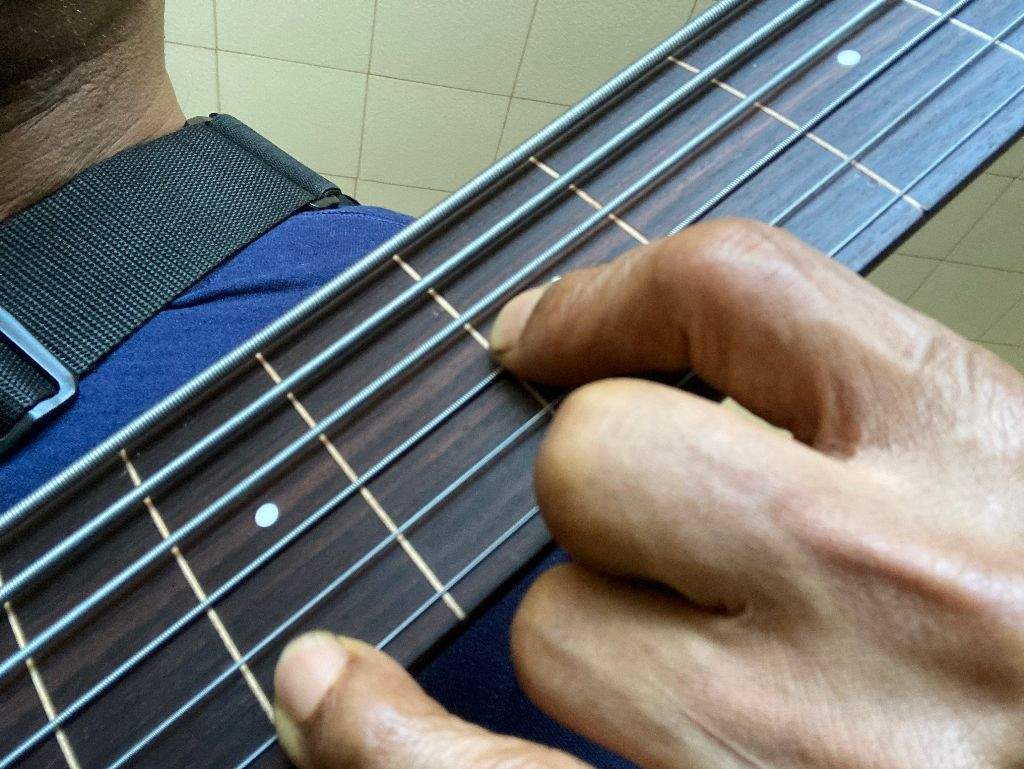
On my fretless I put my fingers just behind but on the line.
This replicates the pitch that the frets would produce.
If they were there.
These A notes are in tune with the open A string.
This replicates the pitch that the frets would produce.
If they were there.
These A notes are in tune with the open A string.
Last edited:
Please explain this to me. I believe the opposite. You can't play in tune unless you put finger in the right place and there are only 2 ways to do that:
1. Muscle memory & hand form. With one finger on a note you know just how far to reach with another finger to hit the second note.
2. Visual - you look at the neck and pick your target. With big jumps this is the way to do it (as Jaco said in the video linked earlier). You need either the lines or the edge dots to provide the reference info so you can find the target position.
What am I missing?
I believe I'll be doing a lot of the latter until I learn how to do the former on this bass. Heck, I still look on a fretted bass!
On my fretless I put my fingers just behind but on the line.
This replicates the pitch that the frets would.
View attachment 4637232
If they were there.
And they were.
Great photo, GEBass - thanks! Yeah, that's about where my fingers are when it sounds right. Someone else mentioned that when one places ones finger centered on the mark, it's actually spreading out a little forward of it. So this all adds up for me. Thanks again!
Double check your intonation. The midway harmonic should be the same pitch as the string and your finger placement there. If everything is in tune just behind the markers, your intonation is likely off and your open strings will be out of tune. Open strings are very important on a fretless, since they are a reference to continually use to check note placements on the neck to keep you from drifting sharp or flat.
Also, don’t totally trust the lines. I personally don’t like lined fretless, but I know many people do. Anyway, the size of your fingers and how you place them can be off if you rely too much on just the lines. They get you very close, but you have to use your ears. One of the best ways to practice fretless after you develop sufficient muscle memory is to play with your eyes closed or just looking enough to reach an anchor point, and then don’t look at the fretboard while you play. That’s also true for fretted bass, but even more so for fretless.
I'll check it. But if you'll notice, the Portamento has no lines on the fingerboard itself - only dots on the top side. And I like it that way. Looks like it sounds with the piezo pickup - like an upright bass.
Just got my first fretless bass - an Ibanez Portamento 5-string - and I have a question about finger placement. Everything I find says to place your finger directly at the marker where the fret would be, but this bass sounds in tune when i place my finger just slightly behind the marks, kinda like a fretted bass. Is it just my ear, or do some fretless basses sound better fingering like a fretted?
Congratulations on your new bass!
Check out the instructions that came with it, or online. Fretless bass guitars do benefit from a proper initial setup too, just like fretted basses.
Intonate the bridge saddles, with the octave harmonic and the line, just like you would on a fretted bass.
Get your setup to be good in all ways A-Z (check the stickies).
ALL BASIC SETUP QUESTIONS ANSWERED HERE
Once that is done..
Play it so it sounds in tune.
I'll put it out there, that OFPF for most everyone, won't sound in tune and powerful, on a fretless bass guitar below the 5th or 7th position. You'll likely have to adapt to a 124 system in the positions close to the nut. Do what you got to do, to get it sounding right.


