• TalkBass has been independent since 1998. Add your voice.
    Create a free account to reply to discussions, view embedded media, and browse with fewer display ads.
    Join freeLog in
    Want zero display ads or expanded classifieds tools? Compare plans.

Finish for cocobolo?

Yeah, if you want that real "liquid glass" look, Rock's process probably the way to go. I'm sure that took some sweat equity to learn how to do though, he WORKED his way to that level of spooky skills. I don't think I'm alone in finding the finish work the hardest part of my builds, and the most error prone.

It's not as hard as you might think to get a bass polished up to that level of gloss but it takes a certain amount of practice for sure. I also use the Sherwood conversion varnish on my gloss basses (I think I even remember talking to Rock about it at some point in the past) and while the end result is glass clear it certainly isn't the most forgiving finish to apply. I suggest getting some practice spraying more forgiving materials. One of the problems with conversion varnish or a 2k lacquer is that you have to mix in the catalyzer yourself and the ratios need to be pretty close. If you mess up this part all the spraying experience in the world won't save you because the finish will never properly catalyze. It gets a bad rap around here but traditional nitro lacquer is a very easy finish to apply and polishes out to a very nice shine. It's s great material to build your spraying and polishing skills, it's relatively cheap and easy to repair. I'd suggest doing a few basses in nitro and then carry those skills over into more complicated finishes like CV or 2k.

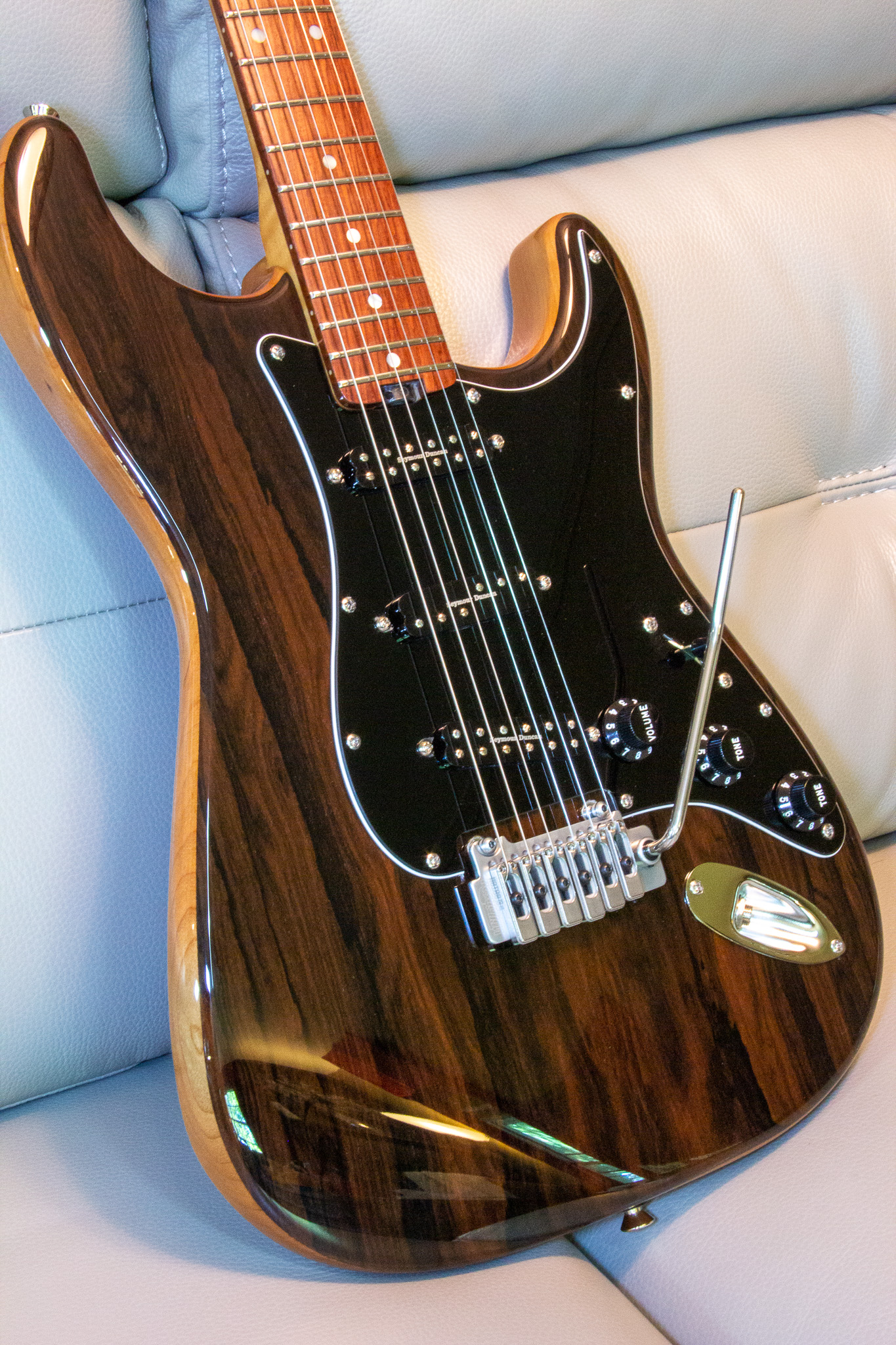
Since we're showing off gloss finishes here's the same Sherwood CV over a ziricote top.
20210407_211957.jpg


Spraying a finish certainly requires more prep and cleanup but honestly I think its less work overall than trying to get a high gloss from a wipe/brush on poly finish or any of the floor coatings ive seen people use. The Home Depot finishes are really meant for easy application to home projects, not fine finishing. I also think Rock is dead on about toxic oil based finishes just looking better. I've asked more than one finish rep who came through the shops I've worked in and off the record every one of them will admit that you will get better results from oil based finishes than their water-based alternatives.
 
It's not as hard as you might think to get a bass polished up to that level of gloss but it takes a certain amount of practice for sure. I also use the Sherwood conversion varnish on my gloss basses (I think I even remember talking to Rock about it at some point in the past) and while the end result is glass clear it certainly isn't the most forgiving finish to apply. I suggest getting some practice spraying more forgiving materials. One of the problems with conversion varnish or a 2k lacquer is that you have to mix in the catalyzer yourself and the ratios need to be pretty close. If you mess up this part all the spraying experience in the world won't save you because the finish will never properly catalyze. It gets a bad rap around here but traditional nitro lacquer is a very easy finish to apply and polishes out to a very nice shine. It's s great material to build your spraying and polishing skills, it's relatively cheap and easy to repair. I'd suggest doing a few basses in nitro and then carry those skills over into more complicated finishes like CV or 2k.

Since we're showing off gloss finishes here's the same Sherwood CV over a ziricote top. View attachment 4774507

Spraying a finish certainly requires more prep and cleanup but honestly I think its less work overall than trying to get a high gloss from a wipe/brush on poly finish or any of the floor coatings ive seen people use. The Home Depot finishes are really meant for easy application to home projects, not fine finishing. I also think Rock is dead on about toxic oil based finishes just looking better. I've asked more than one finish rep who came through the shops I've worked in and off the record every one of them will admit that you will get better results from oil based finishes than their water-based alternatives.

That is a beautiful bass and a beautiful finish! I really agree with so much of what you brought up. I see a lot of builders on LC that chase a high gloss finish, yet are trying to do so in what I would consider to be the hardest approach.

As you mentioned, spray finishes in general get a bad rap here in LC. I'll be the first to say that spraying is certainly not for everyone. You need to have a decent setup. It doesn't have to be a high end spray booth with a $600 gun, but then again, you're not going to be shooting nitro in the spare bedroom of your apartment. :eek:

So, I think that some builders dismiss it out of hand because of the initial investment of time, money and the learning curve... and not so much out of direct experience. I say try it, it's easier than you think, especially nitro which is a breeze to shoot and easy to repair compared to others and it takes an incredible shine. Yes, be sure to invest in proper PPE; but jump in, the water's fine. :D

Here is a ziricote topped Strat shot in nitro as another example.
XAIYf1G.jpg
 
That is a beautiful bass and a beautiful finish! I really agree with so much of what you brought up. I see a lot of builders on LC that chase a high gloss finish, yet are trying to do so in what I would consider to be the hardest approach.

As you mentioned, spray finishes in general get a bad rap here in LC. I'll be the first to say that spraying is certainly not for everyone. You need to have a decent setup. It doesn't have to be a high end spray booth with a $600 gun, but then again, you're not going to be shooting nitro in the spare bedroom of your apartment. :eek:

So, I think that some builders dismiss it out of hand because of the initial investment of time, money and the learning curve... and not so much out of direct experience. I say try it, it's easier than you think, especially nitro which is a breeze to shoot and easy to repair compared to others and it takes an incredible shine. Yes, be sure to invest in proper PPE; but jump in, the water's fine. :D

Here is a ziricote topped Strat shot in nitro as another example.
XAIYf1G.jpg
Unless you live in California, where many such products are verboten...
 
  • Like
Reactions: Gary_M
One more question to all of you: as mentioned in the original post, the same cocobolo that will cap the body will be the fretboard and the headstock cap. Is there any finish that would be appropriate for all three, and keep them all looking the same, or is the fretboard doomed to darken as the body / headstock stays bright and beautiful? The whole concept is that the bass looks like an uninterrupted piece of cocobolo… thoughts?
 
One more question to all of you: as mentioned in the original post, the same cocobolo that will cap the body will be the fretboard and the headstock cap. Is there any finish that would be appropriate for all three, and keep them all looking the same, or is the fretboard doomed to darken as the body / headstock stays bright and beautiful? The whole concept is that the bass looks like an uninterrupted piece of cocobolo… thoughts?
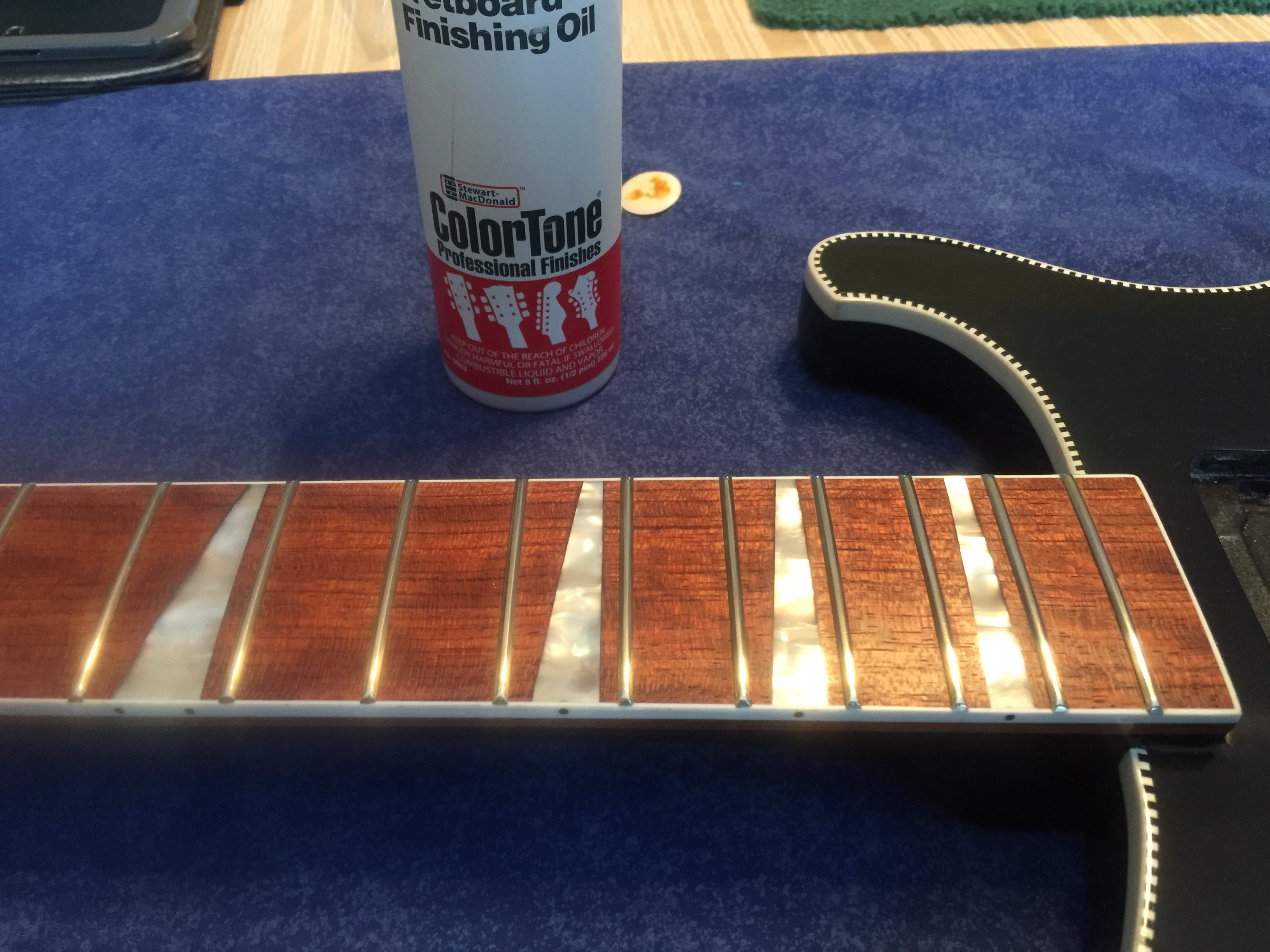
I've been using Stewmac Fretboard Finishing Oil on my builds for fingerboards. You put two or three coats on, the first two more or less get drunk right into the grain. It dries REALLY fast, so you can do a couple coats in a day. The more you put on, the shinier it gets, but I think I only did 4 coats total, which is a nice satin sheen. It looks like a freshly oiled board, and just stays that way without feeling like a coat of plastic. It still "pops" the fingerboard grain nicely. If you want a high-gloss board like a Rickenbacker, you have to lay on a lot of finish. If you look at older Rics, they all develop a whitish line either side of the fret, which is the laquer pulling away from the fret as the metal and wood move differentially. Ric just laquers right over the frets (or used to) and then grinds the laquer off the fret tops while leveling. If you finish over the frets, it builds up in "ramps" either side, so it's hard to crown the frets without cutting into the finish. I don't now how Fender does it on maple boards, never owned one. Do they laquer the boards first, and then cut fret slots into the finish?

ColorTone Fretboard Finishing Oil - StewMac

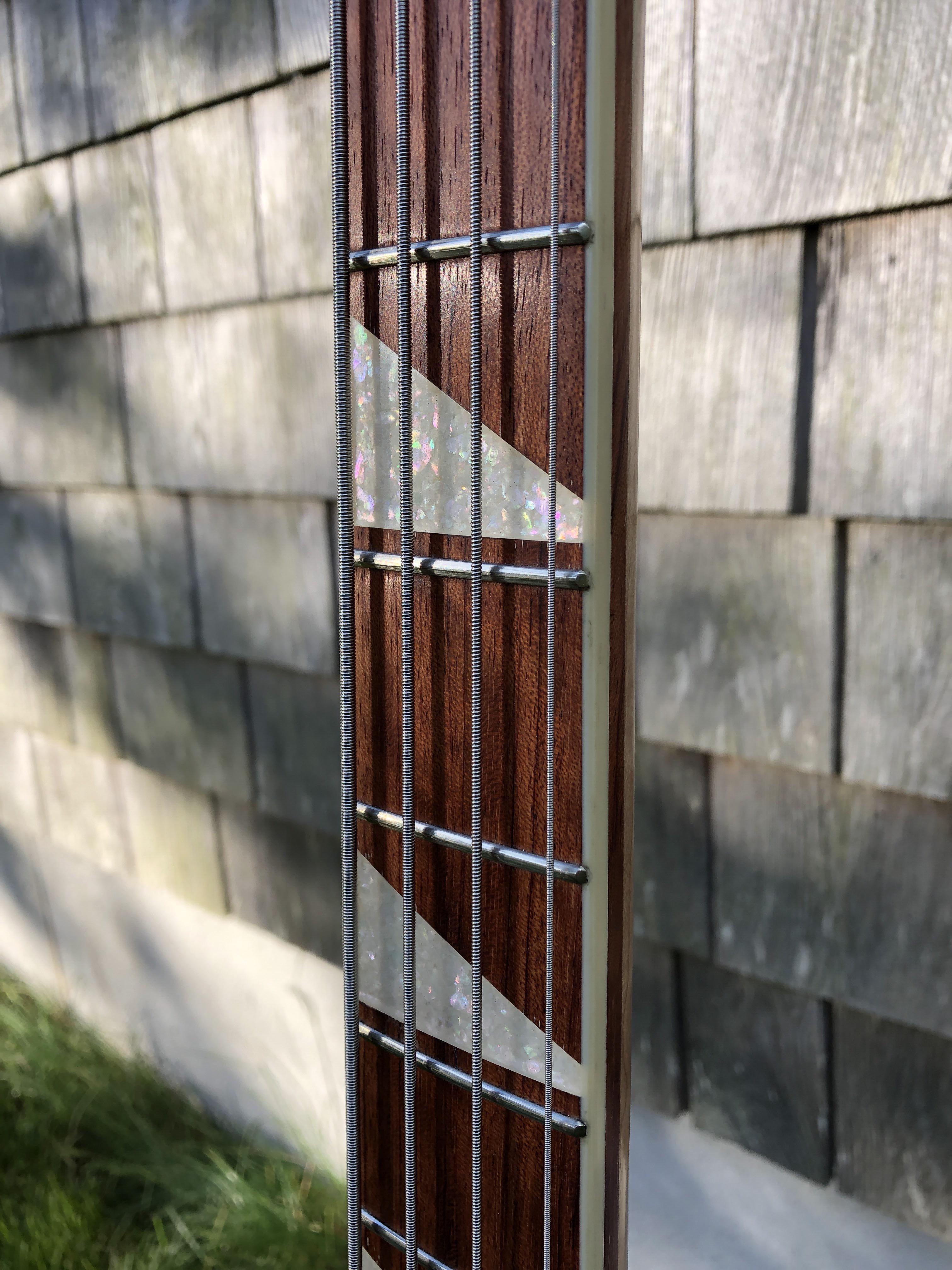
Here's a couple Bubinga boards I did with the Finishing Oil. I wasn't looking for high gloss, but they look exactly like this after about 4 years.
slybd86.jpg

SryU9Ec.jpg
 
Last edited:
Unless you live in California, where many such products are verboten...
Like lacquer, shellac is not known for its durability. It does have great adhesion to a variety of materials and other finishes, is easy to repair, can be mixed (cut) anywhere from a paste to very thin, and can be a great product to use as an introduction to spraying.
The aerosol is highly flammable. Toxicity can vary with the version of ethanol/methanol you use as a solvent - the cured finish is very safe, food safe even. I'm assuming it is available there, although I've been wrong about other things and welcome correction.
 
Like lacquer, shellac is not known for its durability. It does have great adhesion to a variety of materials and other finishes, is easy to repair, can be mixed (cut) anywhere from a paste to very thin, and can be a great product to use as an introduction to spraying.
The aerosol is highly flammable. Toxicity can vary with the version of ethanol/methanol you use as a solvent - the cured finish is very safe, food safe even. I'm assuming it is available there, although I've been wrong about other things and welcome correction.
True but shellac, while available here, is a weak finish, it yellows with time, is amber upon application, clouds when exposed to moisture. (Like lacquer does also)
I have experience with shellac. Sprayed brushed and French polish .

Solarez is a far better choice for an instrument finish than shellac . Can be brushed, wiped, and sprayed. Cures completely in minutes. 0 voc...crystal clear, polishes to a brilliant shine. Sands easily. Self leveling, also food safe. Long shelf life.

I have many options, just far fewer because of regulations.
 
Last edited:
There's no arguing that nitro looks beautiful, while it lasts, anyway. Its a fragile finish, but as described, easy to repair with more coats of nitro that "burn in" to the previous layers. I went down the Water Based finish rabbit hole, but they still havent reached the "holy grail" of a zero VOC finish that burns in. The traditional spray techniques dont work well with WB, and people are still.figuring oit best practice. I think thats just a question of time though, the WB has improved massively in just the past few years. Having breathed or otherwise absorbed more than my share of paint and other evil toxins, I wont be sorry to see all the toxic and highly flammable stuff get phased out.
 
  • Like
Reactions: /\/\3phist0