• TalkBass has been independent since 1998. Add your voice.
    Create a free account to reply to discussions, view embedded media, and browse with fewer display ads.
    Join freeLog in
    Want zero display ads or expanded classifieds tools? Compare plans.

First Build - And May My Mistakes Be Minimal

Nice. Is it flush mount or will you need to rout? Just looking at the plating on the APII bridge there. It is in excellent shape.

Flush. And thanks! Yeah the bass is in fantastic condition. A little buckle rash, but otherwise sterling. In fact, the original owner has scratched "take good care of her" under the control plate. It has been well loved for many years.

Hopefully the new gold tuners are as high quality as the new bridge. hipshot is good so my hopes are high.
 
If you were building a Black n' Gold you should have pinged Hipshot an email. They'll mix and match black/gold components if you ask nicely.
Transtones are very low profile. Have you calculated the neck angle and fingerboard offset from the body yet? I suspect they will be slighter than the originals. If I get time I'll throw my Transtone CAD drawing into the SB plan and see how it comes out of the wash....
 
I draw them out full size, or at least in CAD. I presume you mean for straightest strIng pull or maybe so the tuning pegs are not clashing, hanging a mile out? We've got a large CAD repository of tuners and components in DXF format.
Prostheta,
Is there a publicly available source for standard DXF format CAD guitar parts like you mention? For obvious reasons, there was NOTHING available online for Rickenbacker parts, but I've seen a few things like tuners and standard bridges scattered around. I drew a pretty good Schaller tuner block, if there is a sharing site for parts like this, I'd gladly upload it for common use.
 
We have a library of CAD component plans on ProjectGuitar.com (click Downloads). We haven't touched Ric parts yet, as we've been doing commonly-available aftermarket stuff instead of hen's teeth :)

The library is totally public and everything is distributed under a CC licence where appropriate. If you want to make your plans publicly available, let me know.
 
  • Like
Reactions: Canadian APII
We have a library of CAD component plans on ProjectGuitar.com (click Downloads). We haven't touched Ric parts yet, as we've been doing commonly-available aftermarket stuff instead of hen's teeth :)

The library is totally public and everything is distributed under a CC licence where appropriate. If you want to make your plans publicly available, let me know.

Thanks prostheta, I've been on ProjectGuitar a few times in pursuit of my Guitar Porn habit, but never tried the downloads. I'll PM you about uploading some parts I've drawn.
 
  • Like
Reactions: Canadian APII
Workbench complete. I just need to run to the store tomorrow to get some lag bolts and a board to mount the bandsaw to so it can be moved and clamped to the bench. I also will get some memaline board to use for 1/3 of the bench top instead of continuing the plywood.

image.jpg
 
If you were building a Black n' Gold you should have pinged Hipshot an email. They'll mix and match black/gold components if you ask nicely.
Transtones are very low profile. Have you calculated the neck angle and fingerboard offset from the body yet? I suspect they will be slighter than the originals. If I get time I'll throw my Transtone CAD drawing into the SB plan and see how it comes out of the wash....

The black 'n gold is a gorgeous design. It will certainly be a consideration in the future.

As far as neck angle on a neck-through...that is news to me! I had not considered it. I figured the fingerboard and bridge saddles would be of a similar height to get the action to the nut. Please enlighten this newbie if I am missing something. :)

 
The black 'n gold is a gorgeous design. It will certainly be a consideration in the future.

As far as neck angle on a neck-through...that is news to me! I had not considered it. I figured the fingerboard and bridge saddles would be of a similar height to get the action to the nut. Please enlighten this newbie if I am missing something. :)
To get an accurate reproduction of a Super Balanced body it should be included. However; the "lesser" RSB line with replaceable neck didn't have that angle factored in. I myself don't find a noticeable difference. I say, your bass, your choice.
 
Neck angle is reduced by either a lower-set bridge and/or a higher-set neck (in relation to the body). Gibson Flying Vs were famous for this, although I'm not good at remembering which years. One release had zero neck angle with a tune-o-matic bridge! TOMs are notoriously tall bridges which usually require a neck angle. This particular one had a neck sitting WAY off the body.
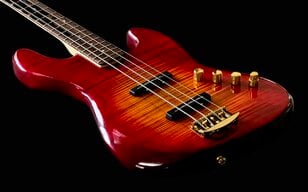
 
Neck angle is reduced by either a lower-set bridge and/or a higher-set neck (in relation to the body). Gibson Flying Vs were famous for this, although I'm not good at remembering which years. One release had zero neck angle with a tune-o-matic bridge! TOMs are notoriously tall bridges which usually require a neck angle. This particular one had a neck sitting WAY off the body.
To achieve an acceptable action you want the bridges at the lowest elevation to ride so that they are touching the frets or the fingerboard if frett less. I like to test this under string tension. Variables such as saddle height, height of the fingerboard off the body, etc., all play a factor. Methods for lowering the strings include angling the neck, routing a "bed" for the bridge, a deeper neck pocket for bolt-ons, etc. Every technique has pros and con's and there is no "right" way in general, though preserving the spirit of the instrument you are inspired by may well be a deciding factor.
 
  • Like
Reactions: Canadian APII
It's fairly common for guitars to have a tall bridge and an angled neck, but basses seldom have it. Your bridge is quite low, so I'm guessing that your neck will be parallel with the body top.
The fingerboard you got is likely ¼" tall (at the highest point), but generally the neck top surface is a bit higher than that (in reference to the body top), so you will probably need to shave off ⅛"-¼" from the top of the neck where it passes through the body, so it's level with the body and so the neck will be at the right height.
It's probably worthwhile to draw up a rough side profile of the assembly to make sure that everything lines up. Don't forget to include fret height in the calculation.
 
I touched on how to plan the neck angle in another build thread for an RSB retrofit neck: Aria Pro II RSB Deluxe-I "Black n' Gold" neck build | TalkBass.com
Currently writing a series of articles on designing instruments in CAD which will deal with scale length, string spacing, neck angles, etc. There's a long way to go with those though, but I'm happy to feed what is distilling in my head into this thread. I'm sure that between all of us we should have enough brain cells to rub together to start a fire. ;-)

I agree with Michael in that it would be good to maintain original specs as closely as is reasonable.
 
This all makes sense to me now. There is indeed a little bit of neck blank riding above the plane of the body on a couple of my guitars. I'll need to grab the calipers and check the offset of my SB. Looks like shaving that small amount from the top of the neck from fingerboard termination to the end of the body may be a good job for Safe-T-Planer. :)

And yes, I do plan on having a side profile drawing that will handle that, as well as headstock angle, volute and general taper.

Next up: Neck laminate. I plan to start at 48" long, 4" wide and 3" deep. What I need to consider, based on that, is how I want to arrange the boards (from a function as well as aesthetic standpoint). It would seem, purpleheart, walnut and maple make for a nice strong blank. With the board thicknesses I have, I am thinking M/W/PH/W/M(1", 1/2", 1", 1/2", 1") to achieve the 4" width in a 5-layer laminate. This would mean I need to scour the local shops for a maple board in the proper dimensions (6" wide x 1" thick x 48" long). Should not be a problem there. I do indeed have a maple board, but I would need to use it in the middle of the blank, and I am not sure I want to do that.

I did pick up a memaline board last night, as well as some bolts, washers and nylon locking nuts. The idea is to mount my bandsaw and drill press to the boards, and clamp them to the bench where I did not top with plywood. More elbow room is a good thing.
 
  • Like
Reactions: Robert Canfield