• TalkBass has been independent since 1998. Add your voice.
    Create a free account to reply to discussions, view embedded media, and browse with fewer display ads.
    Join freeLog in
    Want zero display ads or expanded classifieds tools? Compare plans.

Fodera Club Part III

Status
Not open for further replies.
Richard's next bass will be very simple -- EXACTLY like the Fodera that he has become known for. The one that he did not keep was a 33" scale. Since he travels so much he wanted us to make him a more compact, lighter weight (Swamp Ash instead of Medium Weight Northern Ash) instrument. After playing it for quite awhile he decided that he preferred not having to switch back and forth between 33" and 34" scale and preferred the tone of his heavier, denser 34". So, we will be replicating that bass as exactly as possible.

Interesting. Would you please share the specs with us?
 
As with all woods, there is a LOT of overlapping. By way of example, we have built Swamp Ash basses that weigh close to 10 pounds and Northern Ash basses that weigh less than 10 pounds...much of the difference depends on the actual weight and density of the given pieces of wood in question.

Designing completely custom instruments is always a series of trade-offs. In the case of Richard's 33" scale Imperial, he really wanted Vinny to make the instrument as compact and lightweight as possible. The weight and size were the prime drivers of the design. So, 33" scale was used, the lightest piece of Swamp Ash in the shop at the time for the body, the body was carved to be slightly undersized to minimize weight, etc. As a compact-sized bass guitar the instrument excels. It plays and sounds really great, for what it is and was emant to be.

Contrasting this to Richard's first Imperial, however, which was a 34" scale and weighs 11 pounds (fairly heavy Northern Ash with an Olive Top) and you get two very different instruments. First off, Richard just never got really comfortable with the way the 33" scale length responded under his fingers. For him, it just never felt like home.

From a tone perspective and having heard both of these basses, I would say that the biggest difference that I personally noticed was the incredible presence in the low-end of the heavier, longer-scaled instrument coupled with an almost ringing-piano like, highly nuanced quality to the low register notes. Funny, the 33" scale bass sounds killer in its own right, but when compared directly to the tone that Richard had in his head from living with the other bass for so many years, they really do sound very, very different. The 33" scale has a more compact tone. Quicker sounding with a more definitive attack and end to each note but with less deep bass...

Of course Northern Ash can go way too far in the other direction. My first real bass was a 13+ pound early 1980's Fender P-Bass and that thing was fairly dead sounding...

So, what are the basic sonic differences between northern ash and swamp ash? My last Imperial had northern (I believe) and it was quite heavy and flat sounding.
 
Hi Jason,

Can you commend also on switching from maple to swamp ash tone block and from large to small frets??

Are the EMG Sopbars Custom wound for Fodera???

Thanks for the discussion.:bassist:


Medium Weight Northern Ash Body
Swamp Ash Tone Block
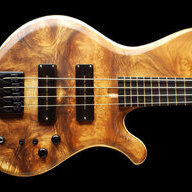
Olive Top
Birdseye Maple FB, Ebony Dot position markers
34" Scale, 24 frets, small frets
EMG Soapbars
Fodera/Pope Preamp (although he will likely always run it passive)
 
This was not a switch, this is merely replicating the way his first 34" Fodera was built...

The EMG's are not custom wound for us...


Hi Jason,

Can you commend also on switching from maple to swamp ash tone block and from large to small frets??

Are the EMG Sopbars Custom wound for Fodera???

Thanks for the discussion.:bassist:
 
please excuse slight derail......hey just thumpin, can u shed some light on the victor wooten classic with JJ pickups, 5 piece maple neck and multi laminate body (quilt/birdseye/quilt top and mahogany/birdseye/mahagany back. I this build type a one off? How does its sound/tone differ from the other classic?
 
I have Foderas with both and can say that more than anything it is a personal preference thing. The feel is the biggest difference with the small frets getting your fretting hand's fingers closer to the wood of the FB. Some people love that (I am one of them) and others don't.

Obviously, small frets have less wear in them, so if you have a pretty heavy touch -- unless you want to deal with refrets more frequently -- the larger frets will wear longer...

Larger frets also leave more room to correct for minor changes to the shape of your FB as the instrument ages (via a fret job).

Jason....what is the difference in feel between large frets and small frets? Are small frets not as good for slapping but for getting more of a fretless feel compared to large frets? I'm just making generalizations since I've never tried a bass with small frets before.
 
If it is not one of a kind I would be surprised. First a word on names -- by definition, a Victor Wooten Classic is a Monarch 4-string with a Mahogany Body, Flame Maple Top, Old Growth East Indian Rosewood FB, EMG P/J pups and our wider, "Classic" headstock shape. That was Vic's original spec and a true Vic Wooten Classic has those specs. Over the years, we have "expanded" the definition slightly to allow for people's preferences for varying their top wood (from Flame Maple). But changes to any of the other specs mean its no longer a "Vic Wooten Classic."

So, a Vic Wooten Classic is ALWAYS a 4-string Fodera Monarch, but MANY 4-string Fodera Moanrchs are NOT Vic Wooten Classics. Make sense?

As to how this specific bass would sound different than a Vic Wooten Classic...I'd need to see pictures of the instrument to have a better look at its exact build and the type of pups that were used in it to offer any kind of real input. That said, assuming it has an old growth East Indian FB and that the core body wood is Mahogany, the MAJOR differences in tone would be from the J/J pups vs. the P/J's that Vic uses. There is certainly going to be less "beef" to the low end because of the J pup in the neck position, but just how different would depend on exactly what kind of pups are in it...wish I could be more helpful!!

please excuse slight derail......hey just thumpin, can u shed some light on the victor wooten classic with JJ pickups, 5 piece maple neck and multi laminate body (quilt/birdseye/quilt top and mahogany/birdseye/mahagany back. I this build type a one off? How does its sound/tone differ from the other classic?
 
Does anyone know where the actual position of the pickup (relative to the 12th fret) is on Anthony Jackson's Presentation bass. I know they are apparently placed by sound, but has anyone measured it out? I wanted to try and replicate the positioning on a shorter scale bass and (obviously) don't have a presentation to measure it off.

Thanks :)
 
It's very close to half way between the bridge and the 24th fret. Take a look at the fodera website section on the AJ Presentation. There is a close up of #9, and a full bass shot of #10 (his current instrument).

Jim

Does anyone know where the actual position of the pickup (relative to the 12th fret) is on Anthony Jackson's Presentation bass. I know they are apparently placed by sound, but has anyone measured it out? I wanted to try and replicate the positioning on a shorter scale bass and (obviously) don't have a presentation to measure it off.

Thanks :)
 
Does anyone know where the actual position of the pickup (relative to the 12th fret) is on Anthony Jackson's Presentation bass. I know they are apparently placed by sound, but has anyone measured it out? I wanted to try and replicate the positioning on a shorter scale bass and (obviously) don't have a presentation to measure it off.

Thanks :)

I think Anthony Jackson did answer a question as to the P/U position on his bass seen from the nut.
From there you could calculate it quite easily.
If I could remember what he wrote...sorry.:) (was it close to 32" from the nut?...I wish I remembered...)
 
Status
Not open for further replies.

Latest posts