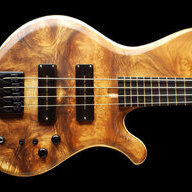
Can anyone tell the different in sound between the 34' and 33' scale? Mainly in the upper register. Not the B string

TalkBass has been independent since 1998. Add your voice.
Create a free account to reply to discussions, view embedded media, and browse with fewer display ads.
Join free Log in
Want zero display ads or expanded classifieds tools? Compare plans.

Can anyone tell the different in sound between the 34' and 33' scale? Mainly in the upper register. Not the B string

Christian, I can tell you that in a general sense I find the 33" scale (using the same strings) sounds rounder and a bit warmer...some would even say bigger. This helps out quite a bit with the higher notes on the instrument. You lose some clarity, but that can be gained back a bit with wood choice. I think this is all simply because the strings aren't as taught. You get more vibration from the strings (someone correct me if I'm wrong).


I also notice a lot more fundamental coming out of the bass than a comparable 35" scale

Gang -- at the risk of sounding preachy, it is really dangerous to get into in-depth discussions about tone using language WITHOUT being able to calibrate that language in real time with the person with whom you are speaking. Hearing is believing, everything else is subject to so many variables as to make discussion almost impossible. My "warm" might be your "bloated and fat." Your "precise" might be my "harsh and analytical." Even if we could all agree on what various words mean we still all hear things differently and without knowing what those inherent biases are, a lot of the information that we pass back and forth to one another might actually be more harmful than helpful.
This is why I try to answer rather broadly and generally when it comes to issues of tone because I have had so many experiences where a customer says over the phone that he / she loves the sound of a "warm vintage sounding bass" and then shows up at the shop with his / her bass (which is "warm and vintage sounding" in their mind) and it sounds NOTHING like that to me and Joey. This is why we ask people to send us sound clips of the bass tones they like if they are unsure about what they want to go with tonally. A good listen is worth a thousand descriptions...
Am I making any sense?
Regards,
Jason


What do you mean? The relationship between bass scale and resonant frequency is 1/.00000000000002pi * (avedgadro's number/scale) to the (any arbitrary number)th power. That's common knowledge.
So "warm" is actually mathematically synonymous with the number 79.
Bring down the 79 for the bass solo.
Gang -- at the risk of sounding preachy, it is really dangerous to get into in-depth discussions about tone using language WITHOUT being able to calibrate that language in real time with the person with whom you are speaking. Hearing is believing, everything else is subject to so many variables as to make discussion almost impossible. My "warm" might be your "bloated and fat." Your "precise" might be my "harsh and analytical." Even if we could all agree on what various words mean we still all hear things differently and without knowing what those inherent biases are, a lot of the information that we pass back and forth to one another might actually be more harmful than helpful.
This is why I try to answer rather broadly and generally when it comes to issues of tone because I have had so many experiences where a customer says over the phone that he / she loves the sound of a "warm vintage sounding bass" and then shows up at the shop with his / her bass (which is "warm and vintage sounding" in their mind) and it sounds NOTHING like that to me and Joey. This is why we ask people to send us sound clips of the bass tones they like if they are unsure about what they want to go with tonally. A good listen is worth a thousand descriptions...
Am I making any sense?
Regards,
Jason
What do you mean? The relationship between bass scale and resonant frequency is 1/.00000000000002pi * (avedgadro's number/scale) to the (any arbitrary number)th power. That's common knowledge.
So "warm" is actually mathematically synonymous with the number 79.
Bring down the 79 for the bass solo.
Gang -- at the risk of sounding preachy, it is really dangerous to get into in-depth discussions about tone using language WITHOUT being able to calibrate that language in real time with the person with whom you are speaking. Hearing is believing, everything else is subject to so many variables as to make discussion almost impossible. My "warm" might be your "bloated and fat." Your "precise" might be my "harsh and analytical." Even if we could all agree on what various words mean we still all hear things differently and without knowing what those inherent biases are, a lot of the information that we pass back and forth to one another might actually be more harmful than helpful.
This is why I try to answer rather broadly and generally when it comes to issues of tone because I have had so many experiences where a customer says over the phone that he / she loves the sound of a "warm vintage sounding bass" and then shows up at the shop with his / her bass (which is "warm and vintage sounding" in their mind) and it sounds NOTHING like that to me and Joey. This is why we ask people to send us sound clips of the bass tones they like if they are unsure about what they want to go with tonally. A good listen is worth a thousand descriptions...
Am I making any sense?
Regards,
Jason
Jason - Your are right! Tone is very different from people to people.
Does people who want 33 scale, prefer it because it makes the bass more compact or is the different tone they get from 33 scale vs. 34 scale that drives them?
Matt Garrison and Janek Gwizdala have the almost the same spec bass (not the MGS) but the sound is still very different

What do you mean? The relationship between bass scale and resonant frequency is 1/.00000000000002pi * (avedgadro's number/scale) to the (any arbitrary number)th power. That's common knowledge.
So "warm" is actually mathematically synonymous with the number 79.
Bring down the 79 for the bass solo.