
Enjoy the benefits of a premium membership!
Upgrade Account
-
TalkBass has been independent since 1998. Add your voice.
Create a free account to reply to discussions, view embedded media, and browse with fewer display ads.
Join free Log in
Want zero display ads or expanded classifieds tools? Compare plans.
You are using an out of date browser. It may not display this or other websites correctly.
You should upgrade or use an alternative browser.
You should upgrade or use an alternative browser.
- Status
- Not open for further replies.
More options
Who Replied?
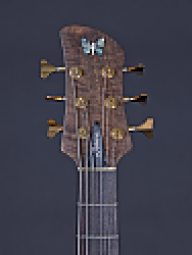
Different strokes for different folks..I have 2+3 on an Emperor and 3+3 with extended B, as in the photo, on my 33" scale 6 string. I love em both and think they both work really well and the Emperor shown is absolutely stunning, one of my fav's.
Minor points with the extended B are;
1. You'll be reaching for the E string tuner, thinking your tuning the B.
2. You might cut a new B string while measuring it's length at the E string peg, as I have.
Minor points with the extended B are;
1. You'll be reaching for the E string tuner, thinking your tuning the B.
2. You might cut a new B string while measuring it's length at the E string peg, as I have.
FWIW, I prefer the aesthetic of the 2+3 headstock anyway. Maybe it's because it looks a little more balanced to have two big strings and three small ones? Dunno, but I like it.
The one I absolutely can't get used to, is the 3+2 or 3+3 where the B string goes outside the tuners. Definitely MHO on this, and no offense to those who like it, but it just looks really wonky to me.
[Invalid or Expired Link Removed]
Attachments

- Aug 21, 2008
- 1,168
- 33
- Disclosures
- Endorsing Artist : Fodera Guitars , Harvest fine leather bags & straps
To me there is NO more sexier headstock shape than the Extended-B headstock - I am talking about the lines... I even would want to have on a 4 string - I got used to it pretty quickly and the B on my 34" 5 is great 
[Invalid or Expired Link Removed]
- I got used to it pretty quickly and the B on my 34" 5 is great [Invalid or Expired Link Removed]

Yep, as always... like I said, "MHO" on that one.Different strokes for different folks...
Yeah, I suppose I should clarify to say I'm strictly talking about the B string path. The shape does not bother me at all, but then again, it pretty much dictates the B string path, so oh well.To me there is NO more sexier headstock shape than the Extended-B headstock - I am talking about the lines...

Something strange happened to my Matt Garrison Standard today...
I left it into its hardshell case behind the insulating glass of a window for a couple of hours. The room was filled with sunlight.
temperature in the room was about 70F. Outside temperature was around 60F. Humidity in the house is about 45-50%
As I pulled the bass out from its case, here and there on the fingerboard was sign of oil, moisture (?). As the bass came in contact with the air in the room it started evaporating. I wiped it off with a paper towel and it was kinda oily brownish substance that exudate from the fingerboard.
I oiled the fingerboard once last August, after 12 months it left Fodera shop, using mineral oil as recommended from the Fodera crew.
FWIW no neck movement of any sort, the bass seems perfectly in shape as the day it came out from the shop and, of course, it's a blast to play.
Any thoughts? Is it normal? Is it the natural oil contained in the Pau Ferro board that exudate because of the temperature rising inside the case?
I left it into its hardshell case behind the insulating glass of a window for a couple of hours. The room was filled with sunlight.
temperature in the room was about 70F. Outside temperature was around 60F. Humidity in the house is about 45-50%
As I pulled the bass out from its case, here and there on the fingerboard was sign of oil, moisture (?). As the bass came in contact with the air in the room it started evaporating. I wiped it off with a paper towel and it was kinda oily brownish substance that exudate from the fingerboard.
I oiled the fingerboard once last August, after 12 months it left Fodera shop, using mineral oil as recommended from the Fodera crew.
FWIW no neck movement of any sort, the bass seems perfectly in shape as the day it came out from the shop and, of course, it's a blast to play.
Any thoughts? Is it normal? Is it the natural oil contained in the Pau Ferro board that exudate because of the temperature rising inside the case?
Something strange happened to my Matt Garrison Standard today...
I left it into its hardshell case behind the insulating glass of a window for a couple of hours. The room was filled with sunlight.
temperature in the room was about 70F. Outside temperature was around 60F. Humidity in the house is about 45-50%
As I pulled the bass out from its case, here and there on the fingerboard was sign of oil, moisture (?). As the bass came in contact with the air in the room it started evaporating. I wiped it off with a paper towel and it was kinda oily brownish substance that exudate from the fingerboard.
I oiled the fingerboard once last August, after 12 months it left Fodera shop, using mineral oil as recommended from the Fodera crew.
FWIW no neck movement of any sort, the bass seems perfectly in shape as the day it came out from the shop and, of course, it's a blast to play.
Any thoughts? Is it normal? Is it the natural oil contained in the Pau Ferro board that exudate because of the temperature rising inside the case?
I would email the Fodera shop on that one. Just to be safe.
Well, Jason would probably chime in here...
I would email the Fodera shop on that one. Just to be safe.
Just Thumpin'
Commercial User
- Mar 7, 2008
- 4,534
- 1,664
- Disclosures
- Manager and Partner, Fodera Guitars (10/14/09 - 12/16/19)
That's definitely a first for me.
The only thing that I can think of is if the instrument itself was very cold and then moved into a humid room. That could have formed condensate and if condensate forms on any rosewood, sometimes the pigment from the wood can mix with the condensate.
That's the only thing I can think of. That said, I definitely would not leave my instrument (even in a case) in direct sunlight...
Regards,
Jason
The only thing that I can think of is if the instrument itself was very cold and then moved into a humid room. That could have formed condensate and if condensate forms on any rosewood, sometimes the pigment from the wood can mix with the condensate.
That's the only thing I can think of. That said, I definitely would not leave my instrument (even in a case) in direct sunlight...
Regards,
Jason
Something strange happened to my Matt Garrison Standard today...
I left it into its hardshell case behind the insulating glass of a window for a couple of hours. The room was filled with sunlight.
temperature in the room was about 70F. Outside temperature was around 60F. Humidity in the house is about 45-50%
As I pulled the bass out from its case, here and there on the fingerboard was sign of oil, moisture (?). As the bass came in contact with the air in the room it started evaporating. I wiped it off with a paper towel and it was kinda oily brownish substance that exudate from the fingerboard.
I oiled the fingerboard once last August, after 12 months it left Fodera shop, using mineral oil as recommended from the Fodera crew.
FWIW no neck movement of any sort, the bass seems perfectly in shape as the day it came out from the shop and, of course, it's a blast to play.
Any thoughts? Is it normal? Is it the natural oil contained in the Pau Ferro board that exudate because of the temperature rising inside the case?




Nice top
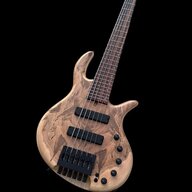
+1 and fretboard is really nice too. great selections
Thanks guys!
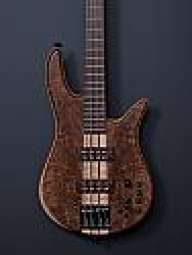
Pretty cool story.... I was adamant that I was spending big $$$ for abalone inlays on this bass. Met with the Fodera gang and over a glass of wine, Joey talked me out of it. He said no inlays would look much better with that board and top. Not often a builder talks you out of a very expensive option. I think he was right in any case.
Very nice! I like a fingerboard without dots
Pretty cool story.... I was adamant that I was spending big $$$ for abalone inlays on this bass. Met with the Fodera gang and over a glass of wine, Joey talked me out of it. He said no inlays would look much better with that board and top. Not often a builder talks you out of a very expensive option. I think he was right in any case.
I agree.
If really "forced" maybe something at the 12th fret like the Sting block but with something else like serial # or ??? or maybe enlarged bass clef only because Vinny's engraving is so special
If really "forced" maybe something at the 12th fret like the Sting block but with something else like serial # or ??? or maybe enlarged bass clef only because Vinny's engraving is so special
I agree.
If really "forced" maybe something at the 12th fret like the Sting block but with something else like serial # or ??? or maybe enlarged bass clef only because Vinny's engraving is so special
Great point and I am kinda glad I didn't think about that as I was at the upper end of my budget anyways!
Plus, I really love the look of ebony with no inlays/dots... and I never have a need to look at markers on the board (side markers are a different story!). Very clean looking to me.
If I don't go fretless with my second build, it will be a fretted maple board with no inlays/dots.
Well, that occourred by accident. I stopped practicing late at night and just stored the bass leaving the case in the room. Curtains were open and the following morning the sun came in.
I don't think it was codensate as the body was dry, just the fingerboard appeared like it was played by someone with sweaty hands.
It was definitely something oily that exudated from the fingerboard.
No sign of damage though. After 24 hours the bass was still in tune and neck relief and string action were the same.
Maybe the temperature inside the case rised and the pau ferro exudated some of its oily content.
I don't think it was codensate as the body was dry, just the fingerboard appeared like it was played by someone with sweaty hands.
It was definitely something oily that exudated from the fingerboard.
No sign of damage though. After 24 hours the bass was still in tune and neck relief and string action were the same.
Maybe the temperature inside the case rised and the pau ferro exudated some of its oily content.
That's definitely a first for me.
The only thing that I can think of is if the instrument itself was very cold and then moved into a humid room. That could have formed condensate and if condensate forms on any rosewood, sometimes the pigment from the wood can mix with the condensate.
That's the only thing I can think of. That said, I definitely would not leave my instrument (even in a case) in direct sunlight...
Regards,
Jason
That is awesome. I love the figuring in the (ebony?) board.Progress pic of my Monarch.


Brent, your bass looks awesome. Very, very jealous. Hopefully I can hear it at a gig next time I'm in Toronto.
Ash & maple?
If I don't go fretless with my second build, it will be a fretted maple board with no inlays/dots.
Ash & maple?
- Status
- Not open for further replies.

