
Enjoy the benefits of a premium membership!
Upgrade Account
-
TalkBass has been independent since 1998. Add your voice.
Create a free account to reply to discussions, view embedded media, and browse with fewer display ads.
Join free Log in
Want zero display ads or expanded classifieds tools? Compare plans.
You are using an out of date browser. It may not display this or other websites correctly.
You should upgrade or use an alternative browser.
You should upgrade or use an alternative browser.
Fretless - position markers, fret lines, and such
- Thread starter BaileyMan
- Start date
More options
Who Replied?

When I got my first fretless (unlined) in the 80s it wasn't intonated correctly, and I adjusted my playing by ear. Once I intonated it, the dots are nominally where the frets would be. It's a little easier to play in tune now, but it wasn't really a huge issue.

I checked the dots on my Warwick with a tuner, in relation to the angle I see them from when I'm playing. They're close enough.


I like those little red circular stickers from the office supply store. You can have a nice, unlined, undotted fretless board, and just throw a couple of those stickers on wherever you need it. Add as many as you need, move them if your setup changes radically, take them off whenever you want, or leave them on forever. It's all good. Nobody can even see it from more than 5 feet away.

When to press your finger to the fret board note how wide the contact area is. For me, depending on which finger and how hard I press, it could be in the 1/2" range. When I play a fretted bass that doesn't matter of course.
However my first fretless was a lined fretless and after a short time I found myself playing with most of my finger contacting slightly toward the nut when playing in the "low" area on the neck. When playing higher up on the neck it went the other way but not as much. The other issue is that there is not as much room for error the higher you go. If you look at your fret board lines you'll notice that the frets/lines are closer up higher. Being a very analytical person (note what the first four letters in analytical spell) all of this drove me crazy. I dissected the visual vs tuner aspect of this for a very long time looking for some sort of correlation to something. I did play blues and rock on stage with this instrument for a few years.
Then came the unlined board with no lines to worry about...visually. I had a great fear of committing to an unlined fret board and in fact I had an unlined neck setting for over a year before I bolted it up and played it. Once I did, I loved it. Now I have to use my ears and sense of pitch to play. More importantly playing a lined fretless is no longer a joy, it's just too distracting for lack of a better term. Go figure! I do have to be honest in the fact that I have yet to play the unlined fretless live other than practice and full rehearsals. But I am confidant that it will be good...now lets get to playing again!
BTW there are side dots on the unlined neck that are very close to where you put your finger.
However my first fretless was a lined fretless and after a short time I found myself playing with most of my finger contacting slightly toward the nut when playing in the "low" area on the neck. When playing higher up on the neck it went the other way but not as much. The other issue is that there is not as much room for error the higher you go. If you look at your fret board lines you'll notice that the frets/lines are closer up higher. Being a very analytical person (note what the first four letters in analytical spell) all of this drove me crazy. I dissected the visual vs tuner aspect of this for a very long time looking for some sort of correlation to something. I did play blues and rock on stage with this instrument for a few years.
Then came the unlined board with no lines to worry about...visually. I had a great fear of committing to an unlined fret board and in fact I had an unlined neck setting for over a year before I bolted it up and played it. Once I did, I loved it. Now I have to use my ears and sense of pitch to play. More importantly playing a lined fretless is no longer a joy, it's just too distracting for lack of a better term. Go figure! I do have to be honest in the fact that I have yet to play the unlined fretless live other than practice and full rehearsals. But I am confidant that it will be good...now lets get to playing again!
BTW there are side dots on the unlined neck that are very close to where you put your finger.

If you play a lined fretless, decide where you want to play in relation to the line. Gary Willis played for all his years as he would a fretted, just behind the line. After all that time, he now wishes that he had set the intonation directly on top of the line, splitting the finger. This allows for tempered tuning, you're not creeping forward of the line at the bottom end of the scale to intonate, or backing off playing in the upper register.

Disclaimer, I don't work at Fender or any guitar factory.This makes NO SENSE to me. It may be true but it makes no sense. It is in effect saying that a modern CNC constructed neck can repeatedly and precisely locate the fret slots but can't do so with the side dots?
Just makes no mechanical engineering / manufacturing process sense at all.
I would expect the lines or dots on an unlined neck to be positioned as precisely as the frets they represent. What should be imprecise in this process is the width of the player's finger, they way the stop the note and the actual resulting witness point. I would expect THAT is the variability, not the manufacturer's placement of the dots or lines.
But I must confess I don't have an unlined fretless to measure.
I'd wager as an engineer and as a musician that that "CNC" dots for fretted and fretless necks at Major Brand Factory are Exactly the same position At Least 9 times of 10. I'd also point out that the 12, the usual first stop for intonating a bridge, is represented by 2 dots. Is it the low side dot or the high side dot? Or maybe it's the middle. I don't know. I only know it is in 4 different places on 4 different fretless basses.
Here's the only thing I'm fully confident in, for a very short run, limited production modification of a standard product there's nearly zero possibility they will pay an NC tech to reprogram the side neck position dots.
Doner Designs
Steve Doner
- Jun 2, 2012
- 5,784
- 6,819
- Disclosures
- Doner Designs is an alias for Steve Doner
On a lined fretless the dots are positioned like on a fretted bass. On an unlined fretless the dots are where the frets would be.
Usually.
Usually.
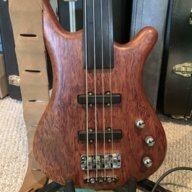
I checked the dots on my Warwick with a tuner, in relation to the angle I see them from when I'm playing. They're close enough.
This has been my experience with my only FL, which happens to be a Warwick. I occasionally glance at the dots on the side of the neck, but mostly I'm playing by ear. It is shocking how often I notice I'm not hitting the right spot. Maybe with time and practice...in the mean time, it's an absolute hoot!

As one who has played both upright and bass guitar for more than four decades, I believe this opinion to be fallacious. The bass guitar has fundamental physical positioning, which makes the techniques used on upright to be not applicable.But I really think if an upright bassist could play without markers electric players could too.
The fact is that there is a general belief that the lack of apparent visual indicators on a fretless bass guitar looks cooler. Meanwhile, visual indicators, such as side dots at a minimum, remain compulsory. The concept that some artist, “better than Jaco,” is going to come along and use no visual aids whatsoever on the fretless bass guitar is naive at best; and generally uninformed.
Players need to do what they need to do, balancing appearance with function. Let’s just leave it there; and more than that try to be kind and NOT depracatory towards our fellow bass players. C’mon, we’re all just trying to get along.

Paint your fingerboard camo and then go for it.I'm sure this has been discussed before, but a quick search didn't turn it up...
Question about the position of dots on unlined fretless basses and fretlines on lined fretless basses.
I measured the distance to the third fret on my fretted bass, and to the fretline on my lined fretless. They're the same distance. My lined fretless (originally unlined) has the dot just behind the fretline, not in the middle between the frets. I've always aimed for the dot.
I measured the distance to the dot at the "third fret" on an unlined fretless I have and discovered that it's the same distance as the dot on the lined fretless, just behind where the fret would go. This was a revelation! I was under the impression that the dots marked the fret position (i.e., where the witness point should be). However, they don't (not on this bass anyhow). The dots mark where you place your finger creating a witness point just in front of it where the fret would go.
I'd been trying to wrap my head around intonation problems. What my ears were telling me was different than what I expected based on what my eyes were telling me. Now it all makes sense.
I'm wondering, for those who play fretless, what kind of bass do you play, is it lined or unlined, what do the dots and/or lines mark (where you aim with the middle of your finger or where the fret/witness point should be)?
Just wondering as I consider changes to my stable...
I think this is the key point. Other basses may have a different arrangement. Different manufacturers do it differently. Custom arrangements are possible.not on this bass anyhow
My current lined fretless bass has side dots centred between the lines, and as best I can tell the lines are where the fret wire would be. This works well for me: if I'm going to have a visual reference at all then I want the lines where the notes are. I try to trust my ears, but when I realise I'm out a quick glance at the lines is the fastest way to get back on track. Plus the lines are a good reference for harmonics.
I went to a bass clinic with Alphonso Johnson (I think: it was a long time ago) who explained that the fretless bass he was playing had lines all offset towards the bridge such that when his finger was playing a note in tune it was behind the line, so it looked similar to playing behind the fret wire of a fretted instrument. Not an arrangement that would work for me, but it worked well for him. I don't know why he has the extra line near the nut though, that just looks weird (to me):
(Image source: Vigier website.)
I'm sure this has been discussed before, but a quick search didn't turn it up...
Question about the position of dots on unlined fretless basses and fretlines on lined fretless basses.
I measured the distance to the third fret on my fretted bass, and to the fretline on my lined fretless. They're the same distance. My lined fretless (originally unlined) has the dot just behind the fretline, not in the middle between the frets. I've always aimed for the dot.
I measured the distance to the dot at the "third fret" on an unlined fretless I have and discovered that it's the same distance as the dot on the lined fretless, just behind where the fret would go. This was a revelation! I was under the impression that the dots marked the fret position (i.e., where the witness point should be). However, they don't (not on this bass anyhow). The dots mark where you place your finger creating a witness point just in front of it where the fret would go.
I'd been trying to wrap my head around intonation problems. What my ears were telling me was different than what I expected based on what my eyes were telling me. Now it all makes sense.
I'm wondering, for those who play fretless, what kind of bass do you play, is it lined or unlined, what do the dots and/or lines mark (where you aim with the middle of your finger or where the fret/witness point should be)?
Just wondering as I consider changes to my stable...
I've got two, both unlined, 1. a TF Fender, there are dots at the 1st, 3rd 5th etc and 2. A Rickenbacker which has side dots at every half step, I've actually never compared them to their fretted counterparts and always just assumed they were right on the note. I just checked the Fender and the G dot on the E string is right on the fret. I use the dots to get in the correct position but not for every note but also use my ears to stay in pitch.
On my '80s MIJ Jazz the side dots are approximately where the note is, or where a fret would be.
I was never going to be a fretless player, but one of my local heroes growing up was one the best players I ever heard, and faultless as a fretless player.
This is in the late 70's, and had ordered an NS Spector from Stuart himself out of a little ad in the back of GUITAR PLAYER ( . . . this is what we did in a pre-internet world . . .), and Stuart advised he only had some fretted axes in stock. They worked it out where Stuart pulled the frets, smoothed the fingerboard, and inlaid the fret slots with wood strips.
First Spector (hell, the first handbuilt bass) I ever saw, PJ EMG's, the whole nine yards. My friend remarked he did it by playing exactly on top of the fret lines with a light touch, and not having been an upright player, he said he'd have not wanted to attempt an unlined one. It must have worked, as his pitch was always flawless.
This is in the late 70's, and had ordered an NS Spector from Stuart himself out of a little ad in the back of GUITAR PLAYER ( . . . this is what we did in a pre-internet world . . .), and Stuart advised he only had some fretted axes in stock. They worked it out where Stuart pulled the frets, smoothed the fingerboard, and inlaid the fret slots with wood strips.
First Spector (hell, the first handbuilt bass) I ever saw, PJ EMG's, the whole nine yards. My friend remarked he did it by playing exactly on top of the fret lines with a light touch, and not having been an upright player, he said he'd have not wanted to attempt an unlined one. It must have worked, as his pitch was always flawless.
I've got a Rob Allen with lines at the fret positions. I also have an NS Designs CR5 unlined, with side dots at the fret positions. I set the intonation so that the 12th "fret" position is correct. I'm not accomplished enough on fretless to play without looking, so I rely on the lines and dots. They call me "Lightning", because I never strike the same place twice ;-) (I can't take credit for the joke; I think I read it elsewhere on TB).
It's totally subjective. Yo-Yo Ma has perfect placement. As does Itzhak Perlman. As did Duke Ellington. As do most professional DB players. But bass guitar is different. The thing that is different is that it is acceptable for basses to have lines. Not trying to be an arse, I am trying to learn why. I absolutely don't have perfect placement but I do practice with a digital tuner so I can improve and do the best I can to come as close as my basketball-palming sized hands will allow. I've never had a lined fretless so I can't honestly say whether I would look if I could. But I can sing and troll a crowd without looking at my fretted or my guitar or piano so who knows. As long as it works everybody has their preference. Luckily there are a lot of right answers.
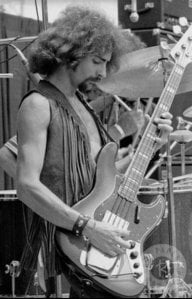
My first fretless was a 4 string with a lined neck, and I definitely had to use the lines to play in tune, but the longer I played, the less frequently I had to look at the neck. I never reached the level of not having to look at the neck at all. There were a few songs I could play without visual reference, but those songs usually had an open string note or two.
After 10 -12 years, I improved, but still used visual reference . Then I ended up with a 5 string unlined. The side marker dots on the neck of my bass are where frets would be on a fretted neck. For me, the side marker dots were easier to use because of the fact they can be seen from directly above the neck rather than having to get in position to see the fingerboard from the front. The line ends can be seen from directly above on most lined necks, but I found the dots on positions 3, 5, 7, etc. are much easier to see, especially in limited lighting.
About six or seven years later, I acquired my first upright. I’m coming up on my 20th year playing upright, and although I do look at the neck occasionally when I play, there is no precise visual indication of where to play a note. The way I play upright is a lot different than electric bass guitar, with more open string notes, and more physical position reference near the nut or near the heel where the neck meets the body. Those physical location references along with the 105 cm (41.3”) scale makes upright a lot easier to play without visual reference.
The most difficult fretless instrument for me to play in tune is a super short scale bass like a 21” scale Ukulele bass. I play violin and I considered it easier to play in tune than a 21” scale fretless bass....
After 10 -12 years, I improved, but still used visual reference . Then I ended up with a 5 string unlined. The side marker dots on the neck of my bass are where frets would be on a fretted neck. For me, the side marker dots were easier to use because of the fact they can be seen from directly above the neck rather than having to get in position to see the fingerboard from the front. The line ends can be seen from directly above on most lined necks, but I found the dots on positions 3, 5, 7, etc. are much easier to see, especially in limited lighting.
About six or seven years later, I acquired my first upright. I’m coming up on my 20th year playing upright, and although I do look at the neck occasionally when I play, there is no precise visual indication of where to play a note. The way I play upright is a lot different than electric bass guitar, with more open string notes, and more physical position reference near the nut or near the heel where the neck meets the body. Those physical location references along with the 105 cm (41.3”) scale makes upright a lot easier to play without visual reference.
The most difficult fretless instrument for me to play in tune is a super short scale bass like a 21” scale Ukulele bass. I play violin and I considered it easier to play in tune than a 21” scale fretless bass....
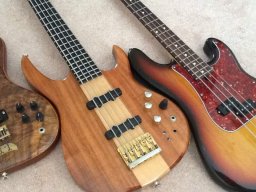
I'm really appreciating everyone's experiences, and insights. I've owned a fretless since 1997 (I was 24 at the time). I noodled with it but struggled with it, never got good at it, never really worked at it.
I love the sound of a fretless and I'm really wanting to stick with it. Part of my learning process is actually an emotional one. I've got to let go of old stories that no longer support me. Namely the story of, "I don't have a good ear". I hadn't trusted my ear for many years. So I had relied on some type of visual guide on the fretless.
Maybe I've had it all wrong though. I have had a good ear, but the visual guides were throwing me off, making me think I had a bad ear.
So any how, for me it all boils down to a desire to become a good fretless player, learning the instrument, and learning to develop those skills.
Reading what y'all have shared is helpful!
Thanks!
I love the sound of a fretless and I'm really wanting to stick with it. Part of my learning process is actually an emotional one. I've got to let go of old stories that no longer support me. Namely the story of, "I don't have a good ear". I hadn't trusted my ear for many years. So I had relied on some type of visual guide on the fretless.
Maybe I've had it all wrong though. I have had a good ear, but the visual guides were throwing me off, making me think I had a bad ear.
So any how, for me it all boils down to a desire to become a good fretless player, learning the instrument, and learning to develop those skills.
Reading what y'all have shared is helpful!
Thanks!

Make sure to adjust the saddles and intonation for each string. so that the first octave harmonics for the strings are more or less in the same spot for your action and string gauge/brand. Then train your ear for relative pitches againts the open strings.
I know upright bass players (I am too) tend to be snobbish with electric players.,but the EB neck even with markers or lines is harder than an upright neck. It is shorter and no tactile and visual landmarks like a double bass neck. Also, the EB neck is further away than the DB neck from the players eyes.
I know upright bass players (I am too) tend to be snobbish with electric players.,but the EB neck even with markers or lines is harder than an upright neck. It is shorter and no tactile and visual landmarks like a double bass neck. Also, the EB neck is further away than the DB neck from the players eyes.


