

Enjoy the benefits of a premium membership!
Upgrade Account
-
TalkBass has been independent since 1998. Add your voice.
Create a free account to reply to discussions, view embedded media, and browse with fewer display ads.
Join free Log in
Want zero display ads or expanded classifieds tools? Compare plans.
You are using an out of date browser. It may not display this or other websites correctly.
You should upgrade or use an alternative browser.
You should upgrade or use an alternative browser.
Fretless with Epoxy Coating
- Thread starter Amplified
- Start date
More options
Who Replied?

CA glue fretless I did myself. Plays like a dream!
That looks amazing. A few questions:
Is this a spray CA glue? How many coats? What did you do to the finish between coats? How hard is the final result?


Zon I believe also uses cyanoacrylate on their coated boards. Zon also uses graphite necks.
They do? I wouldn't think phenowood needed a coating.

Thank you. That is very helpful.I had epoxy on the neck for ~12 years. When it was time to refinish, I tried my hand at it myself with 2-part epoxy, but I was not entire pleased with the result. It was alright, but I wasn't satisfied.
I called Eric's Guitar Shop for some advice; he suggested that I talk to Pat Wilkins, and think about using poly instead. So, I took the bass to Wilkins Guitar, and he applied the poly.
For me (and my bass), the poly produces a bit more high-mid grind, resulting in a growlier sound.
Epoxy feels a little softer to me, and I prefer glassier to gummier.
As for the look, I don't see much of a difference.
(This is all subjective opinion, of course.)
Here is the poly finish by Wilkins:
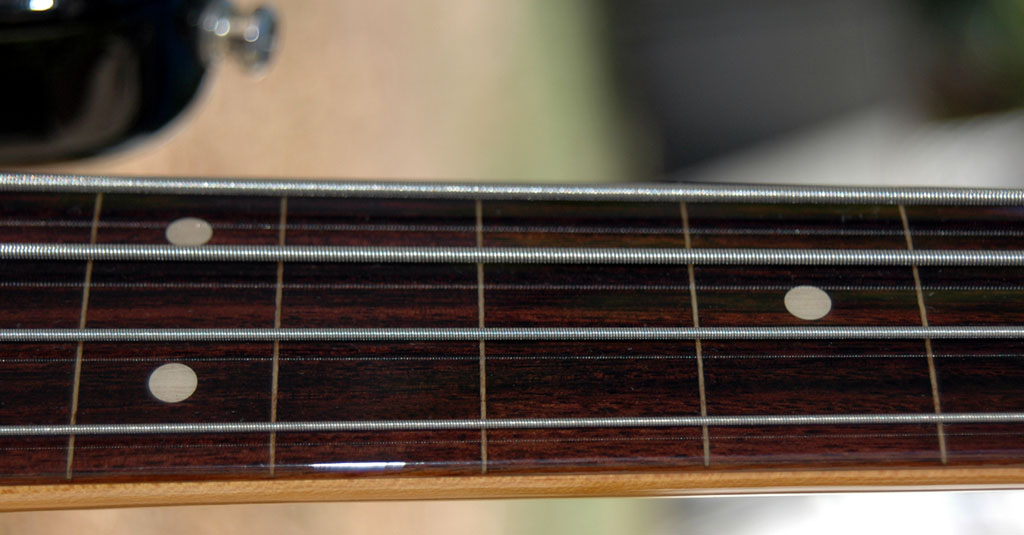

Epoxy coating adds more top end to the "Mwah"I've never owned a coated fretless neck- have been loyal to ebony FB over the years...
I'd love to get down with some extra mwah
Brightness.
You'll sound more like Manring.
I prefer uncoated rosewood.

Epoxy coating adds more top end to the "Mwah"
Brightness.
You'll sound more like Manring.
I prefer uncoated rosewood.
i think i'm more enamored w the idea than i would enjoy the sound...
I've been designing a semi-hollow graphite necked fretless 5/6/7 or string bass w drone strings in my head for many years.
IMHO, the best fretless i've EVER played (and I've played most of the big names at some point) was an Elrick semi hollow neck thru w a huge bart MM pup and ebony/piezo bridge.
Not to mention that if you want to DIY, you have to wear a respirator.i think i'm more enamored w the idea than i would enjoy the sound...
AND it can get very messy!!
You may need to do a few practice blanks before doing the real thing.
I have never thought that polyurethane was very hard, I have gotten buzzes very quickly with that on fretless necks, there is another poly I think most people are talking about here. Epoxy is very hard but is a PITA to apply and it changes the sound to me. Superglue (cyanoacrylate) dries very hard and can look really good and lasts a long time.

Both Eric Chaz and Pat Wilkins both told me, "In spray booth."What's the best way to apply polyurethane?
I'm sure there are others who would have different approaches.
:edit:
As a side note, Norik Renson (Invalid Link Removed) prefers using epoxy... spcifically, Petit's PolyPoxy. But, he says he can no longer get it, and he hasn't found an epoxy yet that he would use to replace it.
Last edited:

DiabolusInMusic
Functionless Art is Merely Tolerated Vandalism
They do? I wouldn't think phenowood needed a coating.
It says here they use polyester, like Pedulla. I guess it isn't superglue.
Zon Guitars

They do if you want it, but you're right... phenowood doesn't need it and Joe actually prefers fretless tone without it.They do? I wouldn't think phenowood needed a coating.
It's a little warmer without and really only slightly harder to achieve an exaggerated "mwah" like you can get with a coating.
He talked me out of a coating for mine, with the option of adding it later... I'm totally happy the way it is.
Best fretless tone I've ever had.
Polyester is epoxy...
DiabolusInMusic
Functionless Art is Merely Tolerated Vandalism
Polyester is epoxy...
I did not know that. Why doesn't everybody call it polyester (or epoxy) then? I have only heard of Pedulla calling it polyester prior to today when I looked into Zon's coating choice. Do you know if anybody else use polyester on their necks?
There are differences; they are not the same:
[Invalid or Expired Link Removed]
What Is The Difference Between Epoxy and Polyester Resin?
Polyester And Epoxy Resin Basics

[Invalid or Expired Link Removed]
What Is The Difference Between Epoxy and Polyester Resin?
Polyester And Epoxy Resin Basics
Last edited:

I had epoxy on the neck for ~12 years. When it was time to refinish, I tried my hand at it myself with 2-part epoxy, but I was not entire pleased with the result. It was alright, but I wasn't satisfied.
I called Eric's Guitar Shop for some advice; he suggested that I talk to Pat Wilkins, and think about using poly instead. So, I took the bass to Wilkins Guitar, and he applied the poly.
For me (and my bass), the poly produces a bit more high-mid grind, resulting in a growlier sound.
Epoxy feels a little softer to me, and I prefer glassier to gummier.
As for the look, I don't see much of a difference.
(This is all subjective opinion, of course.)
I have a light poly finish on my Jaco clone and the tone is indeed different to epoxy. I'd call it warmer than the hard, bright tones of epoxy that I have on another J-Bass neck.
There are differences; they are not the same:
[Invalid or Expired Link Removed]
What Is The Difference Between Epoxy and Polyester Resin?
Polyester And Epoxy Resin Basics
I was trying to clarify the difference between poly(ester) and poly(urethane).
Polyester is a two part resin.
I might be wrong, but isn't Pettit Easypoxy and West Systems finishes a type of polyester?

That's a good start, more or less. I'd be cautious about some of the blanket statements that guy makes in the last video. As you point out, there is a pretty significant difference between these polymers, due to their different molecular structures.There are differences; they are not the same:
[Invalid or Expired Link Removed]
What Is The Difference Between Epoxy and Polyester Resin?
Polyester And Epoxy Resin Basics
Polymers are often thought of as molecular scale pasta noodles; where the number of repeat units along the polymer chain is very large (= long noodles). The term "Polyester" includes a VERY large family of molecular "pastas;" the most common being PET. Some further information, for those so inclined, and diagrams of the molecular structure can be found here:
Polyester - Wikipedia, the free encyclopedia
Polyethylene terephthalate - Wikipedia, the free encyclopedia
The structure of a material determines it's properties; and one of the aspects of the PET structure is that it is somewhat "rod like," which means it is somewhat resistant to bending; and that makes the material somewhat stiff.
Epoxy, OTOH, is an entirely different animal. Here is a reference for the epoxy structure:
Epoxy - Wikipedia, the free encyclopedia
The aspect of epoxy that makes it so entirely different is that the chemical reaction that creates the epoxy macromolecule makes more of a Brillo pad than a pasta noodle. So, the basic structure is much more heavily interconnected (polymer scientists call this cross linking) than the polyester structure. And that structure has a big significance in the properties of the coating. BTW, there are also a pretty large number of molecular variations in the epoxy family.
So, one thing is when one says "polyester" or "epoxy" and then makes some statement about the properties, one would be wise to ask which of those materials is being discussed.
That said, another thing is that polymer properties in some ways are not quite as intuitive as metals or glasses. For example, most inorganic materials tend to have a correlation between stiffness (or modulus) and hardness; where if one is high, then the other will also be high. That relation goes out the window with polymers. Hardness is the resistance to permanent indentation during an indentation test. With polymers, one often finds that the less stiff materials are also more apt to recover from the indentation test with little to no permanent indentation. Rubbers are particularly the case, having very low modulus (NOT stiff) and essentially infinite hardness. So, this seeming paradox needs to be kept in mind when discussing fingerboard coatings.
OK, enough theory. Experience trumps all. Bottom line is that the polyester coatings, as used on the Pedullas for example, are bright but somewhat prone to wear. In fact, Mike recommends using nickel strings, which are softer than SS, to reduce the wear on the coating. Epoxy, OTOH, being cross linked, tends not to wear as quickly and stands up better to SS strings. Polyurethane is yet a third material, which also has numerous variations, but kind of sits in between the polyester and the epoxy. All of them can work. They do sound a little different and their durability is different. I like polyurethane because of the durability and tone. But, I also like the other two. Preferences will likely vary from player to player, depending on durability needs and tonal goals.
Hope maybe a little bit of that helps.
Bucephalus,That's a good start, more or less. I'd be cautious about some of the blanket statements that guy makes in the last video. As you point out, there is a pretty significant difference between these polymers, due to their different molecular structures.
Polymers are often thought of as molecular scale pasta noodles; where the number of repeat units along the polymer chain is very large (= long noodles). The term "Polyester" includes a VERY large family of molecular "pastas;" the most common being PET. Some further information, for those so inclined, and diagrams of the molecular structure can be found here:
Polyester - Wikipedia, the free encyclopedia
Polyethylene terephthalate - Wikipedia, the free encyclopedia
The structure of a material determines it's properties; and one of the aspects of the PET structure is that it is somewhat "rod like," which means it is somewhat resistant to bending; and that makes the material somewhat stiff.
Epoxy, OTOH, is an entirely different animal. Here is a reference for the epoxy structure:
Epoxy - Wikipedia, the free encyclopedia
The aspect of epoxy that makes it so entirely different is that the chemical reaction that creates the epoxy macromolecule makes more of a Brillo pad than a pasta noodle. So, the basic structure is much more heavily interconnected (polymer scientists call this cross linking) than the polyester structure. And that structure has a big significance in the properties of the coating. BTW, there are also a pretty large number of molecular variations in the epoxy family.
So, one thing is when one says "polyester" or "epoxy" and then makes some statement about the properties, one would be wise to ask which of those materials is being discussed.
That said, another thing is that polymer properties in some ways are not quite as intuitive as metals or glasses. For example, most inorganic materials tend to have a correlation between stiffness (or modulus) and hardness; where if one is high, then the other will also be high. That relation goes out the window with polymers. Hardness is the resistance to permanent indentation during an indentation test. With polymers, one often finds that the less stiff materials are also more apt to recover from the indentation test with little to no permanent indentation. Rubbers are particularly the case, having very low modulus (NOT stiff) and essentially infinite hardness. So, this seeming paradox needs to be kept in mind when discussing fingerboard coatings.
OK, enough theory. Experience trumps all. Bottom line is that the polyester coatings, as used on the Pedullas for example, are bright but somewhat prone to wear. In fact, Mike recommends using nickel strings, which are softer than SS, to reduce the wear on the coating. Epoxy, OTOH, being cross linked, tends not to wear as quickly and stands up better to SS strings. Polyurethane is yet a third material, which also has numerous variations, but kind of sits in between the polyester and the epoxy. All of them can work. They do sound a little different and their durability is different. I like polyurethane because of the durability and tone. But, I also like the other two. Preferences will likely vary from player to player, depending on durability needs and tonal goals.
Hope maybe a little bit of that helps.
That's the best explanation of the differences, I have ever read. Thank you.


