• TalkBass has been independent since 1998. Add your voice.
    Create a free account to reply to discussions, view embedded media, and browse with fewer display ads.
    Join freeLog in
    Want zero display ads or expanded classifieds tools? Compare plans.

fundamental frequncy cabinet design

Coming from the "because I can" camp, a pair of Bag End S18E-D under a Q10X-D powered by a pair of CrownXTi4000, processed through an ELF integrator and driven with a preamp d'jour, will get you to a good place to start. I even bought cases for them all. You may not get the output you're looking for but it'll shake yer innards! Honestly I had it set up in a practice space for about a year and only took it out once. It's been in cases for awhile now and much of the rack equipment re-purposed to more practical uses. I never measured it for output and response, but on paper, and practically speaking, I was getting more extension than could be provided by most sound companies I would use. Especially those that typically threw a Behringer DI on the floor and said, "Plug into this!" If rehearsal were to become a regularly scheduled affair at the same location, I'd probably reassemble it.
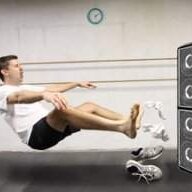
 
...it'll shake yer innards!

...wait a minute, I think I see what the OP is up to here, and he's not going to get away with it!

brown-note.jpg
 
I understand that happens around 7.23hz. Yes, I would do that.

So far, it looking like Mike's 1x15 LAB sub and Bag End cabs are the most practical. If I missed something, please mention it. Those horns are incredibly cool, but so is a true pipe organ. Both are just about as portable.

This whole discussion is interesting. I really like the different methods.
 
Just for fun some straight 30Hz horns http://vincent.brient.free.fr/bass_horn.htm
The 3m path does indeed provide quarter-wave function down to 28 Hz.
The combined mouth area provides full radiation to 34 Hz.

The WAF (wife acceptance factor) appears to be quite low.
Mine looked at the photo, said "sheesh" and silently thanked her lucky stars that I don't have one of these.
 
Just for fun some straight 30Hz horns http://vincent.brient.free.fr/bass_horn.htm
The 3m path does indeed provide quarter-wave function down to 28 Hz.
The combined mouth area provides full radiation to 34 Hz.

The WAF (wife acceptance factor) appears to be quite low.
Mine looked at the photo, said "sheesh" and silently thanked her lucky stars that I don't have one of these.

Note to self.....

Design bass horns as nice furniture, like folding it up under the seat of a couch.

Sell to married women.

Profit.
 
Already done.
Tom Danley has one, I think BFM has a modified table tuba that is similar.
I have a design for personal use, but it goes behind the couch up against the wall.

Didn't know about Danley's. Was thinking along the lines of Bill's table tuba, but building it inside other large furniture. Wife would have to approve of style and size of table to have a table tuba. Could build it inside wall as part of a remodel I guess.


Something is weird with these quotes. I quoted you and got B-string, even deleted the post and typed it again to make sure I wasn't going nuts. Then you quoted me and got yourself, but when other people quoted me, they got me???:confused:
 
Already done.
Tom Danley has one, I think BFM has a modified table tuba that is similar.
I have a design for personal use, but it goes behind the couch up against the wall.
+1 to Tom Danley but best of all if the OP slips a buttkicker down his trousers he will have it all going on:D
BK-CT.jpg

buttkickerbass.jpg

Much more efficient and less power hungry than standing on a board.:bassist:
 
will33 said:
"Close but no cigar with the car analogy assuming we're talking about places one would normally play their bass....ie:...not in their car. 2000 watts from a 12 volt power source is fantasy. Depending on duty cycle, it's not that easy to achieve from a common 120 volt source. You Europeans get all the good stuff, like 240 volt supplies.

If you want to get the cabin gain you get in a car in even the smallest of gigging environments, we're back to loud, low, and can't fit through the door. "

I kindly suggest you go back and study some basic, electrical fundamentals, such as Ohm's law. That would greatly reduce the amount of false information you are spreading.
2000W from a 12 Volt ca system is not even a tough job to do - it would be about 167A. Many cars have that kind of power in the electrical starter alone. (And those tend to work.) Your 120V/240V analogy is completely off, as a 12 Volt car system would only be limited by alternator output, battery capacity and the fuses installed byt the user. The sky is the limit and many cars sport over 10 kW of true amplifier output.

By the way, those micro bass amps so popular on TB use the same kind of power supply found in car stereo amps since decades - SMPS. Compact, efficient and less sensitive to voltage variations.

Finally, given the power demands / duty cycle of music, even US and other low voltage mains countries can easily have 2 kW amps. I recommend the white papers at the QSC homepage for some basic reading. Like I said, Powersoft does 18 kW in the K20 model, even from a 115V single outlet. That is an amp that is one RU tall and weighs 12.6 kg.
 
1958Bassman said:
"And how much does a real, well-designed dance club system cost? About 20x what a great bass rig costs. How many speakers in those dance club speakers? A lot more than a great bass rig. Best to compare apples to apples- a fixed installation system is far different from what's being discussed for a bass rig."

It does not matter. You could get by with a fraction of it, of course. Instead of eight 21" subs, one could suffice, along with 2-3kW of amplification.
The point is, when people say stupidities that it woud "defy the laws of physics" and other nonsense, I just say that the kind of system the OP seeks already exist as "off the shelf" solutions and do quite well in real life.
 
It does not matter. You could get by with a fraction of it, of course. Instead of eight 21" subs, one could suffice, along with 2-3kW of amplification.
The point is, when people say stupidities that it woud "defy the laws of physics" and other nonsense, I just say that the kind of system the OP seeks already exist as "off the shelf" solutions and do quite well in real life.
A fraction of a club system will only entertain a fraction of a club. Presumably our hero has performance ambitions beyond his bedroom.