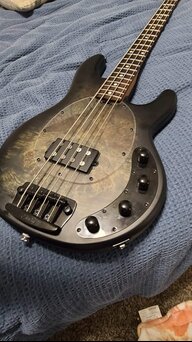
Honestly...could you imagine? That could be a seriously ass-kicking sticky thread.Man, I wish there was a whole Cookbook of Tone Recipes, for all kinds of basses and amps! Somebody should start a thread...

TalkBass has been independent since 1998. Add your voice.
Create a free account to reply to discussions, view embedded media, and browse with fewer display ads.
Join free Log in
Want zero display ads or expanded classifieds tools? Compare plans.
Honestly...could you imagine? That could be a seriously ass-kicking sticky thread.Man, I wish there was a whole Cookbook of Tone Recipes, for all kinds of basses and amps! Somebody should start a thread...
I've posted this before; years ago did extensive testing on RF shielding materials.
Copper tape is MUCH better than even the most expensive shielding coatings.
We could get an easy 100 dB of attenuation from the low mHz range to 10 gHz.
Even the paint with silver (well over $100 a pint even in 1990's dollars) was not nearly as good.
Expectations of the inexpensive coatings sold by guitar shops should no be that high IMO.
The paint is so much quicker to apply though.
Also, copper tape with conductive adhesive is not really necessary so long as you use an overlap condition and burnish the joint with a Popsicle stick.
The LB-100 sounds awesome with overdrive

I just placed an order for a MatadorGreat work as always, Iv@n! Informative, clear, insightful and practical.
Are you keeping any of these G&Ls?


What an awesome bass. I didn't know at first that they were using the MFDs. I thought it was the alnico pickups in the LB100. Those split MFDs in the bridge position must be killer. Enjoy!I just placed an order for a Matador
Hmm, i'm not sure if G&L Germany is gonna let me keep the LB and JB after the Matador arrives, but I'd definitely like to keep them

With G&L, even if you think the cavity is shielded with conductive paint, it's usually only one coat—not nearly enough to really produce the Faraday cage effect. When I've seen this and taken an ohmmeter to it, there was a ridiculously high resistance between any two points on the coated surface or between the coating and say a pot ground. With that stuff, it takes a minimum of three good coats to get high enough conductance to effectively shield a cavity—and as we know, G&L's shielding motivation could use some upgrading.

A couple days ago shielding for G&Ls was being discussed . I bought a JB a few weeks ago and had run a ground wire to the bridge pickup route and screwed it to the conductive paint there . I put a strip of copper tape between the control plate and pickguard into the cavity and screwed the ground wire to to copper tape . I figured I should be good but then read this '
I hadn't tested the grounds or the paint but when I did I couldn't get any conductivity at all to the paint with my meter . I was good from the bridge and strings to the control plate . I had some copper tape , enough to do the bridge pickup so I did that today , worked great . I ordered some copper tape for the control cavity and the neck pickup cavity and it will get here in a few days . Already did the pickguard too . I didn't expect this from a bass as great as this JB but I've done shielding a lot and like projects . I'm glad I read what you guys were saying and checked , thank you ! I really can't get over how great this bass plays and sounds .

Hmm I'm not sure what the "standard"'pickups for the Matador are, but I requested the Alnico version. I really like how the LB-100 sounds and i wanted more of thatWhat an awesome bass. I didn't know at first that they were using the MFDs. I thought it was the alnico pickups in the LB100. Those split MFDs in the bridge position must be killer. Enjoy!

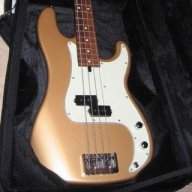
Hmm I'm not sure what the "standard"'pickups for the Matador are, but I requested the Alnico version. I really like how the LB-100 sounds and i wanted more of that
These are my specs:
Swamp ash natural frost top
Maple clear satin neck
Maple fingerboard
1.5" nut
SS frets
Black pickguard
Awesome! Do you have pictures?I think you'll love that Matador! I have an ash/maple Matador with the alnico LB-100 pickups and I love the tone.

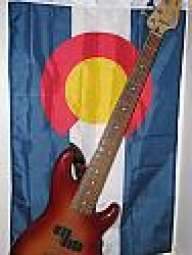

A couple days ago shielding for G&Ls was being discussed . I bought a JB a few weeks ago and had run a ground wire to the bridge pickup route and screwed it to the conductive paint there . I put a strip of copper tape between the control plate and pickguard into the cavity and screwed the ground wire to to copper tape . I figured I should be good but then read this '
I hadn't tested the grounds or the paint but when I did I couldn't get any conductivity at all to the paint with my meter . I was good from the bridge and strings to the control plate . I had some copper tape , enough to do the bridge pickup so I did that today , worked great . I ordered some copper tape for the control cavity and the neck pickup cavity and it will get here in a few days . Already did the pickguard too . I didn't expect this from a bass as great as this JB but I've done shielding a lot and like projects . I'm glad I read what you guys were saying and checked , thank you ! I really can't get over how great this bass plays and sounds .
Don't quote me on this, but I'm pretty sure the conductive paints aren't very conductive on the surface once the paint dries. If you want to run a ground wire from the paint, you need to put the wire into the paint while it's still wet... which is hard to do after the fact.
I recall Mike Lull used to put a small bare metal plate in the paint while it was still wet, and there was a screw into that plate that would allow you to connect a ground wire anytime after the paint had dried.

Don't quote me on this, but I'm pretty sure the conductive paints aren't very conductive on the surface once the paint dries. If you want to run a ground wire from the paint, you need to put the wire into the paint while it's still wet... which is hard to do after the fact.
I recall Mike Lull used to put a small bare metal plate in the paint while it was still wet, and there was a screw into that plate that would allow you to connect a ground wire anytime after the paint had dried.
I recall Mike Lull used to put a small bare metal plate in the paint while it was still wet, and there was a screw into that plate that would allow you to connect a ground wire anytime after the paint had dried.
Awesome! Do you have pictures?
Stunning!!
While not quoting Greg, it would be *very* surprising if the surface of electrically conductive paint were non-conducting. It's simply a (colloidal) suspension of conductive particles in some solvent which then forms a continuous, conducting sheet as it dries. The conductivity will depend on that of the individual particles and the degree of connectivity between them. Such paints are used to create touch sensors etc., so have to be surface-conducting. We also use them in the lab to drain surface static charge to ground. On a more practical level, I've measured surface conductivity while applying sequential coats of the carbon variety and, as expected, conductivity goes up (resistance goes down) with increasing coating thickness, consistent with greater amounts of conducting particles per sq cm of coated area.
[Invalid or Expired Link Removed]
Hahaha. Thanks for not quoting me! LOL
And thanks for correcting me, more importantly. I swear I tried to run a conductivity test between dried paint in a cavity and anything else with no conductivity resulting... but that was years ago, and my memory is cloudy at best.